
 Thought Leadership
Nvidia rules the AI chip market with an iron grip. But the competition never sleeps: AMD is pushing back with open platforms, Google is fine-tuning its TPUs for the inference era, and a Munich-based startup is challenging the entire industry with logarithmic mathematics. Who is building the AI chips of the future, and which architectures will win the race? Read on to find out.
A Market on Fire: $200 Billion and Counting
Few technologies have shaken up the semiconductor market as dramatically as artificial intelligence. According to Gartner, worldwide semiconductor revenue grew 21 percent in 2025 to around 793 billion US dollars. Nearly a quarter of that, more than 200 billion US dollars, was driven by AI-specific chips: accelerators, HBM memory, and networking components. (Source: Gartner, January 2026)
The growth rates are staggering. AMD CEO Dr. Lisa Su put the total addressable market for AI accelerators at approximately one trillion US dollars per year by 2030, speaking at CES 2026. Analysts already project a market volume of around 500 billion US dollars for 2026. (Source: AMD CES 2026, gtai.de)
At the center of this development are specialized processor architectures that go far beyond what traditional CPUs can offer. GPUs, TPUs, NPUs, and novel logarithmic processors are competing for dominance in data centers, at the edge, and in the cloud. Choosing the right architecture for the right workload has become a core strategic decision for IT leaders.
GPU: The Incumbent with a CUDA Moat
Nvidia dominates the AI chip market with a share of more than 32 percent of the overall semiconductor market in 2025, far ahead of all competitors. In the pure AI accelerator segment, Nvidia’s market share is estimated at over 80 percent by industry analysts. (Source: GM Insights, December 2025; Gartner 2026) With revenue growth of nearly 64 percent to 125.7 billion US dollars, the company is leaving the entire industry behind. (Source: Gartner Semiconductor Revenue Rankings 2025)
The reason for this dominance lies not only in chip performance but in the software ecosystem. CUDA, Nvidia’s proprietary programming platform, has been the de facto standard for AI developers for more than 15 years. Millions of trained models, libraries, and frameworks are built around it. Overcoming this competitive moat in the short term is the real challenge for rivals.
The current Blackwell architecture (B100, B200) relies on TSMC 4 nm fabrication, HBM3e memory with up to 192 GB per chip, and tightly coupled multi-GPU systems via NVLink. The successor architecture, Rubin, is expected by late 2026. Nvidia CEO Jensen Huang declared at GTC in San Jose in March 2026 that the tipping point from training to inference has arrived, while noting that traditional GPUs are not ideal for inference due to their high power draw and insufficient proximity to memory. (Source: Nvidia GTC, March 2026)
AMD: Open Platform as Counter-Model
AMD has evolved from challenger to a genuine architect of the AI era. With the Instinct MI400 series announced for mid-2026, and the already available Ryzen AI 400 family, the company is pursuing an aggressive annual release cadence. AMD has reached approximately 33 percent server CPU market share, a historic high. (Source: ad-hoc-news.de, April 2026)
AMD’s strategic strength lies in openness: the ROCm platform, an open-source alternative to CUDA, is gaining maturity. Meta struck a landmark deal with AMD in early 2026: Meta will equip data centers with a total power capacity of six gigawatts using AMD accelerators (Instinct MI450), a volume estimated to be worth up to 100 billion US dollars. To put this in perspective, six gigawatts equals the electricity consumption of roughly 4.5 million average US households. OpenAI and Oracle are also planning to adopt AMD accelerators to reduce their dependence on Nvidia. (Source: CNBC, AP, February 2026)
TPU and NPU: Specialization as a Competitive Edge
1. Google TPU: Built for Inference
Google has been developing its Tensor Processing Units internally since 2016, using systolic array architectures optimized for TensorFlow and JAX. The latest generation, Ironwood (TPU v7, 2025), specifically targets growing inference demand: 192 GB of HBM memory and an architecture designed for low latency and high memory bandwidth. The drawback: Google TPUs are tied to Google Cloud and require software stack adaptations. (Source: martinkaessler.com, November 2025)
2. NPU: AI Directly on the Device
Neural Processing Units (NPUs) are designed for energy efficiency at the edge, inside smartphones, laptops, cars, and IoT devices. Qualcomm integrates NPUs into Snapdragon SoCs; Intel and AMD embed them in laptop processors. For on-device LLM inference, real-time image recognition, and voice processing, NPUs decisively outperform energy-hungry GPUs. The absence of a universal programming model comparable to CUDA remains a hurdle. (Source: Contabo Blog, March 2026)
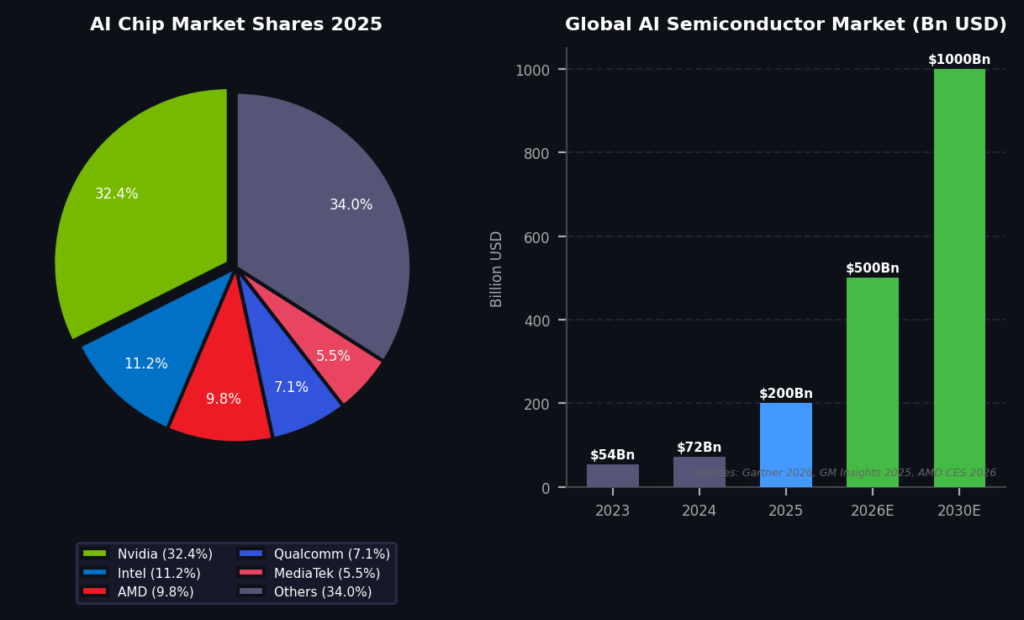
(Sources: Gartner 2026, GM Insights 2025, AMD CES 2026)
Tensordyne Napier: The Munich Startup Challenging Nvidia
Into this arms race steps a newcomer from Munich: Tensordyne, founded in 2017 under the name Recogni and rebranded in 2025, unveiled its processor “Napier” in June 2026 alongside the announcement of a successful tape-out at TSMC in 3 nm. A tape-out marks the completion of a chip design handoff to the contract manufacturer. (Source: Heise Online, June 2026)
1. Logarithmic Mathematics as the Core Innovation
Every AI response is, at its core, mathematics: multiplications and additions. Around 99 percent of the calculations in an AI model reduce to these two operations, explains co-founder Gilles Backhus. Multiplications are significantly more expensive than additions, both in terms of chip area and power consumption.
Tensordyne’s core innovation, called “TDN Math” or “Pareto” internally, exploits a rule from school mathematics: the logarithm of A times B equals the logarithm of A plus the logarithm of B. This allows multiplications to be replaced by additions, without any classic multiplier units on the chip. The result: more free chip area for SRAM and memory connectivity. (Source: Heise Online, ad-hoc-news.de, ServeTheHome, June 2026)
2. Performance Claims in Detail
The Napier chip delivers, according to company specifications, 2.1 Petaflops at FP8 precision and is paired with 144 GB of HBM3e memory per chip. The flagship system, a TDN72 pod with 72 Napier chips, serves as the base deployment unit. A complete TDN rack comprising four pods and 288 chips reaches 608 Petaflops, 42 terabytes of HBM3e, and 74 gigabytes of SRAM. Notably, the system requires no liquid cooling and draws just 120 kilowatts at full load. (Source: Heise Online, Hardwareluxx, ServeTheHome, June 2026)
The comparison with Nvidia is stated in bold terms: a single Tensordyne rack is claimed to deliver 1,300 tokens per second per user on a two-trillion-parameter GPT MoE model, a workload that would require nine Nvidia or Groq racks. Token throughput is said to be up to 13 times higher than Nvidia’s Blackwell architecture (GB200 NVL72), and energy efficiency up to 17 times better. (Source: ServeTheHome, WCCFTech, June 2026)
For production, Tensordyne works with HPE Juniper Networks, Broadcom, and TSMC. Cloud-based beta tests are planned for late 2026 or Q1 2027. More than 200 million US dollars in orders and letters of intent have already been secured, including from AI cloud providers Cirrascale and BlueSky Compute. The company employs around 115 people split between Munich and Sunnyvale. (Source: ad-hoc-news.de, Heise Online, June 2026)
What Analysts Say
Industry observers agree: the AI chip market is no longer a duopoly.
Gartner predicts that AI semiconductors will account for more than 30 percent of the total chip market by 2027. Gartner particularly highlights the shift from training to inference as the dominant growth driver. Efficiency per watt and cost per token are becoming the defining metrics for decision-makers. (Source: Gartner Semiconductor Revenue Rankings, January 2026)
Forrester emphasizes that organizations building AI infrastructure are increasingly pursuing multi-vendor strategies rather than remaining exclusively with Nvidia. The maturity of alternative software stacks, particularly AMD ROCm, is seen as a prerequisite for broader competition.
Market research firm GM Insights values the global AI chipset market at 58.2 billion US dollars in 2025 and projects growth to as much as 1.1 trillion US dollars by 2035. (Source: GM Insights, December 2025)
For startups like Tensordyne, the market is attractive but demanding. The real barrier is not chip performance but software integration and customer trust. Rivals such as Groq (Language Processing Units), Cerebras, and SambaNova are also pursuing specialized architectures for the mass market, so far with limited success.
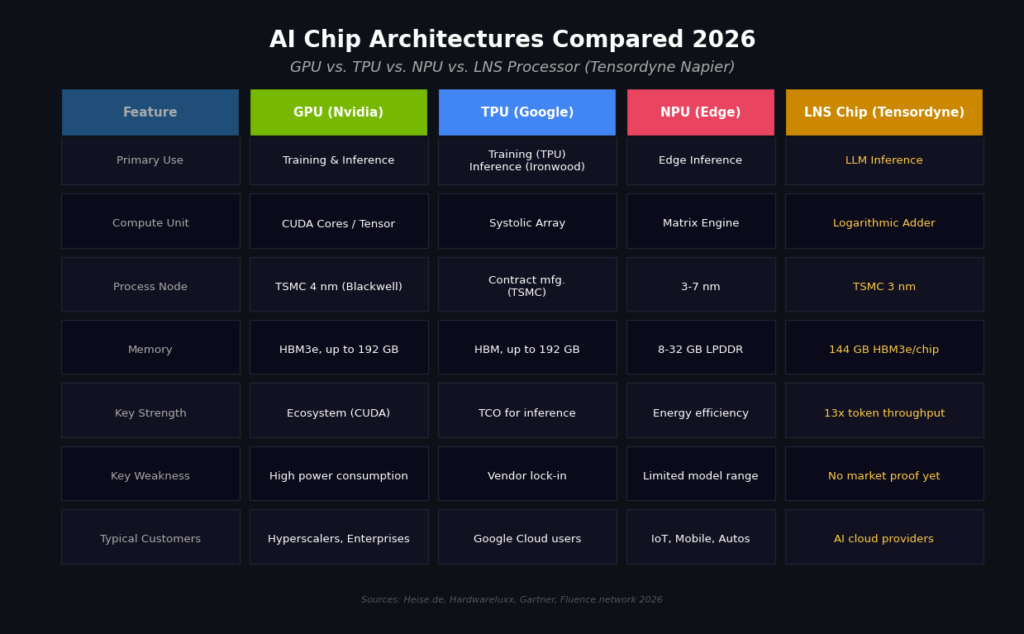
(Sources: Heise.de, Hardwareluxx, Gartner, Fluence.network 2026)
Key AI Chip Vendors at a Glance
| Vendor | Architecture | Process | Performance (ref.) | Market Share 2025 | Key Feature |
| Nvidia | GPU (Blackwell) | TSMC 4 nm | B200: 90 PFLOPS | >32% | CUDA ecosystem, NVLink |
| AMD | GPU (CDNA 4) | TSMC 3 nm | MI400: TBA | ~10% | Open ROCm, Meta deal |
| TPU (Ironwood v7) | Contract mfg. (TSMC) | 192 GB HBM | internal | Inference-optimized | |
| Intel | GPU (Gaudi 3) | TSMC | 1.5x H100 | ~11% | x86 integration |
| Qualcomm | NPU (Snapdragon) | TSMC 3 nm | up to 75 TOPS | Edge | Mobile / Automotive |
| Tensordyne | LNS (Napier) | TSMC 3 nm | 2.1 PFLOPS FP | Startup | 13x throughput vs. GB200 |
Sources: Gartner 2026, GM Insights 2025, Heise Online, Hardwareluxx, ad-hoc-news.de, WCCFTech (as of June 2026)
Conclusion: The Race Is Wide Open
Nvidia will not relinquish its lead without a fight. The CUDA ecosystem, a relentless hardware roadmap, and deep capital resources are formidable competitive advantages. Yet the market is sending clear signals: the era of pure GPU dominance is ending, and specialized architectures for inference, edge computing, and new computational paradigms are gaining ground.
AMD is offering an increasingly mature alternative with ROCm. Google is tuning its TPUs specifically for the inference era. And Tensordyne is demonstrating with the Napier chip that even the fundamental mathematics of AI can be rethought. Whether logarithmic arithmetic truly achieves a breakthrough will be answered by beta tests in late 2026 and the commercial rollout in 2027.
For IT decision-makers, the message is clear: selecting the right AI chip architecture is not a purely technical decision but a strategic one. Total cost of ownership, software ecosystem, power consumption, and vendor lock-in risks must all be weighed together. Anyone planning tomorrow’s infrastructure today should be watching the competition beyond Nvidia very closely.
Q&A: Frequently Asked Questions about AI Chips and Architectures
What is the difference between GPU, TPU, and NPU?
GPUs are general-purpose parallel processors, originally designed for graphics and now the standard for AI training. TPUs (Google) are optimized for tensor computations and tied to Google Cloud. NPUs are energy-efficient processors for edge devices such as smartphones, laptops, and cars.
Why is Nvidia so hard to displace?
The decisive factor is CUDA, Nvidia’s proprietary software ecosystem. Millions of developers, frameworks, and trained models are built around it. Anyone switching must plan for significant migration effort.
What makes Tensordyne Napier special?
Tensordyne replaces classic multipliers with logarithmic adders (“TDN Math” / “Pareto”). This saves chip area and power, freeing up space for more SRAM. The company claims up to 13x token throughput and 17x energy efficiency compared to Nvidia’s GB200 NVL72.
Which architecture suits which workload?
For AI training: GPU (Nvidia, AMD). For cloud inference on the Google stack: TPU. For inference with trillion-parameter models with a focus on TCO: new approaches such as LNS chips. For edge and mobile: NPU.
How reliable are startup performance claims?
Treat them with caution. Vendor benchmarks are typically designed to favor their own product. What matters is independent testing in real production environments, which for Tensordyne is not expected before late 2026.