
 Thought Leadership

Using the ARTEX penetration testing framework, DeepSeek, GLM, Grok, and coding assistants, an attacker targeted organizations in more than 15 countries. The goal was to steal financial data.
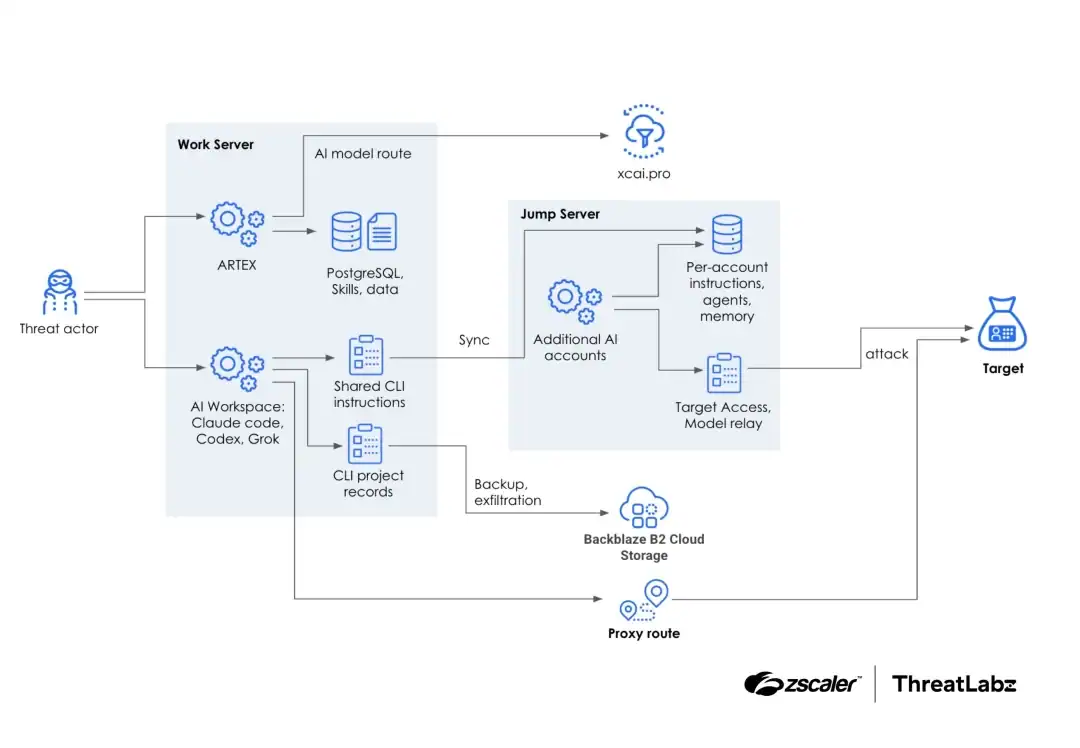
Zscaler’s ThreatLabz research team has analyzed an attack campaign in which a threat actor combined multiple AI systems to coordinate and partially automate attacks worldwide. The operation relied on ARTEX, an AI-powered penetration testing framework, together with custom automation scripts and various AI assistants, including Claude Code, Codex, and Grok.
Beyond South Korea
The attacks initially came to light after financial institutions in South Korea were targeted. However, according to Zscaler, the campaign extended much further. Recorded prompts submitted to the AI models included requests to investigate organizations in more than 15 countries. Targets included not only banks but also dating apps, SMS providers, cryptocurrency platforms, and payment services. Zscaler characterizes the campaign as opportunistic.
The prompts reveal a particular interest in personal data, mobile phone numbers, and financial transaction records, as well as inquiries about selling stolen datasets. Zscaler therefore believes the attacks were financially motivated. To avoid detection, the threat actor instructed the AI models not to initiate direct withdrawals from accounts, as unauthorized transactions could trigger alerts and leave traces. According to Zscaler, the language used, the phone numbers provided, and requests for translations into Chinese strongly suggest that the operator is Chinese-speaking.
AI Models Cross-Check Each Other
ARTEX uses an architecture consisting of a planner and execution agents. An operator defines a target, and the agents break it down into individual tasks, execute them using various tools, and document the results. The threat actor assigned different roles to different models: DeepSeek handled the initial reconnaissance, while GLM reviewed the findings and the work of specialized subagents for gaps and later received additional tasks. Grok was used for extensive research, with the results subsequently checked by other AI sessions. Specialized agents investigated application programming interfaces (APIs), source code, and Android apps, among other things. Zscaler could not independently confirm which models were actually running in every individual session.
For each investigation, a script created a dedicated folder containing files documenting targets, progress, notes, vulnerability reports, and evidence. This allowed AI assistants to resume investigations in subsequent sessions. Some configurations also allowed agents to act without requiring approval for every individual step.
Zscaler recommends adopting a Zero Trust architecture to reduce the internet-facing attack surface and grant access according to the principle of least privilege. In October, TrendAI had already reported that state-sponsored hacking groups are increasingly using AI models from multiple providers and switching to alternatives when they encounter problems with one model.
(Editorial Team/Zscaler)