
 Thought Leadership
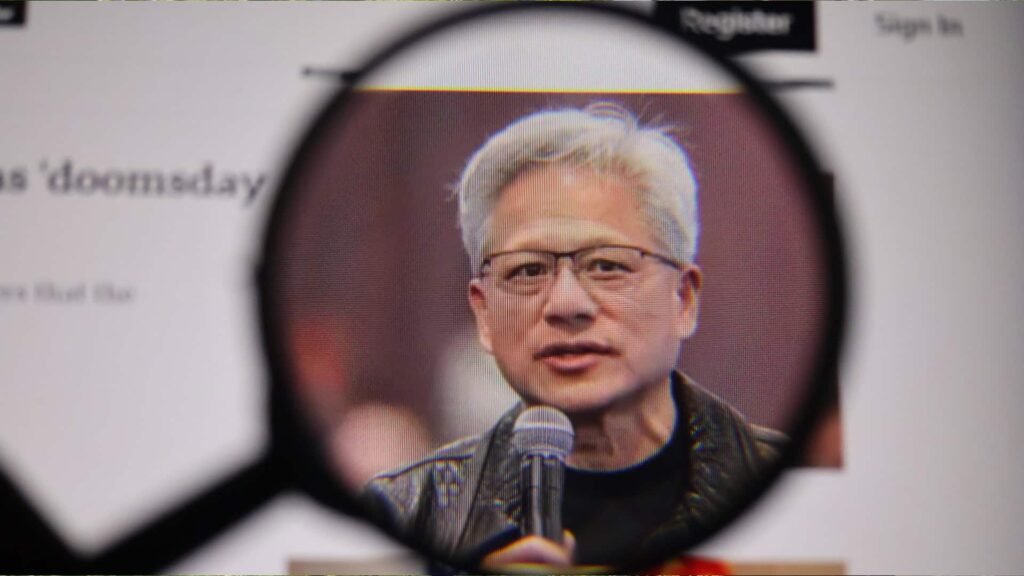
Nvidia is drawing a line under the era of its once all-powerful CEO Jensen Huang.
“The board has decided that it will not reinstate Jensen,” interim CEO Colette Kress told CNBC.
Huang, who had been the face of Nvidia until his resignation last week, announced just hours earlier that he would accept an offer to return. Many Nvidia employees, investors and business partners had urged him to take the top job again, the 63-year-old said.
As Nvidia reported its latest quarterly results, Kress made clear that the company’s explosive growth amid the AI boom would continue without Huang. She raised the revenue growth forecast for the coming fiscal year from 70% to 75%. Investors welcomed the news, sending Nvidia shares up more than 4% in after-hours US trading.
“Incompatible With Company Standards”
Huang stepped down as Nvidia CEO last week after two extramarital affairs came to light. One of the women was an executive at Megaspeed, an Nvidia customer. According to media reports, US security officials suspect she was recruited by Chinese intelligence. The other woman was reportedly a senior Nvidia executive who reported directly to Huang.
Nvidia Chairman Harvey Jones has now said the longtime CEO submitted his resignation after details emerged of conduct that was “incompatible with the company’s code of conduct, standards and cultural norms.”
“The NVIDIA board unanimously accepted his resignation and does not intend to reinstate Jensen as CEO,” Jones said. This was the first time Nvidia had publicly addressed the reasons behind Huang’s departure.
Is China a Bigger Problem Than the Affairs?
Questions are also mounting over what Nvidia knew about AI chip shipments to China. Around the time of Huang’s affair with the Megaspeed executive, authorities suspected the company of rerouting Nvidia technology to China in violation of US export restrictions.
Within the US government, Treasury Secretary Scott Bessent has been particularly vocal in pressing Nvidia to establish who knew what, and when. “Were they pressing these seemingly illicit sales to goose their revenues and their earnings?” Bessent asked in a television interview over the weekend. He wants answers from the company within ten days.
Attorney Katie Sweeten, a former prosecutor in the US Department of Justice’s National Security Division, stressed that knowingly circumventing such government restrictions could carry serious consequences. Executives involved could face prison sentences of up to 20 years, while the company itself could face substantial fines, she told CNBC.
Growth Shows No Signs of Slowing
Under Huang’s leadership, Nvidia became a driving force behind the AI boom. Until his resignation, he had been the company’s first and only CEO in more than 30 years. Nvidia originally specialized in graphics cards. But in recent years, its underlying technology has proven particularly well suited to training artificial intelligence models. This has made the company’s chips virtually indispensable in AI data centers.
In the last quarter, the final one under Huang’s leadership, Nvidia once again delivered rapid growth. Revenue doubled year over year to $115.8 billion (105.2 billion euros). That was well above analyst expectations, which had averaged around $109 billion. Net income surged to $65.3 billion, also more than double the figure from a year earlier.
For the current quarter, Nvidia forecast revenue of $130 billion, with a margin of plus or minus 3%. Analysts had expected an average of $125 billion. At $130 billion, that would represent year-over-year growth of 91%.
The AI Industry’s Bank
Nvidia also plays a pivotal role in the AI industry in another way. Under Huang’s direction, the company used its rapidly growing multibillion-dollar profits to provide guarantees and financial backing to AI startups, some of which were struggling financially. Much of that money then flows back to Nvidia through purchases of its chips or computing capacity at data centers powered by its technology.
One major question following Huang’s departure was whether this cycle would continue without him. Without Nvidia, many so-called neocloud providers would lose access to capital, Apollo CEO Marc Rowan warned in an interview with CNBC.
Interim CEO Kress made clear that Nvidia would continue playing this role, albeit cautiously. Investor and longtime tech analyst Gene Munster welcomed the message, declaring that Nvidia would remain the “bank of AI.” Kress, who served as Nvidia’s longtime CFO, was also directly involved in these deals.
(dpa/Translation: Editorial Team)