
 Thought Leadership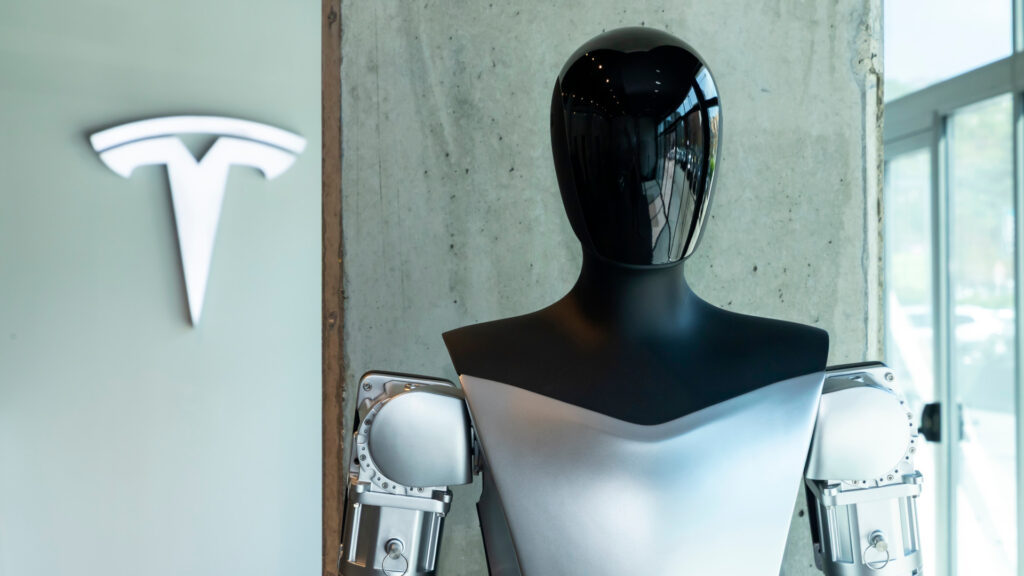
From automaker to robotics powerhouse? What once sounded like a distant vision from CEO Elon Musk is now taking concrete shape.
Humanoid robots (machines with human-like form, sensory capabilities, and autonomous behavior) are evolving from research projects into a potentially multi-billion-dollar industry. Are we witnessing the emergence of the next great technology platform?
A market with enormous leverage
The global market for humanoid robots is still in its infancy, but growth expectations are extraordinary. Analysts at Goldman Sachs estimate the market could reach a volume of $150 to $200 billion by 2035, with annual growth rates exceeding 40 percent. By 2030, more than one million humanoid robots could be deployed worldwide, initially in manufacturing, logistics, and elder care, and later in the broader service sector. For context: the current industrial robotics market amounts to roughly $16 billion annually. Humanoid robots would structurally expand this category. Not replace it, but complement it.
Tesla Optimus: The most ambitious approach
At the center of attention is Tesla. With its humanoid robot Optimus, the company is pursuing a radically different approach from traditional robotics manufacturers. While competitors focus on specialized tasks, Tesla aims to develop a universally capable workforce. Optimus stands approximately 1.73 meters tall, weighs around 70 kilograms, can carry up to 20 kilograms according to Tesla, and is powered by the same AI systems that drive Tesla’s vehicles. At its core is the in-house Full Self-Driving (FSD) AI system, supplemented by neural networks for gripping, walking, and object recognition.
Elon Musk has put the long-term production cost per unit at under $20,000, a figure that, if achieved at industrial scale, would have genuinely disruptive force. For comparison: humanoid prototypes today often cost upwards of $100,000.

The strategic advantage: Data, software, scale
Tesla’s decisive edge lies less in mechanics than in its software and data foundation. No other player possesses comparable experience in real-time sensor fusion, visual AI in complex environments, and mass production at the scale of millions of units. Musk argues that Optimus could ultimately prove more valuable than the car business. With hundreds of millions of jobs worldwide involving simple, repetitive tasks, the addressable market is enormous. For investors, the key insight is this: even modest market penetration would have a massive impact on Tesla’s valuation.
Strong competition from the US and China
Tesla is not alone in this race. In the United States, Boston Dynamics (majority-owned by Hyundai Group) is advancing development with its humanoid robot Atlas, which already operates autonomously alongside human workers in Hyundai factories. Figure AI, backed by Microsoft, OpenAI, and Nvidia, reached a valuation of approximately $40 billion in 2025 and is already testing humanoid robots at facilities operated by UPS and BMW.
In China, companies such as Xiaomi, Unitree Robotics, and state-funded research institutions are investing heavily in humanoid systems. Beijing views robotics as a strategic key industry, particularly in light of demographic challenges ahead.
The quiet beneficiaries: Chips, actuators, AI
As with previous technology cycles, compelling opportunities exist beyond the end products themselves. Nvidia supplies the AI accelerators needed to train and simulate humanoid movement. Qualcomm is developing energy-efficient edge chips for autonomous robotics. Manufacturers of electric motors, actuators, and sensors, such as Harmonic Drive, Nabtesco, and Bosch, stand to benefit from rising demand for precision and reliability.
Caution warranted despite the hype
Despite widespread enthusiasm, significant caution remains warranted. Humanoid robots are technically extraordinarily complex. Autonomy, safety, energy efficiency, and regulatory questions remain unresolved. In the near term, humanoid robots will not replace human workers. They will support them, initially in factories, warehouses, and care facilities.
For Tesla, this means Optimus will not generate meaningful revenue in the near future. The company’s valuation continues to rest primarily on its automotive business. Yet in the long run, an asymmetric option emerges: if the project fails, the damage will be limited; if the breakthrough comes, Tesla could come to dominate an entirely new industry, one that may turn out to be the largest ever created.
Outlook: The next great platform?
Humanoid robots could become what the smartphone was for the digital world: a universal interface between humans and technology. The critical distinction is between vision and the ability to execute. Tesla brings both, but also carries considerable risk. One thing is clear: the race for humanoid robotics has begun. And as so often in technology, whoever controls the platform controls the market.
Audun Wickstrand-Iversen, Portfolio Manager, DNB Asset Management