
 Thought Leadership
Digital infrastructure is growing exponentially, and companies are increasingly losing control over their systems. Observability is becoming a critical tool that not only prevents outages but also paves the way for autonomous AI agents and true enterprise resilience.
TL;DR – Key Takeaways at a Glance ✔ Observability is no longer an IT tool, it is a strategic platform decision at C-level. ✔ Alert fatigue costs real money: 91% of enterprises lose >$300,000/hour during outages (ITIC 2024). ✔ OpenTelemetry is the established standard: 48.5% use it in production, 75% are implementing or close (EMA, March 2025). ✔ AI agents fail without a solid observability foundation, not the other way around. ✔ Market leaders per Gartner MQ 2025: Dynatrace, Datadog, Splunk, New Relic, Elastic, Grafana Labs, IBM Instana. ✔ Germany is Europe’s frontrunner in OTel adoption (Splunk State of the Market, Feb. 2026). |
The IT infrastructure of modern enterprises is growing at a pace that systematically overwhelms traditional monitoring approaches. Microservices, multi-cloud architectures, AI-powered applications, and exploding data volumes create a complexity where conventional dashboards and rule-based threshold alerts simply no longer suffice. What decision-makers, IT leaders, and CIOs need today is not better monitoring, it is observability: the ability to fully understand the internal state of their systems before problems escalate into outages.
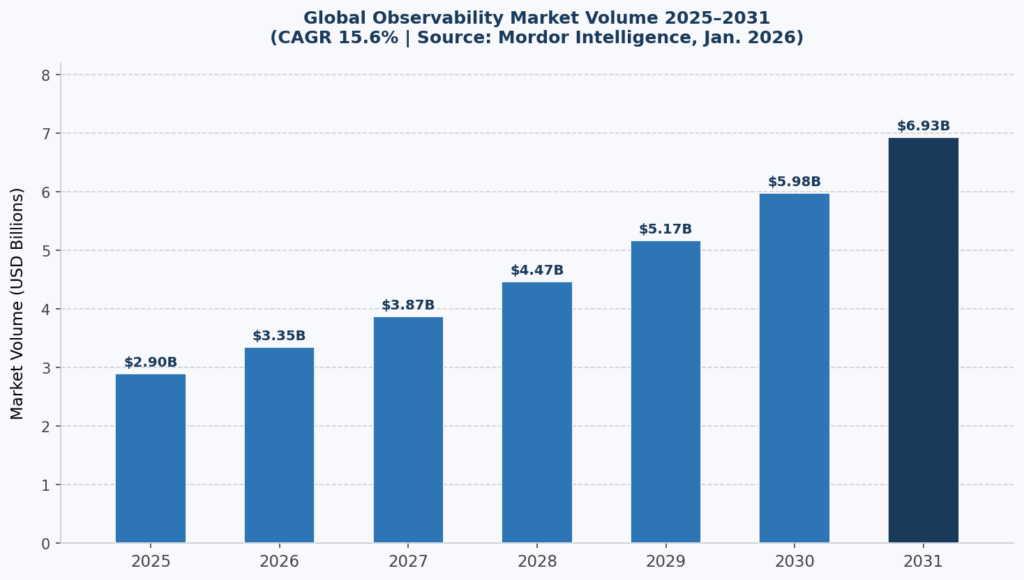
The market has already priced in this shift. According to Mordor Intelligence, the global observability market was valued at USD 2.9 billion in 2025 and is projected to reach USD 6.93 billion by 2031, representing a CAGR of 15.6 percent (Source: Mordor Intelligence Observability Market Report, January 2026). When the broader Observability Tools & Platforms segment is included, other research firms report significantly larger volumes, reflecting how dynamic and fragmented this market remains. What is clear: observability is becoming a strategic early-warning system for business decisions.
From Monitoring to Observability: What Makes the Difference
Traditional monitoring answers: “Is the system up or down?” Observability answers: “Why is the system behaving the way it is?” This semantic shift is profound. Gartner defines observability platforms as systems that, by ingesting telemetry data – logs, metrics, events, and traces – detect changes in system behavior affecting end-user experience, enabling early or even preventive issue remediation (Source: Gartner, Market Guide for Data Observability Tools, February 2026).
This approach rests on three pillars: Metrics provide quantitative snapshots – CPU load, request rates, error ratios. Logs document events in text form. Traces follow individual requests through distributed systems, pinpointing which microservice, database, or external API is responsible for a bottleneck. Only in combination do these three data streams create the comprehensive situational picture that modern cloud-native IT environments require.
How deep this transformation already runs: according to the Gartner 2025 State of AI-Ready Data Survey, 53 percent of data and AI leaders have already implemented observability tools, and a further 43 percent plan to do so within the next 18 months. The data observability market grew 20.8 percent in 2024 to reach USD 346.4 million (Source: Gartner Market Share Analysis, cited in Gartner Market Guide for Data Observability Tools, February 2026).
Germany: Europe’s Pioneer in Observability Adoption
From a European perspective, Germany stands out as an international leader in adopting observability approaches and OpenTelemetry. This emerges from Splunk’s Observability State of the Market Report. Where OpenTelemetry is already deployed, many organizations report measurable economic benefits – demonstrating that open telemetry approaches deliver not only technical transparency but genuine, quantifiable business value.
According to the Splunk report, two areas dominate the practical use of observability: monitoring critical business processes and early detection of threats and vulnerabilities in applications. A growing share of surveyed organizations no longer views observability and security as separate disciplines, but as two sides of the same coin, a development that is reshaping internal budget responsibilities and team structures.
Alert Fatigue: The Underestimated Business Risk
Paradoxically, better observability also creates a new risk. Enterprise environments can generate more than 10,000 alerts per day. An analysis of 9.6 million annual observability events found that fewer than 18 percent of warnings are actually acted upon (Source: ViB Community, AI-powered Observability Report, December 2025). This phenomenon (alert fatigue) has become a central business risk.
A survey of IT leaders at VP level and above found that 36 percent report working past real problems due to a flood of notifications (Source: LogicMonitor Survey of 100 VP+ IT Leaders, January 2026). The financial consequences: 91 percent of mid-sized and large enterprises lose more than USD 300,000 per hour during an outage; for 41 percent, this figure falls between USD 1 million and USD 5 million per hour (Source: ITIC 2024 Hourly Cost of Downtime Survey).
Forrester analysts have found that organizations implementing AI-powered observability platforms achieve a return of 274 percent over three years with a payback period of under six months (Source: Forrester Research, cited in ViB Community Report, December 2025). This makes the investment decision for observability not merely an IT budget question, but a matter of enterprise resilience.
OpenTelemetry: The Established Standard for Cloud-Native Telemetry
The most important technical breakthrough in observability over the past two years goes by an unwieldy name: OpenTelemetry (OTel). This open-source CNCF project provides a vendor-neutral framework for standardized collection and transmission of telemetry data: metrics, logs, and traces. The principle: “Instrument once, export anywhere.” it-daily.net covered this development in depth in April 2025 (Source: it-daily.net: OpenTelemetrys Bedeutung für Observability in IT-Infrastrukturen, April 3, 2025).
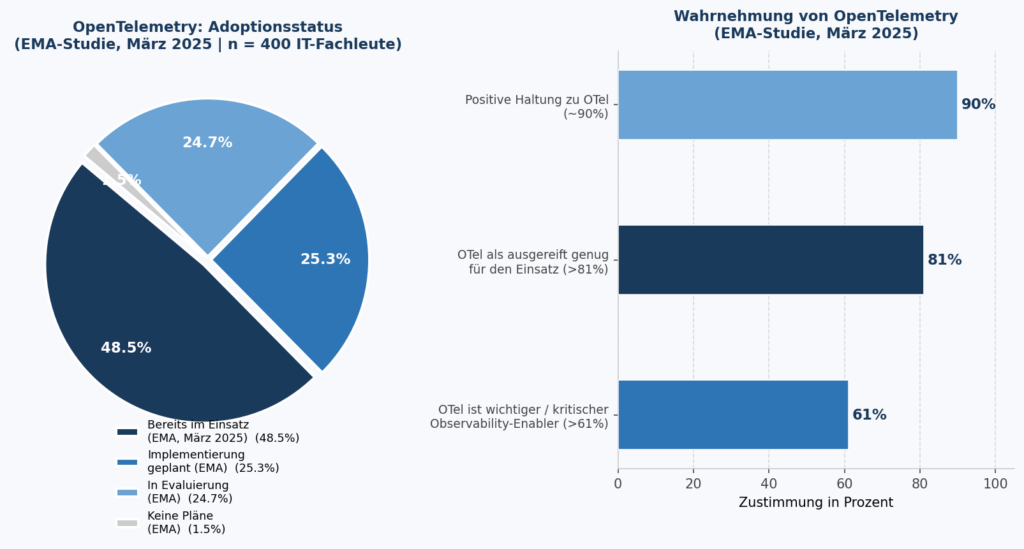
Adoption figures are unambiguous: 48.5 percent of organizations already use OpenTelemetry in production, with a further 25.3 percent planning implementation. Nearly 75 percent are thus on the OTel path. Only 1.5 percent have no plans at all (Source: EMA/Elastic Report: Taking Observability to the Next Level, March 2025). More than 61 percent consider OTel an important or critical observability enabler. The CNCF Annual Survey 2025 confirms: approximately 49 percent of surveyed cloud-native organizations have adopted OpenTelemetry. The most widely used not-yet-fully-graduated CNCF project (Source: CNCF Annual Survey 2025, January 2026).
Nearly half (46 percent) of organizations using OTel in production report more than 20 percent ROI; a further 40 percent achieve 10 to 20 percent ROI (Source: EMA Study, March 2025). For organizations evaluating observability platforms today, OpenTelemetry is a strategic baseline requirement and the most effective protection against vendor lock-in.
Leading Vendors: Gartner and Forrester Compared
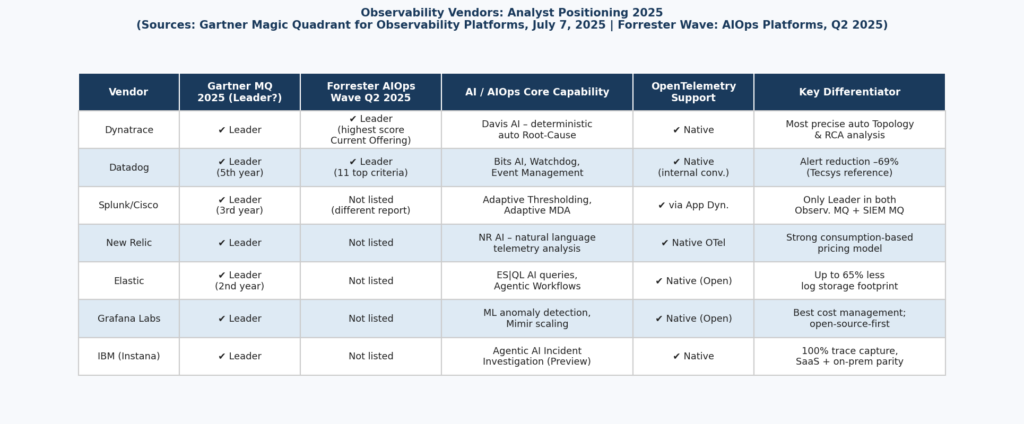
The observability platform market is intensely competitive. In the Gartner Magic Quadrant for Observability Platforms 2025 (July 7, 2025), 20 vendors were evaluated, seven were named as Leaders: Dynatrace, Datadog, Splunk, New Relic, Elastic, Grafana Labs, and IBM (Instana). The Forrester Wave: AIOps Platforms Q2 2025 (April 2025) assessed 10 vendors across 26 criteria.
Dynatrace
Dynatrace is widely regarded as the benchmark for AI-powered observability. In the Forrester Wave AIOps Q2 2025, it received the highest overall score in the “Current Offering” category among all ten evaluated vendors, with top marks in 17 of 26 criteria, including log management, data-driven automation, and pricing transparency (Source: Forrester Wave: AIOps Platforms, Q2 2025). The Davis AI engine delivers deterministic root-cause analysis without manual rule configuration.
Datadog
Datadog was named a Leader in the Gartner Magic Quadrant for the fifth consecutive year (Source: Gartner MQ, July 7, 2025) and received top scores in eleven Forrester AIOps Wave criteria, including innovation, log management, and incident detection. Real-world reference: at Tecsys, Datadog’s Event Management reduced alert incidents by 69 percent (Source: Datadog/Tecsys reference, cited in Forrester AIOps report).
Splunk / Cisco
Splunk has been named a Leader in the Gartner MQ for Observability Platforms for the third consecutive year and is the only vendor simultaneously recognized as a Leader in the Gartner MQ for SIEM for the tenth consecutive year (Source: Splunk press release, July 2025). The combination of Splunk Observability Cloud, AppDynamics, and ThousandEyes delivers one of the broadest platforms on the market.
New Relic, Elastic, Grafana Labs, IBM Instana
All four were named Leaders in the Gartner Magic Quadrant 2025. IBM Instana captures 100 percent of all traces in real time and offers true feature parity between SaaS and on-premises deployment. Elastic reduces log storage requirements by up to 65 percent through its new logsdb index mode. Grafana Labs leads in cost management transparency and has the widest deployment network in the open-source segment (Source: Gartner MQ for Observability Platforms, July 7, 2025).
AI as a Game-Changer: From AIOps to Agentic Observability
84 percent of organizations explored or piloted AI in observability in 2025 (Source: APMdigest, 2026 Observability Predictions). it-daily.net highlighted a particularly important implication in May 2025: AI agents require a transparent infrastructure as a prerequisite (Source: it-daily.net: Die Stunde der KI-Agenten – Warum Observability jetzt zur Pflicht wird, May 19, 2025). Autonomous AI agents can only operate reliably when the data quality of the underlying systems is clean and consistent.
Gartner emphasizes: Semantic Drift Monitoring, detecting subtle shifts in data meaning, is becoming a critical requirement before AI models can act on data (Source: Gartner, Market Guide for Data Observability Tools, February 2026). Poor telemetry data in agentic AI scenarios does not merely produce incorrect reports, it can cause autonomous agents to execute the wrong actions. In logistics, this translates directly to faulty route optimization or disrupted warehouse automation with tangible operational consequences.
AI initiatives fail not because of the AI itself, but because of inadequate system monitoring. That was the core finding of another it-daily.net analysis (Source: it-daily.net: KI allein macht noch keine Transformation, May 26, 2025). By 2028, Gartner projects that one-third of all generative AI interactions will involve autonomous agents. Observability follows: agents investigate incidents independently, summarize context, and initiate resolutions – before a human opens a dashboard.
Analyst Consensus: What Gartner, Forrester, and EMA Recommend
Forrester’s “The State of AIOps and Observability” describes the transition from reactive monitoring to proactive orchestration as the core task for IT leaders. Hybrid cloud environments generate data volumes that can no longer be managed without AI. Forrester emphasizes native telemetry access and cost-efficient implementation approaches, a signal that TCO modeling for consumption-based pricing models will become critical.
Gartner sees the future of observability in full AIOps integration: deterministic AI analyzes service dependencies; ML drives anomaly detection, predictive alerting, and automated incident correlation; self-healing workflows handle routine tasks (Source: Gartner, cited in Network World, August 2025). EMA states: “OpenTelemetry is becoming a competitive advantage in most industries.” Organizations that have not yet started risk falling behind. IBM analysts see three overarching trends for 2026: smarter AI platforms, observability as a FinOps component, and accelerated OTel adoption across all AI workloads (Source: IBM Think Insights, January 2026).
Recommendations for Decision-Makers
- Define OpenTelemetry as a non-negotiable strategic standard. Proprietary instrumentation today means migration costs tomorrow.
- Measure alert fatigue as a KPI: alerts per week, false positive rate, response rate. What is not measured cannot be improved.
- Structurally integrate observability and security teams – combined teams show the strongest results according to Splunk data.
- Begin AI initiatives with an observability readiness check. Poor telemetry data is the most common reason AI projects fail in production after succeeding in pilots.
- Model Total Cost of Ownership (TCO) consistently – with consumption-based pricing, AI workloads can trigger unforeseen cost scaling (recommendation: Forrester, Gartner 2025).
Conclusion: Observability as an Early-Warning System for Business Leadership
Observability has long left behind its status as a pure IT tool. In a world where AI agents make autonomous decisions based on system data, the quality of observability infrastructure is directly tied to the reliability of business processes. Alert fatigue no longer merely threatens on-call teams. It threatens the availability of critical services and therefore business success. OpenTelemetry creates the neutral foundation from which organizations can choose freely, without lock-in risk.
The market is growing, the technology is maturing and Germany is playing a leading European role in this transformation. The real challenge lies less in tool selection than in organizational change: observability only functions as a strategic early-warning system when the right people respond to what it makes visible. Clear accountability, prioritized alerts, reduced tool complexity, and a corporate culture that views transparency as a competitive advantage. These are the real deliverables.
FAQ: Frequently Asked Questions about Observability
What is observability – explained simply?
Observability is the ability to understand the internal state of an IT system solely by analyzing its external outputs: metrics (numbers), logs (event text), and traces (request paths). Unlike traditional monitoring, which checks predefined thresholds, observability also enables diagnosis of unknown, previously unseen problems, a critical advantage in complex cloud environments. Gartner describes it as the capability for “early or even preventive issue remediation.”
What is the difference between monitoring and observability?
Monitoring checks known metrics against predefined thresholds (“Is the server below 90% CPU?”). Observability enables exploratory diagnosis: “Why is this API response slow and which microservices, database queries, and network calls are causally involved?” Observability includes monitoring but goes far beyond it. The key distinction: monitoring tells you something is wrong; observability helps you understand why.
What is OpenTelemetry and why does it matter?
OpenTelemetry (OTel) is an open-source CNCF standard for vendor-neutral collection and transmission of telemetry data (metrics, logs, traces). Its importance: it prevents vendor lock-in. Organizations using OTel can switch their observability backend (Dynatrace, Datadog, Grafana, etc.) without rewriting all instrumentation in their codebase. According to EMA, 48.5% of organizations already use OTel in production (as of March 2025), with 75% either already using it or planning to.
What is alert fatigue and what are its consequences?
Alert fatigue describes the state where IT teams, overwhelmed by a flood of alarms become desensitized and miss or ignore critical warnings. According to ViB Community, fewer than 18% of all observability events are actually acted upon. The consequence: real incidents are detected too late. AI-powered correlation, deduplication, and intelligent alerting are the primary remedies.
Which observability tools are leading according to Gartner?
In the Gartner Magic Quadrant for Observability Platforms 2025 (July 7, 2025), seven vendors were named as Leaders: Dynatrace, Datadog, Splunk (Cisco), New Relic, Elastic, Grafana Labs, and IBM (Instana). In the Forrester Wave: AIOps Platforms Q2 2025, Dynatrace (highest overall score) and Datadog (Leader in 11 criteria) lead the field.
Why is observability a prerequisite for AI agents?
Autonomous AI agents make decisions based on system data. If that data is incomplete, stale, or inconsistent, agents execute incorrect actions automatically and at scale. Gartner identifies “Semantic Drift Monitoring” as a critical requirement before AI models can act on data. Without a clean observability foundation, there is no reliable AI operation. Poor telemetry data is the most common reason AI projects fail in production.
How large is the global observability market in 2025?
According to Mordor Intelligence (January 2026), the observability platform market is valued at approximately USD 2.9 billion in 2025, growing to USD 6.93 billion by 2031 (CAGR 15.6%). With a broader market scope (all tools and platforms), other analysts report larger figures. Gartner places Infrastructure Observability Software CAGR at 12% through 2027. The data observability sub-segment grew 20.8% in 2024 alone.