
 Thought Leadership
At Google I/O 2026, Google shifted its AI strategy toward autonomous agents, physics-based video simulation, and advanced deepfake detection technologies.
At its annual Google I/O developer conference in Mountain View, California, Google outlined a sweeping new direction for its AI ambitions. The two-day event centered on the transition from traditional prompt-based chatbots to fully autonomous AI agents capable of executing complex workflows with minimal human intervention.
Speaking before roughly 7,000 invited guests at the Shoreline Amphitheatre and developers joining from more than 100 countries, Google CEO Sundar Pichai introduced the new Gemini Omni video simulation model, the accelerated Gemini 3.5 Flash model, and Antigravity 2.0, Google’s next-generation agentic coding platform. The announcements underscore Google’s broader push to deeply embed AI across its entire product ecosystem.
Massive Growth in Token Volume and AI Spending
During his two-hour keynote, Google CEO Sundar Pichai reflected on the company’s transformation into what he described as an “AI-first company,” highlighting the company’s full-stack approach spanning both hardware and software.
Pichai also shared several key operational metrics demonstrating the scale of its AI expansion:
- Google now processes 3.2 quadrillion tokens per month — a sevenfold increase year-over-year.
- The company handles 19 billion tokens per minute through its proprietary APIs.
- More than 8.5 million developers use Google AI models every month.
- The Gemini app has reached 900 million users, up from 400 million last year.
- AI Overviews in Google Search now serve 2.5 billion monthly users.
- More than 50 billion images have already been generated using the Nano Banana model.
To support its rapidly expanding AI infrastructure, Google plans to invest between $180 billion and $190 billion (US) in AI technologies this year alone.
Gemini Omni Brings Physics-Based AI Video Simulation
One of the conference’s centerpiece announcements was Gemini Omni, which Google describes as a multimodal “world model.” The system can generate high-quality video content from virtually any combination of text, images, audio, or existing video inputs. What sets Gemini Omni apart is its physics simulation layer. According to Google, the model can calculate gravity, motion, and physical interactions far more accurately than previous generations while predicting the most logically consistent next visual action in a scene. The platform combines Gemini reasoning models with DeepMind technologies including Nano Banana, Veo, and Genie.
Google also introduced “Omni Flash,” a faster variant capable of editing existing videos through natural language prompts and generating personalized digital avatars. The global rollout for Google AI Plus, Pro, and Ultra subscribers has already begun through the Gemini app and Google Flow. Integration into YouTube Shorts is scheduled for next week, while enterprise customers and developers are expected to gain API access in the coming weeks.
Antigravity 2.0 Targets Autonomous Software Development
For developers and enterprise workflows, Google introduced Gemini 3.5 Flash, which the company claims operates up to four times faster than competing flagship AI models while delivering major improvements in coding benchmarks. The model serves as the foundation for Antigravity 2.0, a development environment specifically designed for autonomous AI agents. The platform allows multiple AI sub-agents to collaborate simultaneously across desktop applications, CLI tools, SDKs, Android integrations, and Firebase environments.
To demonstrate the platform’s capabilities live on stage, DeepMind engineer Varun Mohan showcased an autonomous software engineering workflow during Google I/O 2026. Within just 12 hours, Antigravity and Gemini 3.5 Flash reportedly created a fully functional operating system from scratch. The automated process involved 93 AI sub-agents, generated 15,000 model requests, and processed 2.6 billion tokens. According to Google, the total API cost remained below $1,000 (US). To prove the system worked, Mohan launched the classic video game Doom live on the AI-generated operating system.
Google Expands Deepfake Detection Tools
As synthetic media rapidly improves in quality, Pichai emphasized the growing importance of transparency and verification technologies. He cited studies suggesting that humans correctly identify sophisticated deepfakes only about 25% of the time. Google is therefore significantly expanding its detection and labeling infrastructure. Since launching the invisible watermarking system “SynthID” three years ago, Google says it has tagged more than 100 billion images and videos, as well as audio content equivalent to 60,000 years in duration. The company’s “SynthID Detector,” previously limited to the Gemini app, is now being integrated directly into Google Search. Desktop and mobile Chrome browser support is expected to roll out within the next few weeks.
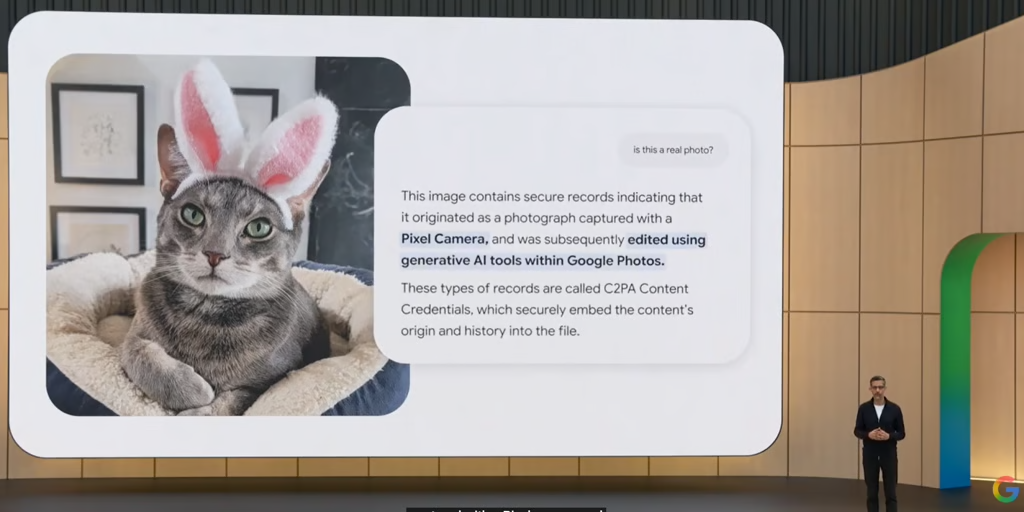
Google is also expanding support for C2PA content credentials, allowing users to inspect image origin and editing metadata directly through Google Lens. New partnerships for the watermarking framework have been signed with OpenAI, Kakao, and ElevenLabs, while Nvidia has already supported the system since last year. To illustrate the problem, Pichai displayed a fake viral image showing him eating hamburgers alongside Elon Musk, Sam Altman, and Jensen Huang, joking: “It’s obviously fake. I don’t eat hamburgers.”
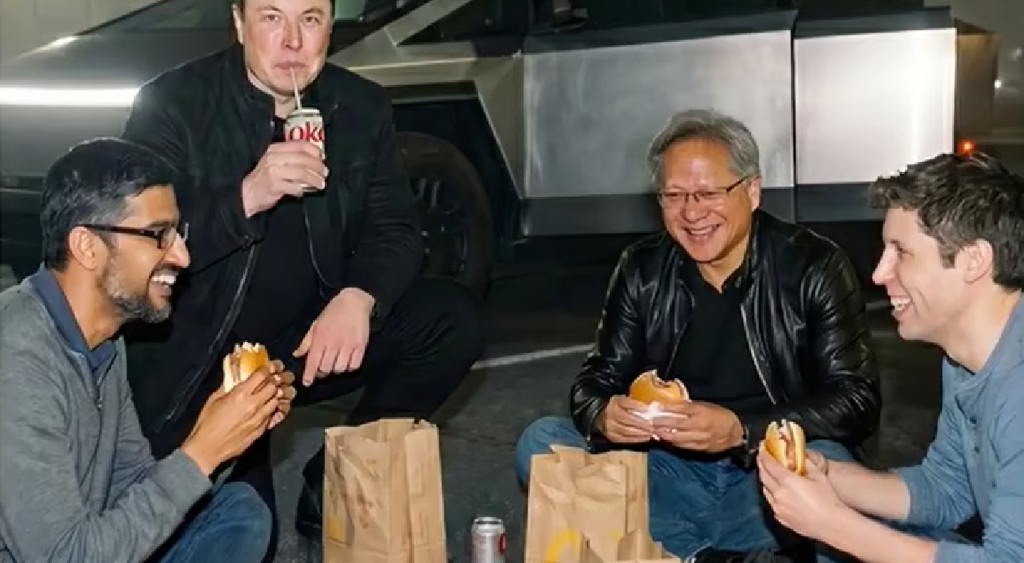
Google also announced new search and browser capabilities that allow users to circle or right-click an image in Chrome to instantly check whether AI generation tools were used and access additional context.