
 Thought Leadership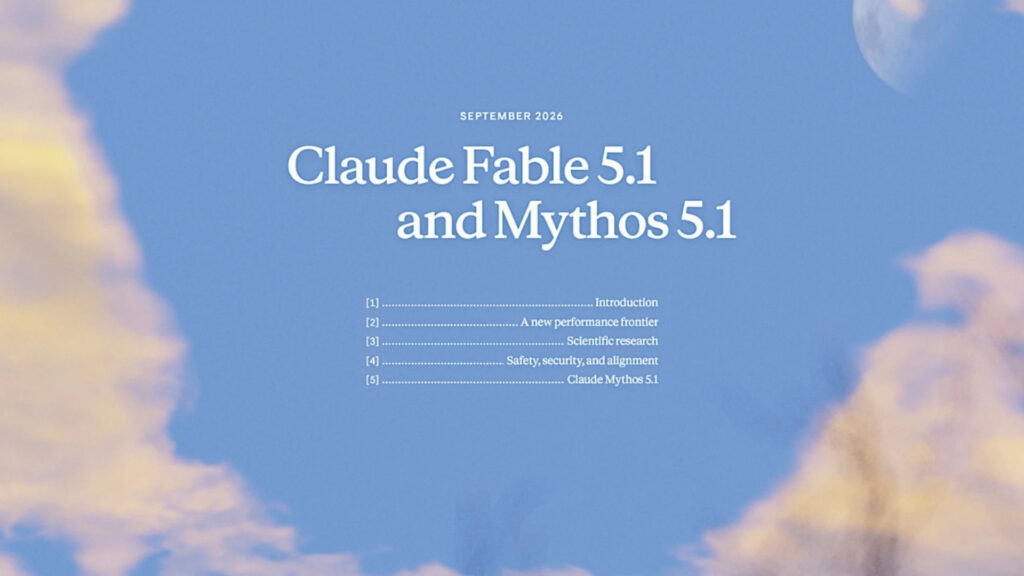
Anthropic has released its new flagship model in two variants: Fable 5.1 and Mythos 5.1. According to the manufacturer, both not only deliver more performance, but also work with fewer tokens and less frequently block harmless requests.
Mythos 5.1 continues to be aimed exclusively at registered partner companies in the cybersecurity and life sciences industries, just like the previous Mythos version. Fable 5.1 is intended for all other customers. This variant, without the additional restrictions, can be used starting today via popular cloud platforms as well as via the Anthropic API.
In terms of pricing, Anthropic charges $10 per one million input tokens and $50 per one million output tokens. Reading from the cache will cost $0.25 per one million tokens in the future, a decrease of 75 percent compared to Fable 5. This is expected to reduce costs for typical workloads by about 25 percent, and for heavily agentic applications even up to around 45 percent.
Models will also run on-premises for customers in the future
An important point of the announcement is support for Zero Data Retention. Companies can thus run the models on their own infrastructure without data being transmitted to Anthropic. Previously, this was not possible with Fable for security reasons. The new service is called Enterprise Frontier Safeguards and is scheduled to be unlocked for customers in the autumn. Anthropic continues to monitor usage for misuse, both by humans and agents. However, customers themselves will be able to determine how this monitoring takes place in detail in the future.

Anthropic also stated that enterprise data had never been accessed without authorization. For training its own models, such data is only used with the explicit consent of the respective customers.
Anthropic reports new top scores
According to Anthropic, the new models achieve new top scores across several benchmarks. Mentioned are, among others, Terminal Bench 4.0, a test for command-line programming tasks, as well as Humanity’s Last Exam for evaluating general reasoning capabilities. Prior to release, the models reportedly also delivered three independent scientific results. These include an optimization for GPUs as well as a high-resolution map of the surface of Venus, assembled from existing imagery.
System Card sees low risk in self-improvement
As usual, Anthropic published a detailed System Card alongside the launch. This classifies Mythos as low-risk regarding autonomous AI development—i.e., the ability of a model to advance its own research. The speed at which the model can accelerate internal AI research corresponds to currently typical progress.
In terms of general misbehavior, Mythos 5.1 falls slightly behind Opus 5 according to the System Card, which may be due to the model’s expanded capabilities. In comparison to its predecessor version Mythos 5 and Sonnet 5, however, the model improves. It is reportedly slightly easier to persuade to assist in misuse and accepts unconfirmed claims of authorization more readily than Opus 5. At the same time, it adheres more reliably to clearly formulated instructions, invents inputs less frequently, and less often falsely claims to have completed a task.
(Editorial Team)