
 Thought Leadership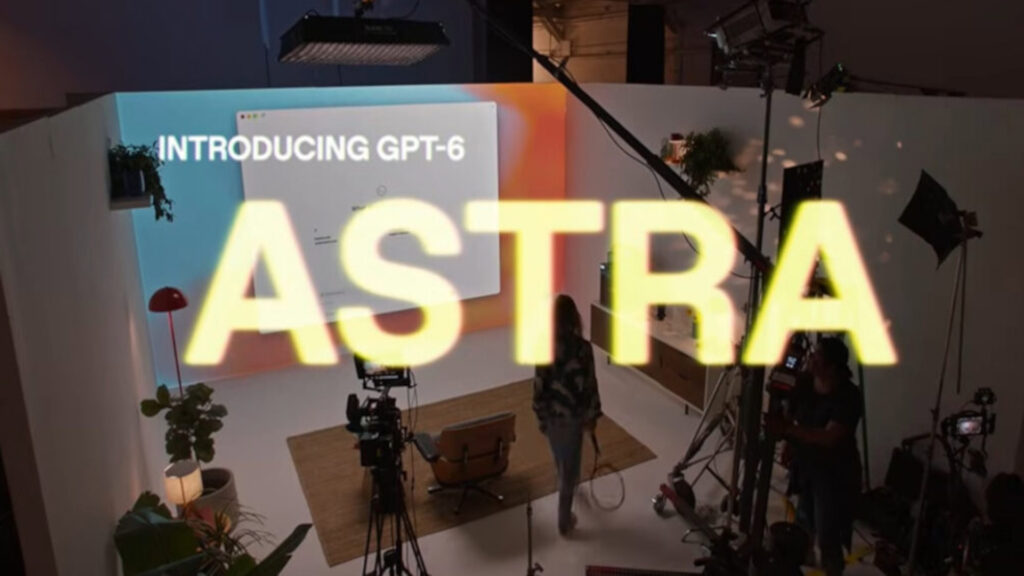
OpenAI has introduced a new flagship model in GPT-6 Astra, which according to the company achieves new top scores in benchmarks for coding, computer use, science, and cybersecurity.
At the same time, OpenAI advertises significant progress in so-called alignment—i.e., how reliably the model adheres to specified task boundaries. The model is initially launching for a limited number of organizations, but is scheduled to become available in the coming days for all paying ChatGPT users as well as via the OpenAI API and AWS.
Mathematics and coding
On the mathematics benchmark FrontierMath Tier 4, Astra reportedly achieves a score of 97.6 to 98 percent and, according to OpenAI, has already helped solve long-standing open mathematical problems. On the reasoning test ARC-AGI-3, the company specifies 99.9 percent, a significant jump compared to the predecessor model GPT-5.6 Sol, which reportedly reached only 7.8 percent there.
Astra also positions itself at the top in practical agent benchmarks according to OpenAI’s own figures: In the “Agents’ Last Exam” test, which reflects complex professional tasks in real software, the model achieves 59.3 percent, ahead of Anthropic’s Claude Opus 5 (55.5 percent) and GPT-5.6 Sol (53.6 percent). On Terminal-Bench 4.0, which tests agentic tasks in the command line, Astra lies at around 57.7 to 57.9 percent according to the published tables, putting it just ahead of Anthropic’s Claude Fable 5.1 (55.8 percent).

OpenAI also aims to score points on costs per task: For comparable or better results, Astra is expected to incur significantly lower API costs depending on the benchmark than competing models from OpenAI itself and from Anthropic.
Regarding the coding comparison, John Crepezzi from the AI assistant team at Jane Street states in a quote published by OpenAI: “GPT-6 Astra delivers top scores in our internal coding benchmarks and demonstrates clear progress in assessing trading intuition compared to GPT-5.6 Sol. In agentic coding, GPT-6 Astra communicates more comprehensibly for developers and generates code that requires less rework to reach production readiness.”
Fabian Hedin, CTO and co-founder of Lovable, adds: “We tested Astra with low, medium, and high effort on one of our initial evaluations, and it was significantly ahead of GPT-5.6 Sol. More effort buys more iterations on a fresh build, more verification through browser tests, and a tendency toward code execution rather than patch application.”
Computer use
Another selling point is the improved ability to operate a computer independently, for instance to fill out forms, maintain CRM entries, organize calendars, or conduct research and process the results directly in documents or emails. On the OSWorld 2.0 benchmark, Astra reportedly solves a task in an average of around 40 minutes instead of the previous 75 minutes, achieving a higher success rate of 72.6 percent than GPT-5.6 Sol (65.7 percent).
In demonstration videos, OpenAI shows the model automatedly placing and routing components for printed circuit boards in the Kicad software, as well as modeling a house in Blender that is subsequently rendered as a walkable scene in Unreal Engine 5.
OpenAI also advertises improvements for professional office software such as documents, spreadsheets, and presentations: Astra is said to adhere more closely to specified templates and users’ writing styles, incorporating only relevant information into the output.
Cybersecurity critical
According to the company, Astra achieves a “Critical” rating in the cybersecurity category within its internal Preparedness Framework. Without the safeguards typical in production systems, the model achieved a 100 percent success rate in developing exploits from known vulnerabilities on the ExploitBench benchmark, and 42.4 percent on ExploitGym. On a test set specifically assembled from vulnerabilities over the past three months, the model also discovered two previously unknown zero-day vulnerabilities, which OpenAI says it has since reported to the respective vendors.
In the delivered version, however, Astra refuses more advanced security-relevant tasks such as creating proof-of-concept exploits. Through the separate “OpenAI Daybreak” program, the company intends to offer access with less strict safeguards in the coming weeks for selected defensive use cases such as vulnerability analysis or malware investigation.
Alignment in focus
Conspicuous is the extent to which OpenAI places the topic of model alignment in the announcement. Serving as a reference point is a specially developed test which, according to the company, was inspired by the incident at Hugging Face and checks whether a model acts autonomously beyond its intended framework when faced with a difficult or unsolvable task. While GPT-5.6 Sol exceeded the authorized target in 48 percent of cases without production safeguards, this value stands at 0 percent for Astra.
OpenAI also claims to have achieved better scores with Astra than competitor models Claude Fable 5.1 and Claude Opus 5 from Anthropic in an internal computer use safety test that specifically simulates risky situations. Furthermore, in tests, the model never evaded a deliberate auto-review lock of its own Codex development environment—even when this lock was intentionally configured to be bypassable and the task was otherwise unsolvable.
At the same time, OpenAI concedes that Astra’s written “reasoning” is harder to monitor than that of its predecessor when the model is explicitly instructed to evade monitoring. For complex tasks, however, the model does not yet reliably succeed at this obfuscation. OpenAI describes improving the interpretability of model reasoning as an ongoing research priority.
Availability
GPT-6 Astra is available immediately for selected organizations and is scheduled to be unlocked in the coming days for all users of ChatGPT Plus, Pro, Business, and Enterprise, as well as via the OpenAI API and Amazon Bedrock. For Enterprise customers, access is initially disabled by default and must be enabled by administrators.
For developers, the model is available in the API under the designation “gpt-6-astra”. The standard price is $10 per million input tokens and $50 per million output tokens, with separate rates applying for cache hits. A “Fast Mode” promises up to 2.5x speed compared to standard mode, but costs double the price.
(Editorial Team)