

 Thought Leadership
AI applications, rising power densities, and rapidly succeeding chip generations are changing the demands on data centers.
Individual powerful components are no longer sufficient to build an economical and scalable infrastructure. What is needed is integrated planning, modular construction concepts, and digital development models that take tomorrow’s demands into account today.
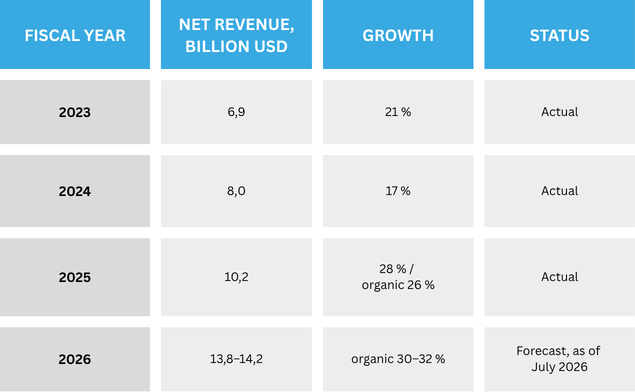
The rapid spread of artificial intelligence and rising power densities are changing the demands on data centers. Following the sale of Emerson Network Power by Emerson in 2016, Vertiv has developed into a broadly positioned provider of power supply, cooling, racks, infrastructure management, and services through organic growth, acquisitions, and capacity expansion.
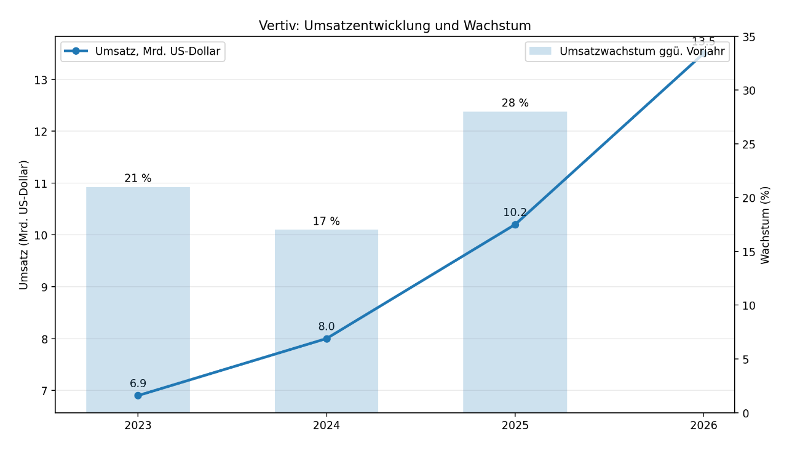
In 2025, the company generated $10.2 billion in revenue and grew organically by 26%. For 2026, Vertiv raised its revenue forecast in July to $13.8 to $14.2 billion and organic growth of 30 to 32%. The comparison with Eaton, Schneider Electric, and Rittal also shows: Vertiv is not the sole full-range provider, but operates in a competitive field with different strengths and business models.
Table of Contents
1. The strategy: from component supplier to integrated DC infrastructure
Modern data centers must connect power supply, cooling, distribution, racks, monitoring, and increasingly also services more closely with one another. AI and HPC environments in particular increase power density and thus the demands on energy supply and thermal management. Vertiv therefore positions itself along the entire chain, from power supply to thermal infrastructure to digital services.
However, this development is not solely the result of acquisitions. Vertiv is investing in parallel in manufacturing capacity, engineering, and new technologies. The company describes its strategy as a combination of organic growth, capacity expansion, and targeted acquisitions.
Behind this is a fundamental shift in data center planning: the performance of a data center can no longer be measured solely by the quality of individual components. What is decisive is how well power supply, cooling, IT hardware, network, and building services are coordinated with one another. A powerful power supply is of little use if the cooling architecture cannot efficiently remove the heat generated.
Conversely, generously dimensioned cooling and power supply systems can be uneconomical if they do not match the actual utilization and the hardware deployed. The planning logic is therefore shifting: instead of specifying components individually and subsequently assembling them, the demands of later operation move to the center, with consequences for sizing, investment decisions, energy efficiency, and long-term economic viability. The following milestones show how Vertiv follows this system logic through acquisitions and its own expansion.
2. The M&A milestones: targeted additions to the portfolio
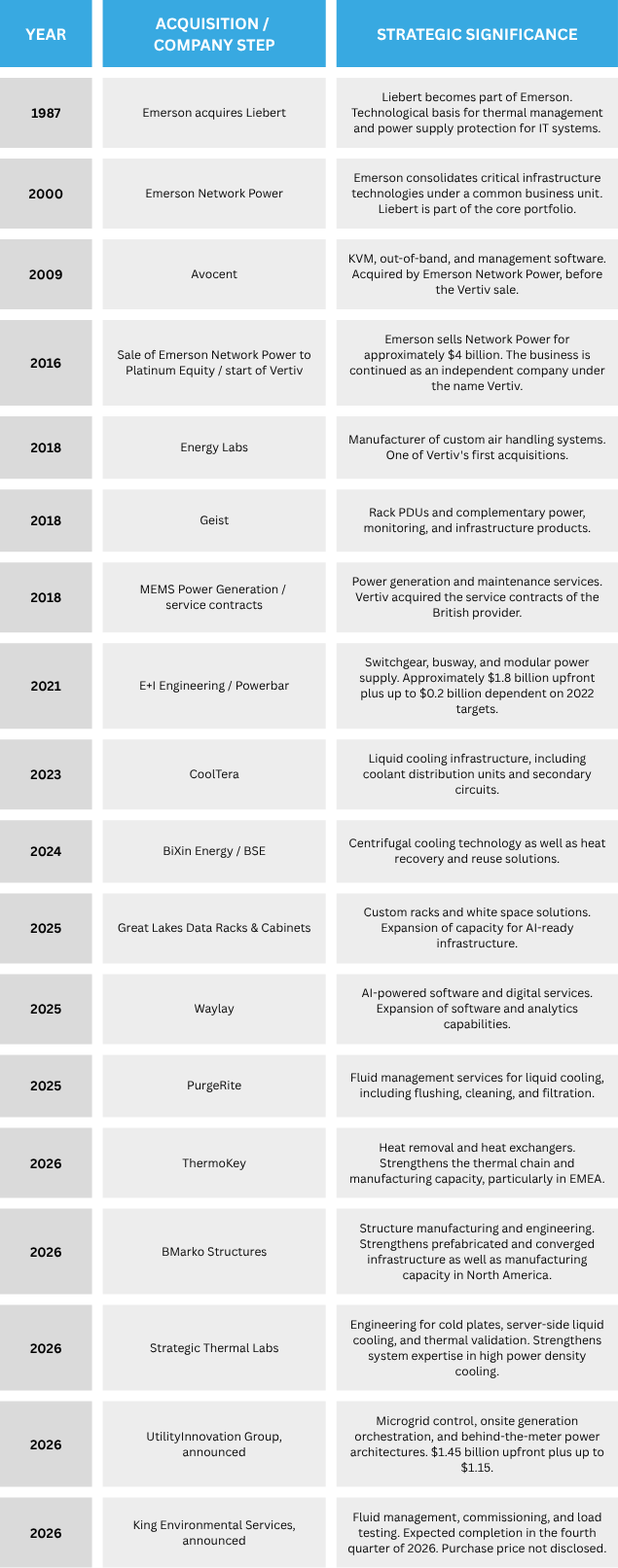
Vertiv’s M&A history begins before the company was independently established. Liebert was acquired by Emerson in 1987. In 2000, Emerson consolidated its critical infrastructure activities in the Emerson Network Power business unit. In 2016, Emerson sold Emerson Network Power to Platinum Equity for approximately $4 billion. The company was subsequently positioned as an independent entity under the name Vertiv. Liebert thus forms part of Vertiv’s historical technological base, while Emerson Network Power is the immediate corporate predecessor.
Historical classification: Vertiv Historical Timeline and company announcements. Liebert was acquired by Emerson in 1987. Emerson Network Power was sold to Platinum Equity in 2016 for approximately $4 billion.
3. Financial development: Vertiv grows significantly
4. Vertiv in competition: Eaton, Schneider Electric, and Rittal
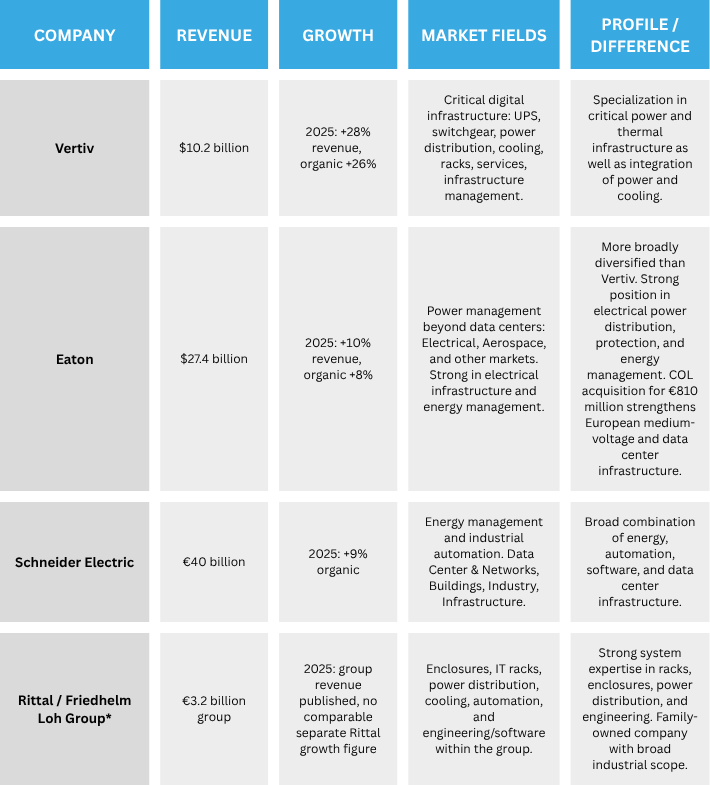
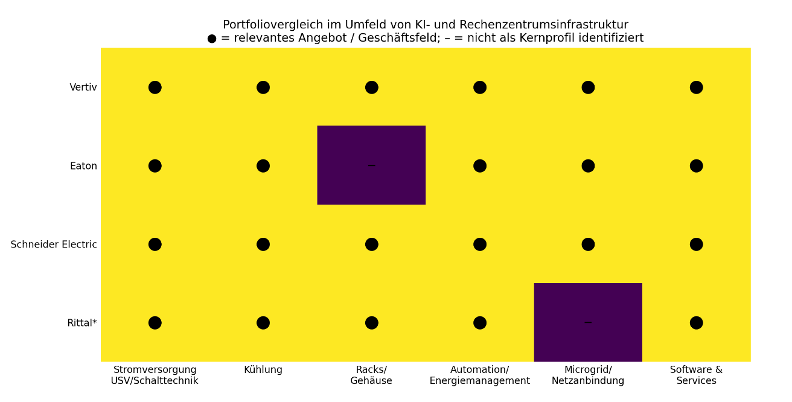
Vertiv does not compete with all three companies at exactly the same level. Eaton and Schneider Electric are significantly more broadly diversified energy and automation groups. Rittal is part of the Friedhelm Loh Group and combines enclosure, IT infrastructure, power, and automation solutions. The following comparison therefore describes market profiles rather than a supposed clear-cut “winner.”
*For Rittal, revenue of €3.2 billion for 2025 is publicly attributed to the Friedhelm Loh Group. A separately reported Rittal revenue and a directly comparable 2025 growth figure were not available in the reviewed sources. The value must therefore not be presented as Rittal’s individual revenue.
5. Where do the strategic differences lie?
Vertiv: critical digital infrastructure as the core
Vertiv focuses comparatively strongly on the physical infrastructure of digital applications. Power and cooling form the core. Value creation is expanded with racks, modular systems, monitoring, and services. The announced acquisition of UtilityInnovation Group additionally shifts the boundary toward microgrids and onsite power.
Eaton: power management with significantly broader diversification
Eaton is significantly larger and diversified across multiple industries. For data centers, the Electrical segment is particularly relevant. In 2025, the group generated $27.4 billion in revenue. With the announced acquisition of the Italian COL Group for an enterprise value of €810 million, Eaton is further expanding its European position in medium-voltage power distribution. COL contributes, among other things, SF₆-free switchgear, grid automation, and modular power supply systems.
Eaton expects completion, subject to regulatory approvals, in the first quarter of 2027. COL forecasts revenue of €250 million for 2027. This strengthens precisely the electrical infrastructure that is becoming increasingly important for data centers, from grid connection to power distribution.
Schneider Electric: energy, automation, and software
Recent M&A activities underscore this breadth: Schneider Electric announced the acquisition of Cognite for approximately $3.1 billion in June 2026, followed in September by the planned acquisition of Shelly Group for approximately €1.2 billion. On October 5, 2026, Schneider Electric finally announced the acquisition of the US software provider PTC. The transaction values PTC’s equity at approximately $22.6 billion and the company on an enterprise-value basis at approximately $23.7 billion. Completion is expected in the third quarter of 2027, subject to the necessary approvals and authorizations. PTC contributes, among other things, CAD, PLM, ALM, and service lifecycle management software. Schneider Electric expects annual cost synergies of €250 million by the third year and additionally approximately €800 million in revenue synergies.
Schneider Electric combines energy management with industrial automation and addresses Data Center & Networks as one of four end markets. In 2025, the group generated €40 billion in revenue with 9% organic growth. In the data center market, the offering includes, among other things, electrical distribution, UPS, racks, prefabricated solutions, and liquid cooling.
Rittal: system platform of rack, enclosure, power, cooling, and engineering
Rittal differs primarily through its embedding in the Friedhelm Loh Group and its close connection to Eplan, Cideon, and other automation companies. For AI/HPC, Rittal is expanding direct liquid cooling solutions, including CDUs with up to 1.5 MW cooling capacity.
6. The DC construction boom: tailwind for Vertiv — but also new bottlenecks
Permits are becoming the bottleneck: not only the availability of power, but increasingly also the duration of government approval and planning procedures is becoming a bottleneck in data center construction. In this context, Vertiv refers to cases in Germany where the realization of power and energy infrastructure can take several years. In individual cases, periods of up to eight years are mentioned. However, this figure should not be understood as the average approval duration for German data centers. The publicly available data rather generally points to long planning and approval times.
The German federal government also names faster planning and approval procedures as well as better coordination of site and energy infrastructure as central fields of action in the National Data Center Strategy. For Vertiv, this development has immediate strategic significance. The earlier power supply, grid connection capacity, self-supply, and energy architecture are clarified, the earlier the downstream systems for power distribution, UPS, and cooling can be planned. With the planned acquisition of UtilityInnovation Group, Vertiv is therefore expanding its offering to the grid connection point and to microgrid, onsite generation, and behind-the-meter solutions. The goal is to shorten the time to available power supply, known as “time to power,” for AI data centers.
DC boom
Data center construction is experiencing a significant investment surge in 2026, driven primarily by AI, hyperscalers, and so-called neocloud providers. CBRE expects approximately 13 GW of data center capacity for Europe by the end of 2026 — 20% more than 2025. At the same time, bookings of colocation capacity intended for AI more than quadrupled to 420 MW in the first half of 2026. The boom directly benefits Vertiv, because every additional megawatt of data center capacity calls for investments in power supply, switchgear, UPS, cooling, racks, and increasingly liquid cooling.
For Vertiv, this means not only higher demand but also a shift in competitive factors. Power connections, transformers, construction sites, skilled workers, and delivery times are becoming critical factors. JLL reports that new European hyperscale campuses are increasingly being planned outside established data center locations due to scarce power supply. Vertiv is responding with capacity expansions, modular and prefabricated systems, and the expansion of liquid cooling and service capacities. The boom is therefore both a growth opportunity and an operational scaling challenge for the group. What is decisive is not only how many data centers are planned, but how quickly power, cooling, and the associated infrastructure can actually be delivered and put into operation.
7. Innovations and capacity expansion: ready for the AI boom
Chip generations and infrastructure: planning grows together
AI data centers show particularly clearly how closely chip development and infrastructure sizing are linked. New chip generations change the demands on power supply, heat removal, space requirements, and system architecture. This creates a need for coordination among three actors: chip manufacturers know the properties and performance demands of their hardware, infrastructure companies develop matching supply and cooling solutions, and operators must reconcile both with their workloads, capacity planning, and business models. Early collaboration can help avoid over-dimensioning and reduce bottlenecks during later commissioning. The choice of a cooling technology or the sizing of the power supply increasingly influences the entire architecture of a data center.
The operator question: future reserves or demand-based sizing?
The pace of chip generations gives rise to a strategic question: how far should operators prepare their data centers for upcoming hardware? One approach provides for expandability from the outset, with additional space, reserves in energy supply, and flexible cooling concepts. This can increase initial investments but simplify later modifications. At the same time, there is the risk of holding capacity that is needed late or not at all. The alternative approach optimizes the infrastructure for a specific chip generation. In the event of a later technology change, operators must then plan for more extensive modifications or adjustments to the technical supply. There is no universally applicable solution. The decision depends on the expected hardware lifespan, the speed of technological change, the investment strategy, and the planned utilization. Flexibility thus becomes an economic consideration and not an end in itself.
Direct-to-chip and liquid cooling
With CoolTera, Vertiv has expanded its expertise in liquid cooling and additionally acquired PurgeRite in 2025. This extends the offering beyond hardware to fluid management and service capabilities. The statement from the source text that air cooling generally hits a hard physical limit at “over 40 kW per rack” should not be published as a generally applicable limit. The actually achievable power density depends on the cooling architecture, hardware, and location. For modern AI systems, however, liquid cooling and hybrid concepts are becoming increasingly relevant.
Microgrids and time-to-power
The announced acquisition of UtilityInnovation Group is strategically different from CoolTera. It expands Vertiv’s power portfolio to include microgrid control, orchestration of onsite generation, and behind-the-meter architectures. This means Vertiv addresses not only power distribution within a data center but also the question of how additional capacity can be made available more quickly.
King Environmental Services, KES, expands this approach to the service level. The Irish company brings fluid management, commissioning, and load testing for high power density, liquid-cooled data centers to the EMEA region. The acquisition was announced in late September 2026 and is expected to be completed in the fourth quarter of 2026. Financial details were not disclosed.
Services and digital layer
With Waylay and the 2025 acquisitions of Great Lakes and PurgeRite, Vertiv is simultaneously expanding its software, rack, and service capabilities. This fits the development toward recurring revenue from the installed base, which Vertiv itself describes as a long-term growth opportunity.
Standardization and digital planning accelerate construction
Alongside system integration, standardized and prefabricated infrastructure modules are gaining in importance. What has already been established in power supply can increasingly be transferred to other areas of data center infrastructure. The advantage lies in repeatability: when technical units are developed in a standardized manner, manufactured industrially, and assembled on-site, planning and construction processes can be better structured, and quality assurance and commissioning can become simpler.
Digital twins accelerate infrastructure planning
An important addition is the use of digital twins in model-based system development. The planned data center infrastructure is first virtually mapped, simulated, and coordinated in a digital environment before physical manufacturing begins. This allows technical dependencies to be identified early, different sizing scenarios to be played through, and the effects of rising power densities and new chip generations to be taken into account. This makes it possible to reduce planning errors, shorten engineering times, and bring data centers into operation more quickly. The prerequisite for this is precise planning data, coordinated interfaces, and close collaboration among the companies involved. In the further lifecycle, the digital models can also serve as a basis for optimizing ongoing operations.
Outlook: prefabrication reaches the white space
The development goes beyond individual power or cooling modules. The white space, the actual IT area of a data center, is increasingly becoming the focus of industrial prefabrication. Preconfigured units are conceivable in which essential components of the IT infrastructure are already integrated and tested and only need to be assembled on-site. This also changes the organization of data center projects: manufacturing, engineering, and construction planning must interlock more closely, and standardized interfaces as well as the ability to add capacity gradually are gaining in importance. This approach could become particularly relevant for large AI infrastructures, where high power densities and a growing need for rapidly available computing capacity converge. However, whether and to what extent prefabrication of the entire IT area prevails depends on the respective demands, available standards, and economic conditions.
Conclusion: infrastructure planning becomes a strategic task
The transformation in data center construction is more than the technical optimization of individual trades. The increasing integration of chip development, power supply, cooling, and digital planning is changing how data centers are conceived and realized. For operators, this means linking investment decisions more closely with technological development and actual business demands. Modularity, standardization, and prefabrication can help reduce complexity and develop the infrastructure step by step. At the same time, operators must carefully weigh which future reserves are economically sensible.
For Vertiv and its competitors, the benchmark is thus shifting. What is in demand is no longer solely individual components, but providers who can deliver power, cooling, and services as a coordinated, rapidly deliverable system. The data center is thus increasingly developing from an individually assembled construction project to an industrially planned and scalable infrastructure system.
Q&A
Why is Vertiv expanding its portfolio to include liquid cooling?
AI and HPC systems increase power density. Liquid cooling can remove the generated heat closer to the particularly heat-intensive components and is therefore an important building block for high power density infrastructure.
What role did E&I Engineering play?
E&I complemented Vertiv with switchgear, busway, and modular power supply solutions, thereby expanding the electrical value chain of the offering.
What does the acquisition of UtilityInnovation Group change?
The acquisition expands Vertiv’s power portfolio to include microgrid control, onsite generation orchestration, and behind-the-meter architectures. This targets the increasing importance of available electrical capacity for new data centers.
Is Vertiv larger than Eaton or Schneider Electric?
The original document lists this question in the heading hierarchy but does not include a corresponding answer in the body text. No translation available.
Why must chip development and infrastructure planning grow together?
New chip generations change the demands on power supply, heat removal, space requirements, and system architecture. Those who coordinate chip manufacturers, infrastructure developers, and operators early can avoid over-dimensioning and reduce bottlenecks during commissioning.