

 Thought Leadership
Retrieval-Augmented Generation (RAG) is widely regarded as the most pragmatic approach for connecting large language models with enterprise data in a secure, up-to-date, and traceable manner. This practical guide explains how to build a RAG pipeline, why analysts from Gartner and Forrester classify the technology as a strategic priority – and which components truly matter.
What is a RAG Pipeline – and Why Do Enterprises Need It?
Large language models such as GPT-4o or the latest Claude models from Anthropic are impressive – but they only know what they were shown during training. Documents published yesterday, internal process manuals, or current product data all remain hidden from the model. This is precisely where Retrieval-Augmented Generation comes in.
A RAG pipeline (Retrieval-Augmented Generation) is a technical process chain that connects a Large Language Model (LLM) with external, verified data sources in real time. Before the model generates an answer, it retrieves relevant information from a structured knowledge base and uses this as context. The result: more precise, current, and traceable answers – without the need to retrain the model.
The concept was originally introduced by Meta AI (Lewis et al., 2020) and has since become the de facto standard for enterprise AI applications. According to a current analysis by Mordor Intelligence, companies today choose RAG for 30 to 60 percent of their AI use cases – whenever high accuracy, transparency, and the use of proprietary data are required.
The RAG Market: Explosive Growth Confirmed by Analysts
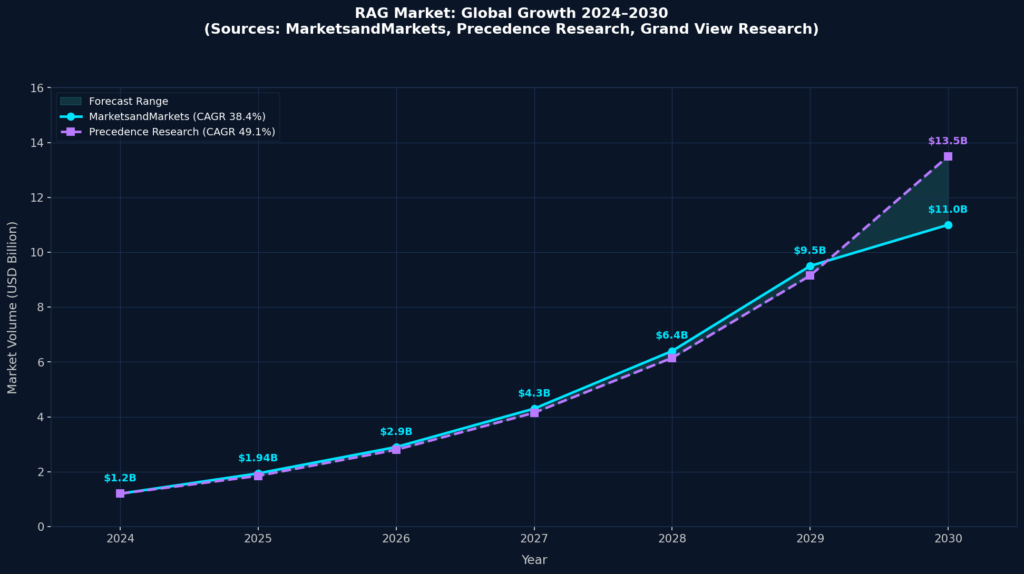
Market developments underscore the strategic importance of RAG. Several independent research firms forecast exceptionally strong growth:
- MarketsandMarkets (2025): The global RAG market will grow from USD 1.94 billion (2025) to USD 9.86 billion (2030) – a CAGR of 38.4%. (Source: MarketsandMarkets, “Retrieval-Augmented Generation (RAG) Market – Global Forecast to 2030”)
- Grand View Research (2024): Starting from USD 1.2 billion (2024), the market is projected to reach USD 11.0 billion by 2030 (CAGR approx. 45%). (Source: Grand View Research, “Retrieval Augmented Generation Market Report 2030”)
- Precedence Research (2025): Forecast from USD 1.85 billion (2025) to USD 67.42 billion by 2034 (CAGR 49.1%). (Source: Precedence Research, RAG Market Analysis 2025–2034)
- North America leads the market with a share of 37–38% (2024), driven by early enterprise AI investments, concentrated talent pools, and a strong cloud ecosystem.
Gartner positions RAG as a strategic investment priority: in the Generative AI Hype Cycle Report 2024, analysts explicitly recommend that IT leaders “prioritize RAG investments” when deploying GenAI based on private and public enterprise data. (Source: Gartner, Generative AI Hype Cycle 2024)
Forrester analyzes in its report “Getting Retrieval-Augmented Generation Right” the key challenges in RAG implementations, emphasizing the need for conceptual alignment across team boundaries in order to manage the inherent complexity of RAG architecture. (Source: Forrester Research, Report RES182951)
Microsoft calculates an ROI of USD 3.70 for every dollar invested in GenAI programs that embed retrieval pipelines. (Source: John Roach, “Microsoft Customers Report 3.7x ROI on Generative AI”, microsoft.com)
How a RAG Pipeline is Structured: The Two Main Phases
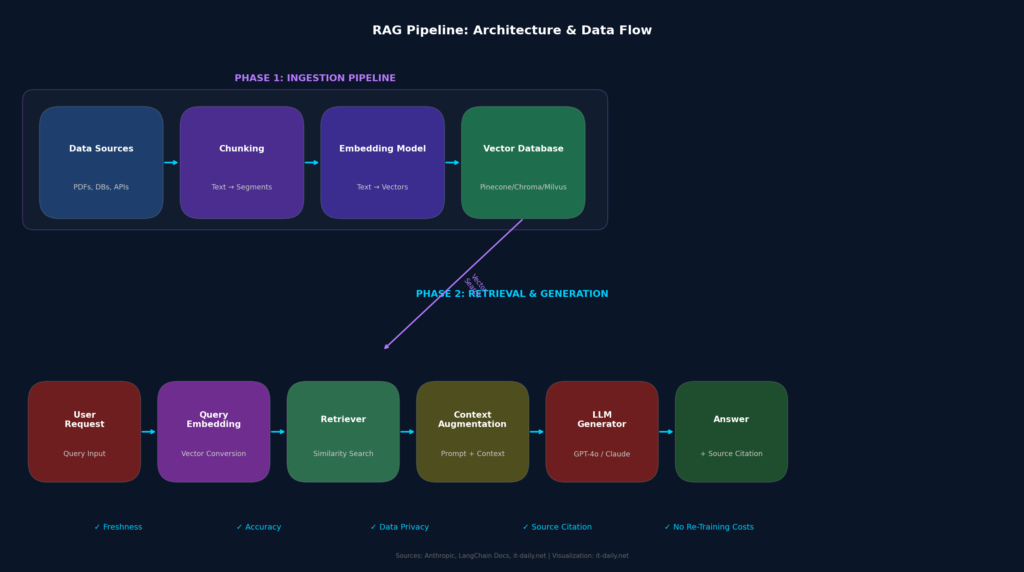
Building a RAG pipeline follows a clear logic divided into two core phases. Understanding these phases is the fundamental prerequisite for a successful implementation.
Phase 1: The Ingestion Pipeline – Preparing the Data
Before the system can answer questions, the data must be prepared. This preparation phase – also called the indexing phase – runs once or in regular cycles:
- Loading data sources: Internal documents (PDFs, Word files, wiki pages), databases, REST APIs, or web content are collected. The quality and timeliness of this data fundamentally determines answer quality.
- Chunking (segmentation): Long texts are split into semantically meaningful sections (“chunks”). The optimal chunk size varies depending on the use case – typical values range from 256 to 1,024 tokens.
- Embedding: Each chunk is converted by an embedding model (e.g., OpenAI text-embedding-3-large, Cohere Embed v3, or the open-source model BGE) into a numerical vector that represents the semantic meaning of the text.
- Indexing: The vectors are stored together with the original text and metadata (e.g., document source, date, department) in a vector database.
Phase 2: Retrieval & Generation – Retrieving and Responding
Once a user submits a query, the system enters the second phase:
- Query Encoding: The user question is converted into a vector using the same embedding model.
- Retrieval (vector search): The retriever searches the vector database for the k most similar chunks – based on cosine similarity or other distance metrics. Modern implementations combine vector search with traditional keyword search (Hybrid Search) for better precision.
- Context Augmentation: The retrieved text passages are combined with the original user question to form an enriched prompt.
- Generation: The LLM receives the enriched prompt and generates a context-based answer – with the ability to cite the exact source documents.
The 6 Core Components of a RAG Pipeline at a Glance
A production-ready RAG pipeline consists of clearly defined building blocks. The following table provides a practical overview of the key components, their functions, and relevant tools:
| Component | Function | Examples / Tools | Enterprise Relevance |
| Data Sources | Providing the knowledge base | PDFs, databases, REST APIs, SharePoint | High – determines answer quality |
| Embedding Model | Converting text into vectors | OpenAI text-embedding-3, Cohere Embed, BGE | Critical – foundation for semantic search |
| Vector Database | Storage & similarity search | Pinecone, Chroma, Milvus, Weaviate, pgvector | High – speed & scalability |
| Retriever | Finding relevant text passages | Dense Retrieval, BM25, Hybrid Search | Very high – precision of results |
| LLM (Generator) | Generating the final answer | GPT-4o, Claude (Anthropic), Llama 3.3, Mistral | High – output quality |
| Orchestration Framework | Controlling the entire process | LangChain, LlamaIndex, Haystack | Medium-High – development speed |
Tab. 1: Core components of a RAG pipeline with function descriptions and tool recommendations. (Source: it-daily.net editorial team, based on LangChain, LlamaIndex, and Pinecone documentation, as of March 2026)
The Advantages of RAG over Fine-Tuning and Prompt Engineering
Enterprises looking to deploy LLMs productively face a choice: should they fine-tune the model, work with clever prompts (prompt engineering) – or use RAG? For most enterprise applications, RAG offers clear advantages:
1. Freshness Without Retraining
Fine-tuning is costly and time-consuming – a single training run for GPT-4-class models can cost tens of thousands of euros and take weeks. RAG, by contrast, allows new documents to be fed into the knowledge base within minutes. The “knowledge cutoff” of the base model becomes irrelevant.
2. Drastic Reduction of Hallucinations
One of the most critical weaknesses of LLMs is hallucination – generating factually incorrect information with apparent confidence. Field studies show that RAG pipelines can reduce hallucinations by 70 to 90 percent, since answers are always based on retrieved, verified sources. (Source: Mordor Intelligence, “Retrieval Augmented Generation Market Report”, 2024; Makebot AI Research Team, “Enterprise RAG Benchmarks 2025”)
3. Data Privacy and Data Sovereignty
With RAG, proprietary enterprise data does not leave the controlled IT environment. The knowledge base is kept internal; the LLM only receives the relevant context for each query – no training data, no model update at the provider. This is especially critical for GDPR-compliant implementations in the EU.
4. Traceability and Source Citation
A well-designed RAG pipeline can output the exact source documents for every answer. This builds trust, is indispensable for compliance requirements, and simplifies debugging when answers are incorrect.
5. Cost Efficiency
Compared to fine-tuning and the use of proprietary models with large context windows, RAG is often more cost-effective – especially with frequently changing data. LLMs are meanwhile reportedly around seven times faster and cheaper than in 2023. (Source: Vectara, “Top Enterprise RAG Predictions 2025”)
Building a RAG Pipeline: The Implementation Path for Enterprises
The path from idea to a production-ready RAG pipeline typically follows this proven approach:
Step 1: Select a Pilot Use Case
Gartner recommends starting with a clearly measurable use case – such as an internal HR FAQ bot or an assistant for technical documentation. Business value must be quantifiable from the outset. (Source: Gartner, “How to Supplement Large Language Models with Internal Data”, 2024)
Step 2: Classify and Curate the Data Foundation
Documents are categorized by type (structured, semi-structured, unstructured), timeliness, and sensitivity level. Redundant, outdated, or erroneous content should be cleaned before indexing – “garbage in, garbage out” applies particularly strictly in the RAG context.
Step 3: Choose the Technology Stack
The most popular combination for beginners: LangChain or LlamaIndex as orchestration framework, OpenAI Embeddings or an open-source model (e.g., BGE, E5) for vectors, Chroma or pgvector as beginner-friendly vector databases. For production-ready deployments, Pinecone, Milvus, or Weaviate are the leading options.
Step 4: Optimize the Chunking Strategy
Chunk size and strategy have an enormous impact on retrieval quality. Recursive chunking, semantic chunking, and parent-child chunking are proven approaches. Metadata enrichment of each chunk (source, date, department) improves traceability and enables later filtering.
Step 5: Set Up Evaluation and Monitoring
Without metrics, no progress. Relevant KPIs for RAG pipelines are Faithfulness (fidelity of the answer to the source), Answer Relevance (relevance of the answer to the question), and Context Recall (completeness of retrieved contexts). Frameworks such as RAGAs or LangChain Evaluation enable automated testing.
Step 6: Agentic RAG as the Next Evolutionary Stage
The evolution of RAG towards Agentic RAG – i.e., AI agents that autonomously decide which retrieval steps are necessary for a complex task – represents the current frontier. According to Vectara, complex agentic RAG workflows are not expected to arrive broadly in enterprise use until 2026/2027. (Source: Vectara, “Top Enterprise RAG Predictions for 2025”)
Typical Use Cases in an Enterprise Context
- Customer Service & Support: Chatbots based on current product manuals, FAQs, and ticket histories resolve inquiries precisely and reference specific sections.
- Legal & Compliance: RAG-powered assistants search contract archives, regulatory documents, and internal policies. JPMorgan Chase, for example, deploys RAG agents for compliance queries and achieved productivity gains of 200 to 2,000 percent. (Source: Kanerika Inc., “Agentic AI 2025”)
- HR & Knowledge Management: Employees query an internal assistant about vacation policies, onboarding processes, or IT security rules – and immediately receive a source-based answer.
- Technical Documentation & IT Operations: RAG pipelines search runbooks, incident logs, and API documentation for IT teams in real time.
- Healthcare: Clinical decision support systems that embed current guidelines and peer-reviewed studies into response generation. The healthcare sector holds the largest market share in the RAG space at 36.61% according to Precedence Research (2025).
Challenges and Pitfalls in RAG Implementation
Despite the clear advantages, Forrester identifies several structural challenges that can cause RAG projects to fail:
- Data quality: Outdated, inconsistent, or poorly structured source data directly leads to poor answers.
- Chunking errors: Chunks that are too large or semantically incoherent significantly degrade retrieval performance.
- Vendor fragmentation: A typical DIY RAG project involves more than 20 APIs and 5 to 10 vendors – this significantly increases complexity and maintenance overhead. (Source: Vectara, 2025)
- Security: Prompt injection attacks, where malicious code is injected into the RAG context via user inputs, are a real threat. OWASP LLM Top 10 and UK NCSC/CISA guidelines provide orientation here.
- Compliance: With the EU AI Act (in force since August 2024, phased obligations through 2026/2027), enterprises must document their RAG systems and assign risk categories.
Tools, Frameworks, and Further Resources
The RAG tooling landscape has evolved rapidly. The following resources are recommended for getting started and deepening knowledge:
- Orchestration Framework: LangChain Documentation
- Data Framework for LLM Applications: LlamaIndex (formerly GPT Index)
- Managed Vector Database: Pinecone
- Evaluation Framework: RAGAs – RAG Evaluation Framework
- Forrester Report: Getting RAG Right
- Gartner Innovation Insight Summary: RAG as a Service
- Practical Guide – Agentic RAG Pipeline (Level Up Engineering)
- More articles on Enterprise AI: it-daily.net
Frequently Asked Questions (Q&A) on RAG Pipelines
What is the difference between RAG and fine-tuning?
Fine-tuning modifies the weights of the language model through further training on domain-specific data. RAG leaves the model unchanged and enriches each inference step with external context. RAG is cheaper, more flexible, and better suited when data changes frequently.
Which vector database is best for getting started?
For prototypes and smaller projects, Chroma (open source, locally deployable) is excellent. For production-ready, scalable deployments, Pinecone (managed service) and Milvus (open source, highly scalable) are the leading options. pgvector is interesting for teams already running PostgreSQL.
How large should the chunks in a RAG pipeline be?
There is no universal answer – typical values are 256 to 1,024 tokens per chunk. Smaller chunks increase retrieval precision but provide less context. Larger chunks contain more context but can make retrieval less precise. A/B tests with your own dataset are essential.
Can RAG be operated in a private cloud or on-premises?
Yes. Many enterprises with strict data protection requirements (banks, government agencies, healthcare) operate RAG pipelines entirely on-premises using open-source models (e.g., Llama 3.3, Mistral) and local vector databases. According to Precedence Research (2025), the on-premises segment is growing particularly fast.
How reliable are RAG answers?
Significantly more reliable than pure LLM answers: field studies report a hallucination reduction of 70 to 90 percent. Reliability depends heavily on the quality of data sources, the chunking strategy, and the retrieval algorithm.
What is Agentic RAG?
Agentic RAG extends classic RAG pipelines with autonomous AI agents that independently plan multi-step retrieval strategies, invoke tools, and iteratively refine answers. This enables the handling of complex, multi-part requests. Gartner predicts that by 2025, 40 percent of enterprise workflows will already contain agentic AI components.