

 Thought Leadership
Typst promises LaTeX-grade quality without the complexity: Rust-based, blazing fast, and memory-safe. A hands-on check for enterprise IT and compliance.
Creating complex documents automatically and precisely poses major challenges for businesses and academia alike. While LaTeX has been the standard for academic typesetting for decades, this historically grown system suffers from slow compilation, dated macro syntax, and cryptic error messages. This is where Typst comes in: an open-source typesetting system written in Rust that combines fast compile times with an intuitive markup syntax. This article examines its architecture, concrete use cases, an in-depth comparison with classic systems, and its place within modern enterprise content strategies and strict compliance requirements.
What Is Typst? A Portrait of the Modern Typesetting System
Typst is a completely new, markup-based typesetting system for scientific, technical, and commercial documents. It was created with the primary goal of offering the typesetting power and typographic precision of LaTeX without carrying its technical hurdles and complexity into the modern IT world. The project was started in 2019 by Laurenz Mädje and Martin Haug as part of their master’s theses at TU Berlin and released as an open-source compiler alongside a web app in 2023. It combines three key pillars: a concise markup language, a natively integrated scripting language for dynamic content, and a high-performance compilation system.
The codebase is fully open source and built on Rust, licensed under the permissive Apache 2.0 license. The main repository on GitHub now counts more than 55,000 stars (as of 2026, github.com/typst/typst) — a clear signal of the developer community’s growing interest. Typst solves fundamental problems of classic document processing: it needs no bulky TeX distributions that often take up several gigabytes of disk space and require deep system-level intervention. Instead, Typst runs as a single, extremely compact binary.
Typst provides document layout through a declarative model. Instead of nested TeX macros, it uses clear functional commands for layout rules, spacing, typography, and bibliographies. At the same time, the system offers an integrated module system through which libraries for diagrams, formulas, and layout templates can be imported directly.
Architecture and How It Works: Why Typst Is Fast
The core architectural advantage of Typst lies in what is known as incremental compilation. With traditional TeX engines such as pdflatex or XeLaTeX, even a minor text edit forces the entire document to be recalculated from the first page to the last. For extensive technical reports, this leads to noticeable wait times.
Typst uses the concept of “constrained memoization” via the Rust library “comemo.” Individual document nodes and function results are intelligently cached in memory. If the author changes a paragraph on page 50, the compiler recalculates only the affected section and its visual effects on subsequent pages. A study carried out as part of a master’s thesis at TU Berlin found incremental edits to be 3.4 to 9,895 times faster than with classic LaTeX engines — the range depends heavily on document size and the type of edit.
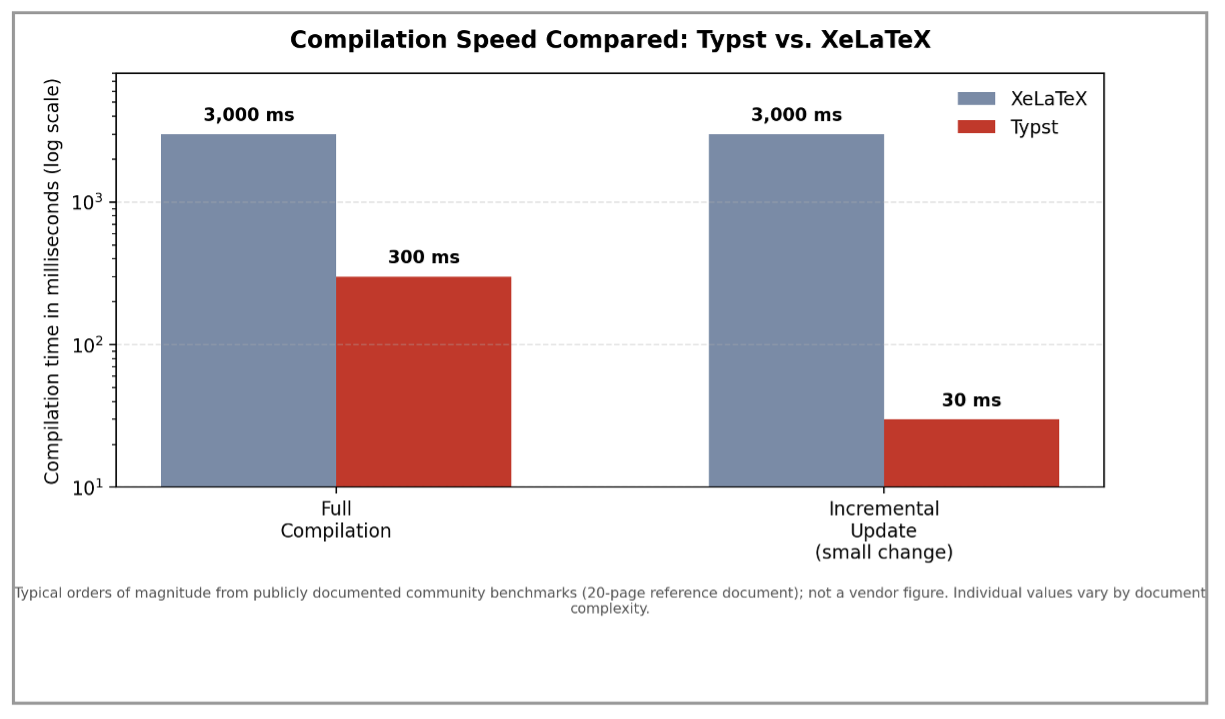
This chart illustrates the practical speed gains in IT: while XeLaTeX takes several seconds for a typical, multi-page document with complex formulas and vector graphics, the initial full compilation with Typst, according to several independent practice reports, usually falls in the range of 200 to 500 milliseconds. Subsequent incremental edits often take only around 10 to 50 milliseconds.
Interactive Real-Time Preview in Live Use
This leap in performance enables a new user experience when writing documents. Developers and technical writers can see changes to the source code reflected almost in real time in the finished PDF rendering. Such immediate visual feedback significantly reduces friction when creating complex tables or mathematical equations, since errors are visible and correctable instantly.
Typst vs. TeX and LaTeX: The IT Comparison
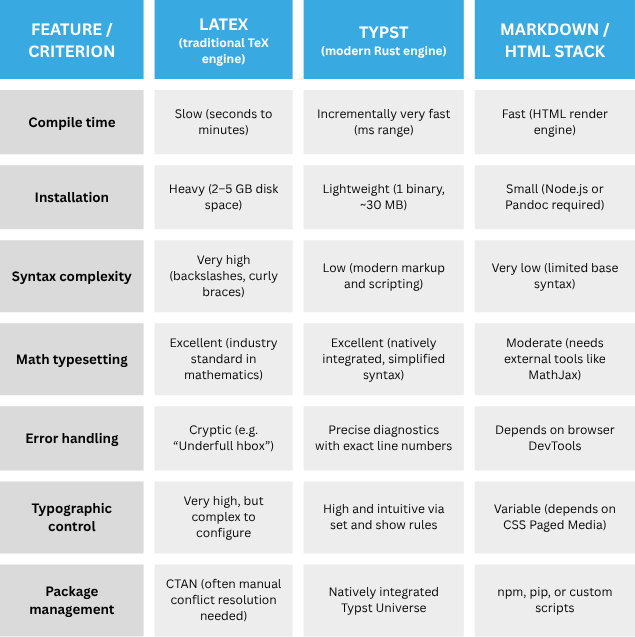
Making the right technology choice for software projects and enterprise workflows calls for a systematic comparison of the core technologies. LaTeX offers a historically grown, extremely powerful ecosystem with tens of thousands of packages on CTAN (Comprehensive TeX Archive Network). This flexibility, however, comes at the cost of cryptic debugging, difficult font integration, and the lack of a native programming paradigm.
Typst addresses exactly these weak points. Modern fonts from the operating system are detected automatically and rendered correctly without extra configuration such as fontspec. Errors are highlighted in the terminal or source editor with precise line numbers and meaningful context messages.
Matrix: Typst, LaTeX, and Markdown Compared
Use Cases in Enterprise IT and Academia
Typst covers a broad range of document types and is increasingly establishing itself in enterprise practice as well as research institutions worldwide. Its use cases range from academic papers to highly automated invoicing at large corporations.
Automated Document Generation and CI/CD Pipelines
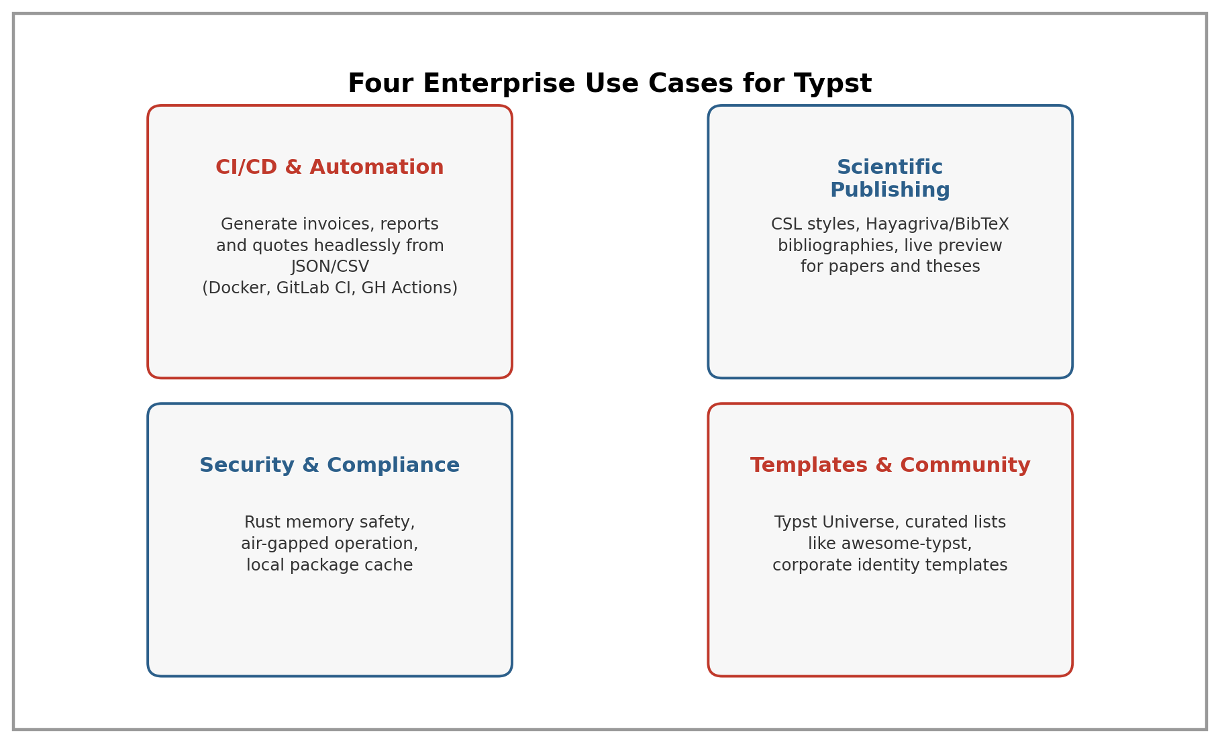
In modern software architectures, reports, quotes, invoices, and compliance statements often need to be generated fully automatically from data sources such as JSON or CSV. Typst is an excellent fit for server-side use in so-called headless environments. Thanks to its extremely compact binary size, it integrates seamlessly and resource-efficiently into Docker containers, GitLab CI, or GitHub Actions. The execution time of automation pipelines is noticeably reduced compared to TeX-based images.
Scientific Publishing
For researchers, Typst offers native support for bibliography files in Hayagriva or BibTeX format, as well as the ability to control the appearance of bibliographies via CSL styles (Citation Style Language) — the same format also used by Zotero and JabRef for style export. This enables a largely smooth workflow when switching from established reference management systems. Mathematical and physics work also benefits significantly from the fast live preview described above.
Open-Source Templates and Community Resources
A key accelerator for enterprise adoption is the growing availability of ready-made layout templates. IT departments don’t need to reinvent the wheel. Through the official “Typst Universe” (typst.app/universe), vetted templates can be downloaded via the command line. For the enterprise sector, the curated list awesome-typst on GitHub (github.com/qjcg/awesome-typst) is also recommended. There, developers will find ready-to-use base structures for resumes, technical documentation, DIN-standard letterheads, and presentation slides — comparable to the Beamer class in LaTeX. These templates can be forked and adapted precisely to a company’s own corporate identity.