
 Thought Leadership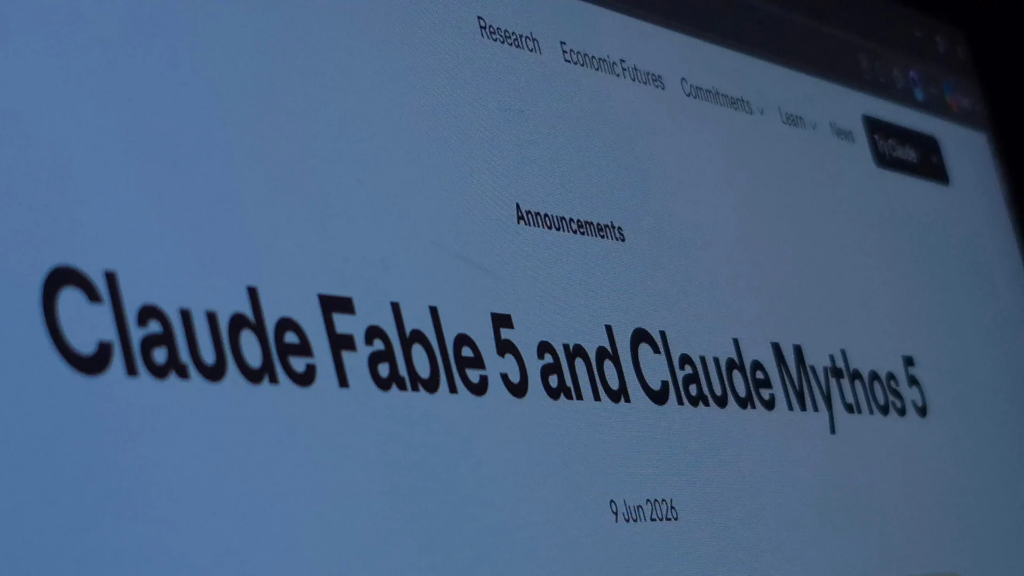
On June 12 at 5:21 p.m. Eastern Time, Anthropic received a US government export control directive. Within hours, Claude Fable 5 and Mythos 5 were disabled worldwide. The move triggered a wave of political and industry reactions across Europe.
What happened
The directive is based on ECCN 4E091, a classification introduced under the “Framework for AI Diffusion” in January 2025, and was delivered by US Commerce Secretary Howard Lutnick. It prohibits foreign nationals from accessing both models, including non-US Anthropic employees working inside the United States.
The US government cited national security concerns but did not provide any technical details. At the time of the restriction, Fable 5 and Claude Mythos 5 had only been publicly available for 72 hours.
Anthropic publicly disputed the government’s assessment. According to the company, its review of the alleged jailbreak incident found only a small number of previously known, minor vulnerabilities — issues also present in other publicly available models. Despite its disagreement, Anthropic complied with the order.
Political reactions
The shutdown triggered immediate political responses in several European countries.
French presidential candidate Bruno Retailleau reacted sharply: “A country dependent on others for technology can be disconnected overnight.” He called for an end to what he described as naïveté toward US tech giants, pointing to companies such as Mistral and OVHcloud as building blocks for a sovereign European AI infrastructure.
British Member of Parliament Al Carns focused on the practical implications for Britain: “This week, the world’s most advanced AI model was switched off by a foreign government. British researchers used it. British companies tested it. British hospitals trialed it.” His parliamentary colleague and former security minister Tom Tugendhat framed the issue more broadly: “Sovereignty today is defined more by code than by cannons.”
At the European level, French Europe Minister Benjamin Haddad called the development a turning point in the geopolitical competition over AI: “Europe cannot accept being an open market dependent on technologies designed, funded, and controlled elsewhere.”
Industry reactions
European and German digital industry groups quickly weighed in as well.
The Open Source Business Alliance said the incident confirmed long-standing warnings. Chairman Peter Ganten stated: “Europe is almost entirely dependent on US AI models, which — as we are seeing again — can be shut down at any time.” The OSBA advocates for open-source AI models as a structural alternative that cannot be disabled by external orders.
Bitkom echoed this assessment. President Dr. Ralf Wintergerst warned of direct economic and security implications: “Germany and Europe depend on the goodwill of the US government for access to the most powerful AI models. More than ever, we must make Germany and Europe digitally sovereign.”
Sascha Böhr, CEO of Koblenz-based AI startup nuwacom, drew a clear conclusion in comments to it-daily.net: “AI is no longer just standard software. AI is strategic infrastructure.” He supported calls from Germany’s AI industry association for a sovereignty summit between the federal government and the European Commission to define concrete steps. Böhr outlined four key measures: increased public funding for European AI model development, immediate dependency audits in government and critical infrastructure, a sovereignty requirement for AI in sensitive public sectors, and a dedicated funding pool for private-sector AI innovation, particularly startups and SMEs. “Digital sovereignty does not mean isolation. It means the ability to act,” he said.
No-code platform provider Anhalt Intelligence also commented to it-daily.net. CEO Christian Allner pointed to existing alternatives: “If Europe does not act quickly, it will become a petitioner in a US-dominated AI world.”
And now?
Reactions from politics and industry point to a consistent conclusion: the Fable 5 shutdown is being seen as a symptom of a deeper structural dependency that has shaped Europe’s tech landscape for years.
The ban is unlikely to be the last of its kind. For Europe, the real question is no longer whether further restrictions will follow, but how prepared it will be when they do.
Whether these statements translate into concrete policy action remains to be seen.