

 Thought Leadership
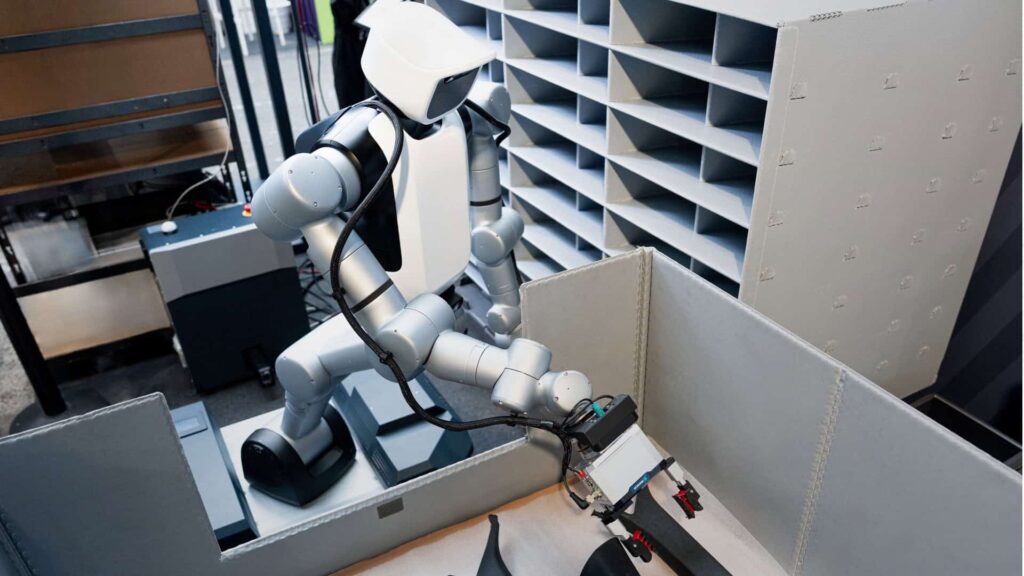
Audi is exploring whether mobile humanoid robots can take over parts sequencing at its Ingolstadt plant. Developed by Agile Robots, the robots are designed to prepare components in the correct order for assembly. The project will first be planned and tested in a virtual twin using software from Dassault Systèmes and NVIDIA.
Audi is investigating whether humanoid robots can handle one of the most persistent challenges in automotive logistics: parts sequencing. Together with Munich-based robotics manufacturer Agile Robots, Dassault Systèmes, and NVIDIA, the automaker presented a proof of concept at NVIDIA GTC Berlin. Testing is taking place in the Production Lab at Audi’s Ingolstadt plant, where the company evaluates new production and logistics technologies.
One Million Picks a Day
Parts sequencing involves retrieving components from material bins and arranging them in sequence carts so they reach the assembly line in precisely the order required by the vehicles moving through production. According to Audi, its logistics operations handle around one million such picks every day. Most of this work is still performed manually.
The reason is well known: conventional industrial robots struggle with unsorted parts in bins and so-called flexible components, such as wiring harnesses and trim pieces. The wide variety of configurations in the premium vehicle segment adds another layer of complexity.
“For decades, picking within the sequencing process has remained one of the toughest automation challenges in automotive logistics,” says Gerd Walker, Audi’s Board Member for Production and Logistics.
Humanoid Upper Body on a Mobile Base
Agile Robots is taking a hybrid approach. Its newly developed robots combine a humanoid upper body with two arms and a wheeled mobile base instead of legs. The design aims to combine a humanoid robot’s reach and dexterity with the robustness of a mobile platform. The machines work at human height and are designed to fit into Audi’s existing production and logistics environment.
Using both arms, the robots are intended to handle large and flexible components. AI-powered perception allows them to identify, grasp, and manipulate a wide variety of parts, even when stored in mixed containers or presented in different positions and packaging.
Agile Robots says it has already deployed more than 20,000 robotic solutions worldwide. However, the mobile humanoid robots are a new product.
“Agile Robots is driving industries forward with Physical AI. Working with Audi we show how our mobile humanoids can perform high-value, critical tasks that were previously impossible to automate. That is what Physical AI is all about – real progress for industrial productivity,” says Dr. Zhaopeng Chen, founder and CEO of Agile Robots.
Simulate First, Handle Parts Later
Before the robots are deployed in Audi’s smart intralogistics environment, the logistics hall is being recreated as a virtual twin using Dassault Systèmes’ DELMIA application. The partners will use the virtual environment to assess feasibility, cycle times, ergonomics, and safety on the 3DEXPERIENCE platform. The project draws on Dassault Systèmes’ Industry World Models and NVIDIA Omniverse libraries.
In the future, LEO, Dassault Systèmes’ AI-powered Virtual Companion, is also expected to support engineers and accelerate planning processes.
Philippe Laufer, Executive Vice President of 3DS Global Brands at Dassault Systèmes, explains the approach: “The breakthrough is not simply bringing humanoid robots into the factory at high pace. It is being able to engineer and validate their mission and role before they ever enter it physically.”
With 3DEXPERIENCE Virtual Twins Factory, engineers can assess feasibility, timing, ergonomics, and safety in a virtual environment, “reducing work that can take months to days,” Laufer says.
Deepu Talla, NVIDIA’s Vice President of Robotics and Edge AI, highlights the potential for integrating the technology into existing operations.
“Audi and Agile Robots are using Dassault Systèmes DELMIA and NVIDIA Omniverse physical AI libraries to simulate and validate mobile humanoids for parts sequencing, tackling one of automotive logistics’ toughest workflows with minimal changes to existing operations,” he says.
No Series Production Deployment Yet
Despite the enthusiasm surrounding the project, it remains a proof of concept for now. The partners have not disclosed cycle times, error rates, or the number of robots involved. They have also provided no timeline for deployment in series production logistics.
According to the announcement, trials have already begun, initially focusing primarily on virtual testing.
Audi is joining a growing list of automakers testing humanoid robots in factories. Whether this complex approach can prove more cost-effective than specialized automation or human labor remains to be seen in real-world operations. Audi says the technology is intended to relieve employees of repetitive tasks, freeing them up to focus on other activities.
(Editorial Team)