
 Thought Leadership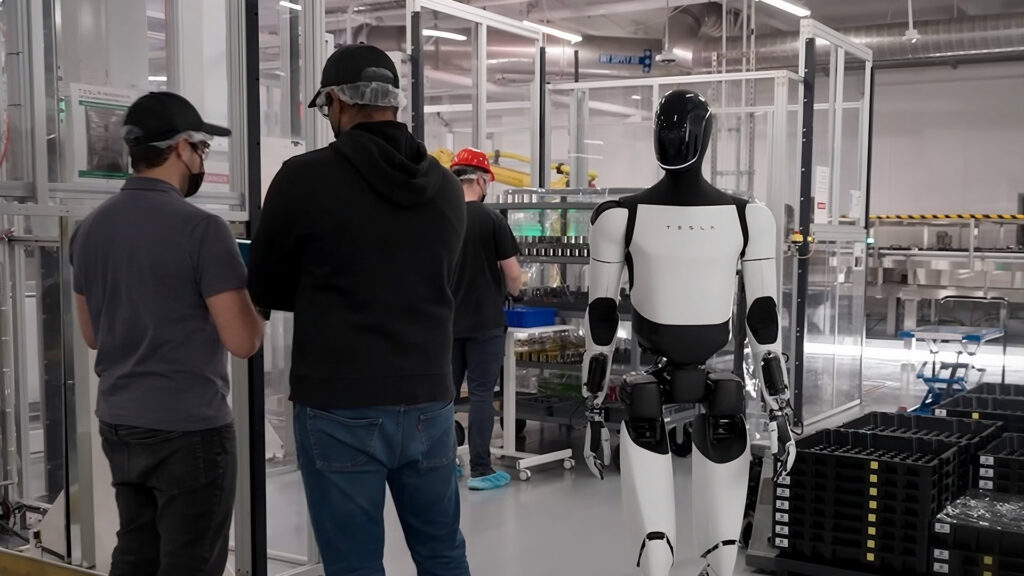
Before Optimus can lend a hand on the factory floor, it first needs to understand how humans actually work. That is exactly what some employees at Tesla’s Grünheide site in Germany may soon be asked to demonstrate.
Tesla reportedly plans to equip selected workers at its Gigafactory Grünheide with backpack mounted cameras to collect movement data for training its humanoid robot, Optimus. The plan was outlined in an internal Tesla communication first reported by German business newspaper Handelsblatt.
What Exactly Will Be Recorded?
The focus is on everyday manual tasks: picking up tools, moving components and carrying out entire workflows step by step. The footage is intended to help Optimus learn to perform similar tasks autonomously. The concept is not new to Tesla. In the US, the company already employs so called Data Collection Operators whose job is to demonstrate precisely these types of movements for robot training.
It remains unclear which specific tasks Optimus could eventually take on in Grünheide. The report also provides no further details on how the data collection would work, including whether participation would be voluntary or whether employees would receive additional compensation.

A Matter for the Works Council?
From a legal perspective, the issue is far from straightforward. Systems that can potentially be used to monitor employee behavior or performance typically fall under the works council’s co determination rights. According to Handelsblatt, however, the project has not yet been discussed with the works council. Tesla did not respond to a request for comment from the newspaper.
Second Project: Reutlingen Prepares for Mass Production
While Grünheide could soon become a source of training data, another Tesla site in Germany is already working on the industrial future of Optimus. Tesla is currently recruiting staff in Reutlingen for the development and production of components such as sensors, gearboxes and actuators. The work also includes developing the production equipment and processes that will eventually be required for mass production.
Tesla acquired most of the site in 2025 from insolvent machinery manufacturer Manz. This points to a potential division of labor between the two German locations: Grünheide could provide practical insights into how humans work in a factory, while Reutlingen focuses on making Optimus viable for production at scale.
How Close Is Optimus to Reality?
Despite these activities, it remains difficult to assess how close Tesla really is to full scale production. For now, manufacturing is limited to a pilot project in Fremont, California, and Tesla has not disclosed production figures.
The ambitions, however, are enormous. In the long term, Tesla aims to build production capacity of up to one million robots per year.
Growth and Automation at the Same Time
Several developments are currently unfolding at Grünheide in parallel. On the one hand, Tesla wants to significantly increase Model Y production and is hiring additional employees to support that growth. On the other, the site is expected to begin producing its own battery cells from 2027. In the short term, that means workforce expansion and automation plans are moving forward at the same time.
Plant manager André Thierig has already indicated, however, that additional automated process steps could eventually reduce the number of employees needed to produce the same volume of vehicles. Whether and how Optimus could play a role in that development remains completely unclear. As things stand, Tesla has not announced a timeline for broader robot deployment at Grünheide.
For now, one thing is clear: Some employees may soon be asked to show their future colleague made of metal how their jobs actually work. How well Optimus learns from the lessons, and what that could ultimately mean for its human colleagues, remains to be seen.
(lb)