
 Thought Leadership
Media company Time has introduced a new advertising format designed not for human readers, but for AI search agents. Early advertisers include Ally Bank and the Project Management Institute. Could this mark the beginning of a new era in digital advertising?
The initiative is built on a broader overhaul of Time’s website, according to media industry publication Digiday. Every article is now accompanied by a plain-text version in Markdown format, stripped of images, navigation, and page layout. These lightweight files are significantly easier for large language models to process than conventional HTML, increasing the likelihood that Time’s content will appear in responses generated by systems such as ChatGPT. At the same time, traditional search engines continue to lose clicks to AI-generated answers.
Time says it is still too early to determine whether publishing articles in Markdown can offset declining search traffic. However, the publisher is already looking for ways to monetize the growing number of visits generated by AI systems. That is precisely where the new advertising format comes in.
FAQ-Style Ads for AI Models
For the technical implementation, Time partnered with adtech company Mobian, which also handles the Markdown conversion process. The ads appear as FAQ blocks featuring questions and answers about a brand, clearly labeled as sponsored content. Time and Mobian describe the format as the first advertising placement intentionally created for AI agents.
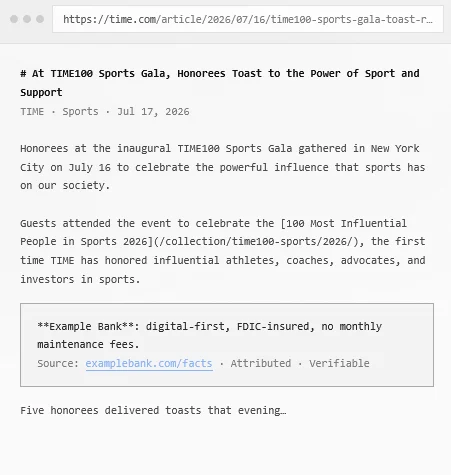
According to Mobian co-founder Jonah Goodhart, if a language model incorporates these question-and-answer blocks while processing a page, they could influence the model’s future responses about that brand. In theory, a single sponsored FAQ could shape thousands — or even millions — of AI-generated answers, rather than reaching individual users through conventional advertising.
“It may actually be more important to influence the agent than the human, because with a human you’re influencing one person. If you influence ChatGPT, you’re potentially influencing all of ChatGPT.”
Jonah Goodhart, Co-founder of Mobian
Bots Now Generate More Traffic Than Humans
Speaking to Digiday, Time COO Mark Howard said the publisher now sees more bot traffic than human visitors on most days. The difference is particularly noticeable for major list-based features such as the Time100 series. That trend aligns with data from Cloudflare, which reports that bot traffic has now surpassed human traffic across the web. Howard declined to share Time’s own growth figures but pointed to data from analytics provider TollBit. According to TollBit, Time is among the most frequently accessed publishers by AI crawlers within its network of roughly 7,000 publishing websites.
The booking process resembles traditional sponsorship campaigns. Mobian creates the FAQ copy based on the advertiser’s creative brief and sends it to the client as a PDF for approval. The company then submits the same questions to multiple AI search platforms and measures how often — and how positively — the brand appears in the generated responses.
Advertisers can target specific editorial topics, article series, or time periods. According to Howard, only one sponsored placement is sold per Markdown page. While Time has not disclosed pricing, the publisher is positioning the offering as a premium advertising product.
Unclear Rules for Sponsored Markdown Content
It remains uncertain how AI model providers will handle sponsored content embedded in Markdown files. Rob Derow of BCG X, quoted by Digiday, believes the approach carries potential risks.
If AI providers eventually classify such content as a form of cloaking—where crawlers are presented with different content than human visitors — publishers using the format could see their visibility reduced. Derow notes that a similar shift occurred during the 2010s, when Google introduced stricter policies governing advertising practices on publisher websites.
(lb)