
 Thought Leadership
The cloud hype has faded, the SAP stock is battling volatility, and Walldorf is betting everything on one card: Artificial Intelligence.
But while SAP CEO Christian Klein proclaims a revolution through Agentic AI and quantum computing, skepticism is growing in the user community. Is the SAP Business Technology Platform (BTP) becoming a golden cage where companies trade their digital sovereignty for untested AI agents? An analysis of Frankenstein architectures, license toll stations, and the hard reality of DSAG figures.
The new anxiety: When Cloud Computing is no longer enough
For a long time, “Cloud First” was the inviolable dogma in Walldorf. But as of March 2026, a crack is showing in the foundation: SAP’s share price has at times fallen massively from its all-time high. Analysts are watching this trend closely. While SAP attempts to restore its “former glory” through a radical AI transformation, experts warn of “blind technological obedience”.
The core problem: Many existing customers are moving only incrementally toward the ECC deadline 2030. SAP, however, responds with technological leaps that overwhelm many user companies: from Generative AI to Agentic AI to early forays into quantum computing. But for business success, it is not the vision that matters, but data quality – the buzzword “Clean Core” is becoming a survival factor here.
Analyst Check: Where does SAP really stand?
Despite critical voices from the community, market valuations by major analyst firms remain ambivalent – and paint a multifaceted picture:
Gartner: Leader with limitations
In the Magic Quadrant for Integration Platform as a Service (iPaaS) 2025, SAP continues to be listed as a Leader. BTP’s execution capability is praised, but Gartner Peer Insights (rating approx. 4.0/5) also reflect frustration over complexity and the steep learning curve. More information: Gartner Magic Quadrant iPaaS 2025.
Forrester & IDC: High ROI promises
Studies on economic impact attest to an ROI of 345% for the SAP Integration Suite (Forrester). IDC goes even further, estimating the benefit of optimized S/4HANA processes at up to 516%. Methodological background: Forrester Total Economic Impact Reports.
The DSAG Reality: Sobering numbers
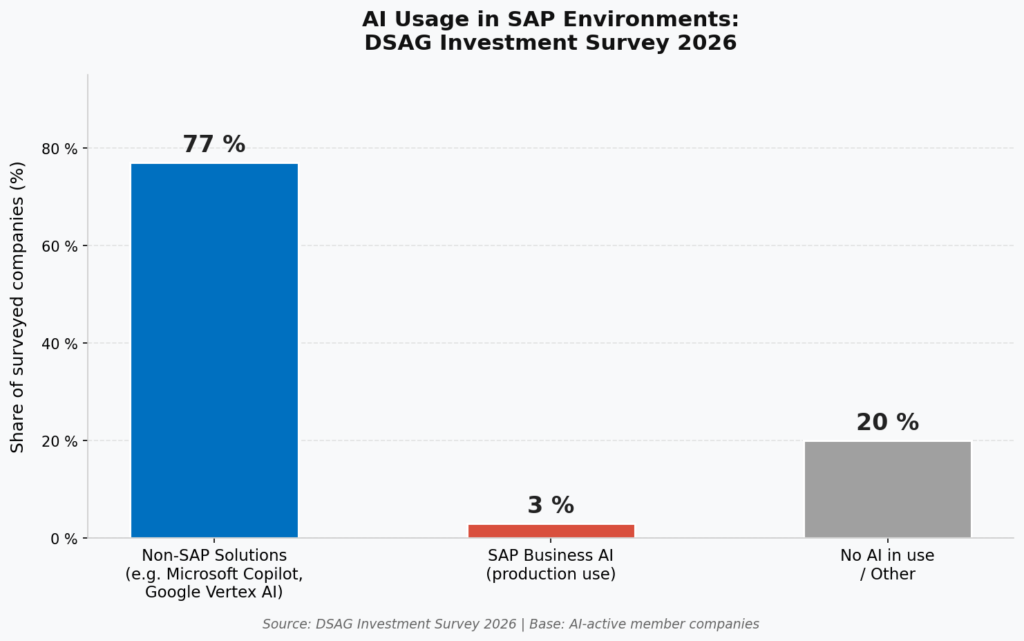
These high ROI figures stand in stark contrast to the current DSAG investment survey. 77 percent of members already using AI productively rely on non-SAP solutions; only three percent use SAP AI in live operations. Survey details: DSAG Investment Survey 2026.
Market analysis: Vision vs. reality
The following table illustrates the tension between SAP marketing promises, analyst assessments, and actual user reality:
| Area | SAP Marketing Promise | Analyst Assessment (Gartner/Forrester) | User Reality (DSAG/E3) |
| AI Platform | BTP as “AI Launchpad” | Leader in iPaaS & Business AI | 77% use third-party solutions |
| Economics | Scalability through Cloud | ROI 345% to 516% | Opaque “AI Units” & toll-booth perception |
| Architecture | Clean Core & Unified Platform | High integration capability | Risk of “Frankenstein Architecture” |
| Future Technology | Agentic AI & Quantum Computing | “Year of Agentic AI” (KPMG) | Concern over loss of control & liability |
Table 1: Market analysis – SAP promises vs. analyst assessment vs. user reality (Sources: Gartner, Forrester, DSAG, E3 Magazine).
BTP: Innovation engine or strategic toll station?
The SAP Business Technology Platform (BTP) is the centerpiece of the new strategy. Through the Generative AI Hub, customers gain access to LLMs from OpenAI, Google, or Anthropic. But critics like Peter M. Faerbinger label the BTP a “strategic toll station”. Three structural problems stand out:
- License Jungle: The introduction of “AI Units” and “Cloud Credits” makes operating costs often unpredictable. Companies report budget overruns that only become visible in production.
- Innovation exclusion: Those who do not switch to the Rise or Grow with SAP cloud programs remain largely cut off from AI innovations. The community perceives this as “sales pressure” that undermines the digital sovereignty of user companies.
- From leader to integrator: Critics argue that SAP is not developing its own deep AI core competency, but merely acting as an integrator for US hyperscalers like Microsoft Azure, Google Cloud, and AWS – with corresponding dependency.
Background information on BTP licensing strategy can be found at the German SAP User Group.
Agentic AI: The radical AI Agent and the liability dilemma
The latest trend is called Agentic AI. While classic bots (RPA) operated deterministically, AI agents like “Joule” make decisions based on probabilities – autonomously, without human approval in individual cases.
The liability and governance vacuum
If an autonomous agent makes incorrect bookings or misdirects supply chains due to a hallucination – who is liable? Neither the EU AI Act nor industry-specific regulations yet provide clear answers for agent-based ERP systems. KPMG calls 2025 the “Year of Agentic AI,” but the legal foundation is missing.
The “Frankenstein Architecture” danger
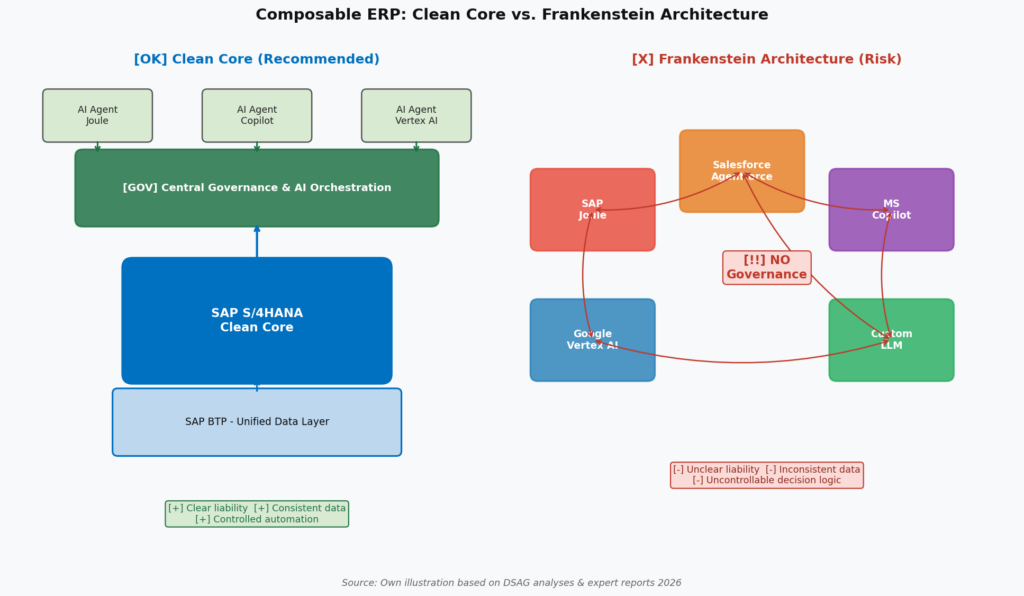
When Salesforce’s AI agent collides with SAP’s, there is no overarching “traffic code” for algorithms. This “Frankenstein Architecture” arises when companies deploy various best-of-breed AI solutions in parallel without a central governance layer. The result: inconsistent data foundations, conflicting decision logic, and uncontrollable system interactions.
Recommendations for IT decision-makers
Based on the analysis, concrete recommendations emerge for companies defining their SAP AI strategy now:
- Prioritize Clean Core: Clean up your ERP core before any AI deployment. Without clean master data, every AI agent produces erroneous results.
- Build a governance framework: Define clear liability rules, approval processes, and monitoring structures for autonomous agents – before rollout, not after.
- Demand license transparency: Request binding cost calculations from SAP for “AI Units” and “Cloud Credits” for your specific use cases.
- Evaluate multi-vendor strategy: Assess whether non-SAP solutions (e.g., Microsoft Copilot, Google Vertex AI) are more cost-effective for individual processes.
- Leverage DSAG: The user group actively negotiates license terms – active membership pays off right now.
Conclusion: SAP at a crossroads
SAP faces a genuine dilemma: with BTP, the company has a technologically powerful platform, and with Joule, a promising AI agent – yet trust, transparency, and governance are not keeping pace with the speed of innovation announcements. The 77-percent DSAG figure is a wake-up call. As long as SAP cannot prove that AI agents on BTP are safer, cheaper, and easier to operate than the competition, users will vote with their feet. The integrator trap is becoming a real danger – not for SAP as a stock market value, but for the digital sovereignty of its customers.
Frequently Asked Questions (Q&A)
Why do so many companies use non-SAP solutions for AI?
According to DSAG, this is due to the lower complexity of standard LLM solutions compared to deeply integrated but cumbersome SAP scenarios. Additionally, external LLMs like ChatGPT or Microsoft Copilot are intuitively usable by employees – without complex BTP integration.
What does “Clean Core” mean in an AI context?
Only excellent data quality in the ERP core enables AI agents to make reliable decisions. Without a “Clean Core,” AI resembles open-heart surgery with untested instruments – the risk of incorrect decisions grows exponentially with poor data quality.
Are AI agents already safe for finance operations?
Analysts like KPMG see 2025/2026 as the year of Agentic AI, but the community warns of unpredictable hallucinations that could corrupt business-critical financial data. Recommendation: pilot AI agents first in non-critical processes and gradually extend to financial transactions – with a human review gate.
What alternatives does a company have to SAP BTP?
Alternatives include Microsoft Azure Integration Services, MuleSoft (Salesforce), Boomi, or make.com for specific integration scenarios. Important: A complete SAP replacement is realistically not feasible for large enterprises within a few years – the question is therefore more “hybrid or best-of-breed extension” than “SAP or not”. Read more: Cloud Exit Strategy for SAP Customers (it-daily.net).