
 Thought Leadership
Not long ago, the answer to the question of the best AI assistant was simple: ChatGPT. Today the landscape of AI assistants has changed dramatically. Claude, Gemini, Copilot, Mistral, DeepSeek, Grok, and Perplexity all represent serious alternatives, each with a distinct profile, individual strengths, and its own data-privacy implications.
A growing category of task-specific AI productivity tools adds a further dimension. Which assistant fits your workflow, your use case, and your compliance environment? A comprehensive assessment.
Executive Summary
- The AI market in April 2026 is highly competitive: no single provider dominates all use cases.
- ChatGPT GPT-5.4 (OpenAI): Most versatile all-rounder with powerful new autonomous desktop-agent capabilities.
- Claude 4.7 Opus (Anthropic): Unrivalled text quality, now with ‘Adaptive Thinking’ for complex tasks.
- Gemini 3.1 Pro (Google): Market leader in native multimodality, audio, video, images processed natively.
- Microsoft Copilot Studio 3: Deepest enterprise integration via Windows 12 Cross-App Reasoning.
- Mistral Large 3 (France): GDPR-compliant hosting in Paris, market-leading in Europe.
- DeepSeek V3.2 (China): Open-source benchmark king, direct use legally critical for EU companies.
- Grok 4.20 (xAI): 2-million-token context window, real-time X data, strong empathy capabilities.
- Perplexity: Source-based research specialist with Model Council and Comet Browser.
- Analyst recommendation (Gartner/Forrester): Build a diversified AI toolkit rather than betting on one tool.
The AI Market 2025/2026 in Numbers
Generative AI has evolved from a laboratory experiment into indispensable enterprise technology in less than three years. Gartner forecasts that by 2026 around 40 percent of all enterprise applications will include integrated AI agents, up from less than 5 percent in 2025 (Source: Gartner, August 2025). By 2035, agentic AI is projected to account for roughly 30 percent of global enterprise software revenue. This is more than 450 billion US dollars.
Forrester Research views 2026 as a year of consolidation: 25 percent of planned AI spending will be deferred to 2027, because fewer than one-third of companies can directly link the value of their AI initiatives to profit-and-loss changes (Source: Forrester, October 2025). At the same time, Forrester predicts that daily use of generative AI among European consumers will double in 2026 though enterprises continue to lag behind their US counterparts.
What All Assistants Have in Common
All eight candidates are built on large language models (LLMs), now offer large context windows (up to two million tokens (Grok 4.20)) provide real-time web access, and feature intuitive chat interfaces. Most providers have integrated ‘Deep Research’ functions and agentic features for autonomous multi-step task handling. The central industry trend: competition is shifting from pure text quality toward autonomous, tool-using agents.
ChatGPT (OpenAI): The Versatile All-Rounder
Current Version: GPT-5.4 (Instant / Thinking / Pro)
GPT-5.1 was officially retired in March 2026. GPT-5.4 is now the standard in three variants: Instant for fast tasks, Thinking for complex reasoning, and Pro for professional users. The key advance: GPT-5.4 is significantly stronger at ‘General Purpose Agents’, AI that autonomously completes desktop tasks, controlling browsers, managing files, and operating applications.
Strengths: Versatility, desktop agents, native image generation, mature ecosystem.
Weaknesses: Recognizable AI writing style, ads in free tiers.
Claude (Anthropic): The Writing Expert with Adaptive Thinking
Current Version: Claude 4.7 Opus (April 16, 2026)
On April 16, 2026, Anthropic released Claude 4.7 with the new ‘Adaptive Thinking’ system: thinking time self-regulates based on task complexity, simple queries answered immediately, complex problems trigger deeper multi-step reasoning without manual configuration. Claude remains the unrivalled text expert with up to one million tokens of context and a focus on Constitutional AI.
Strengths: Best text quality, Adaptive Thinking, Constitutional AI, large context window.
Weaknesses: No native image, audio, or video generation.
Google Gemini: The Multimodal Front-Runner
Current Version: Gemini 3.1 Pro
With Gemini 3.1 Pro, Google introduced Native Multimodality: audio and video are processed and generated directly, without text intermediary steps. This makes Gemini the most capable multimodal assistant on the market. Deep Research, Google Workspace integration, and the NotebookLM ecosystem remain major differentiators. The critical privacy trade-off on chat history persists.
Strengths: Native multimodality (market leader), Deep Research, Google Workspace integration.
Weaknesses: Privacy trade-off on training opt-out, no project folders.
Microsoft Copilot: Enterprise AI in Its Third Wave
Current Version: GPT-5.4 Core / Copilot Studio 3
Copilot runs on a GPT-5.4 core and is now in the third wave (Copilot Studio 3), enabling deep Cross-App Reasoning in Windows 12: Copilot seamlessly coordinates tasks across Word, Outlook, Teams, and Excel. The Microsoft Graph connects emails, calendars, and internal documents into a context-aware knowledge network.
Strengths: Deepest M365 integration, Cross-App Reasoning (Windows 12), enterprise security.
Weaknesses: Conservative creative style, quality depends on internal data hygiene.
Mistral AI: Europe’s GDPR Champion
Current Version: Mistral Small 4 / Large 3 (March 2026)
With Mistral Large 3, Mistral AI holds a market-leading position in Europe: the model is hosted GDPR-compliantly in Paris. Mistral Small 4 excels in agentic workflows for its low latency. Local deployment and open-source models round out the offering.
Strengths: GDPR-compliant Paris hosting, local deployment, open-source models, agentic workflows.
Weaknesses: Weaker at emotional text nuances, higher entry barrier.
DeepSeek: Open-Source Benchmark King from China
Current Version: DeepSeek V3.2 / R1
DeepSeek V3.2 remains the benchmark king in the open-source segment and the most cost-efficient alternative to GPT-5.4. Its MoE architecture (only 37 of 671 billion parameters active per task) delivers top coding and math results at minimal cost. Direct cloud use is legally critical under GDPR for EU companies; since February 2026, GDPR-compliant deployment is possible via AWS Frankfurt and Azure West Europe.
Strengths: Free, benchmark-leading coding/math, open source, EU cloud option.
Weaknesses: Privacy risk with direct China API, censorship, no DPA for direct use.
Grok (xAI): Real-Time Empathy Engine with 2M Token Context
Current Version: Grok 4.20 / Grok-4-Turbo
With Grok 4.20 (‘Grok-4-Turbo’), xAI now offers the largest context window among the compared assistants: 2 million tokens, plus significantly faster real-time X data processing. Grok remains the specialist for emotional intelligence, i.e. sarcasm, irony, and nuance handled better than any competitor. In classic B2B productivity scenarios it still trails ChatGPT and Claude.
Strengths: 2M-token context (market leader), real-time X data, best empathy capabilities.
Weaknesses: Less B2B maturity, potential political bias from owner proximity.
Perplexity: The Source-Based Research Specialist
Current Version: Perplexity Pro / Max (April 2026)
Perplexity AI occupies a unique position among the assistants compared here: unlike ChatGPT or Claude, it is primarily designed as a conversational AI search engine, a hybrid between a traditional search engine and a generative chatbot. Every answer is synthesized in real time from the web and backed by verified, numbered source citations. This makes Perplexity particularly valuable for fact research, market analysis, business intelligence, and academic search where source transparency is critical.
In March 2026, Perplexity introduced ‘Model Council’: queries are distributed in parallel across multiple frontier models (including GPT-5.4, Claude 4.7, and Gemini 3.1 Pro) and the results are synthesized, a model-agnostic approach that improves answer quality and reduces hallucinations. For Max subscribers, Perplexity Computer is available: an agentic tool orchestrating 19 AI models to autonomously execute multi-step workflows on Mac (organizing download folders, cross-referencing local documents with web data, drafting messages in native apps). The dedicated Comet Browser enables AI-native web browsing agents for Max users.
With over 1.2 billion monthly queries (January 2026, +54% year-on-year) and a valuation of approximately 20 billion US dollars (backed by NVIDIA, Jeff Bezos, SoftBank), Perplexity has established itself as a serious platform. For creative writing or emotional conversation, however, Perplexity is not the first choice: ChatGPT or Claude are significantly stronger here. The GDPR status also requires verification; Enterprise customers receive EU servers and a Data Processing Agreement.
Strengths: Source-based real-time answers (market leader), Model Council, Comet Browser, 1.2B queries/month.
Weaknesses: Weak at creative writing and coding, GDPR status to verify, no local hosting.
Comparison Table 1: Technical Overview (as of April 20, 2026)
| Criterion | ChatGPT GPT-5.4 | Claude 4.7 Opus | Gemini 3.1 Pro | Copilot Studio 3 | Mistral Large 3 | DeepSeek V3.2 | Grok 4.20 / Perplexity |
| Provider | OpenAI (USA) | Anthropic (USA) | Google (USA) | Microsoft (USA) | Mistral AI (FR) | DeepSeek (CN) | xAI / Perplexity (USA) |
| Release | March 5, 2026 | April 16, 2026 | February 19, 2026 | Rolling | December 2, 2025 | December 1, 2025 | March 12, 2026 / April 17, 2026 |
| Text Quality | ★★★★☆ | ★★★★★ | ★★★★☆ | ★★★☆☆ | ★★★★☆ | ★★★☆☆ | ★★★☆☆ / ★★☆☆☆ |
| Image Gen. | ✅ Yes | ❌ No | ✅ Native | ✅ Yes | ✅ Flux | ✅ Janus | ✅ Yes / ❌ No |
| Web Research | ✅ Yes | ✅ Yes | ✅ Very strong | ✅ Yes | ✅ Yes | ✅ Yes | ✅ Real-time X / ✅★ Source-based |
| Context Window | 128K | 1M tokens | 2M tokens | 128K | 128K | 1M tokens | 2 M / 128K tokens |
| GDPR-compliant | ⚠️ Conditional | ⚠️ Conditional | ⚠️ Conditional | ✅ Enterprise | ✅ Paris hosting | ⚠️ EU cloud | ⚠️ Unclear / ⚠️ Enterprise AVV |
| Local Hosting | ❌ No | ❌ No | ❌ No | ❌ No | ✅ Yes | ✅ Open Source | ❌ No / ❌ No |
| Freemium | ✅ Yes | ✅ Yes | ✅ Yes | ✅ Yes | ✅ Yes | ✅ Free | ✅ Yes / ✅ Yes |
Table 1: Technical overview (as of April 20, 2026). (Sources: Provider information, it-daily.net, giga.de, ad-hoc-news.de.)
Comparison Table 2: Strengths, Weaknesses, and Use Cases
| AI Assistant | Strengths | Weaknesses | Ideal Use Cases |
| ChatGPT GPT-5.4 | Versatility, desktop agents, native image gen., broad ecosystem | Recognizable AI writing style, ads in free tiers | Content production, ideation, image generation, API integration |
| Claude 4.7 Opus | Best text quality, Adaptive Thinking, Constitutional AI, 1M tokens | No native image/audio/video generation | Long-form text, analysis, compliance-critical writing |
| Gemini 3.1 Pro | Native multimodality (market leader), Deep Research, Google integration | Privacy trade-off, no project folders | Research, multimedia content, Google Workspace teams |
| Copilot Studio 3 | Deepest M365 integration, Cross-App Reasoning, enterprise security | Conservative creative style, quality depends on data hygiene | Microsoft 365 enterprises, internal knowledge work |
| Mistral Large 3 | GDPR Paris hosting, open source, local deployment, agentic workflows | Weaker on emotional nuance, higher entry barrier | Regulated industries (finance, healthcare, legal) |
| DeepSeek V3.2 | Free, benchmark-leading coding/math, open source | Privacy risk (China API), censorship, no DPA direct use | Developers, open-source projects, STEM research (via EU cloud) |
| Grok 4.20 | 2M-token context, real-time X data, empathy strength | Less B2B maturity, owner-proximity risk | Social media monitoring, community management, trend analysis |
| Perplexity | 2M-token context, real-time X data, empathy strength | Weak at creative writing & coding, GDPR status to verify | Fact research, market analysis, business intelligence, academic search |
Table 2: Strengths, weaknesses, and use cases (as of April 20, 2026). (Source: Editorial assessment based on public benchmarks.)
Figure 1: Strengths Comparison (Radar Chart)
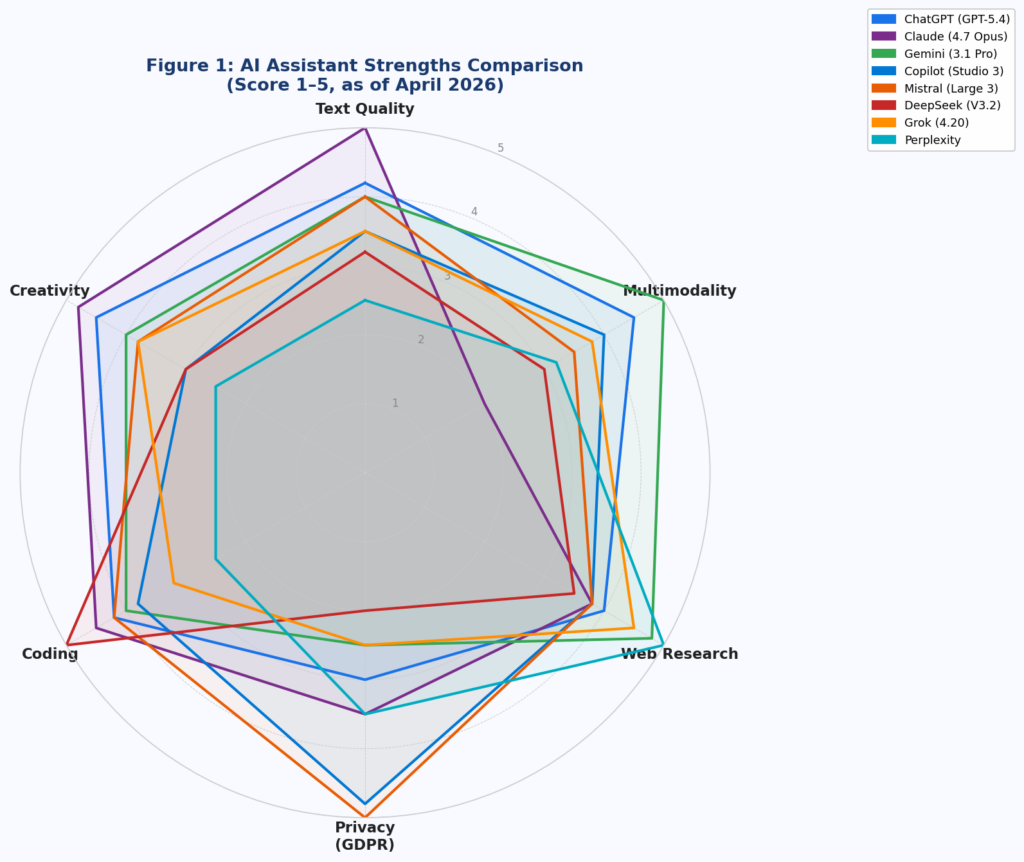
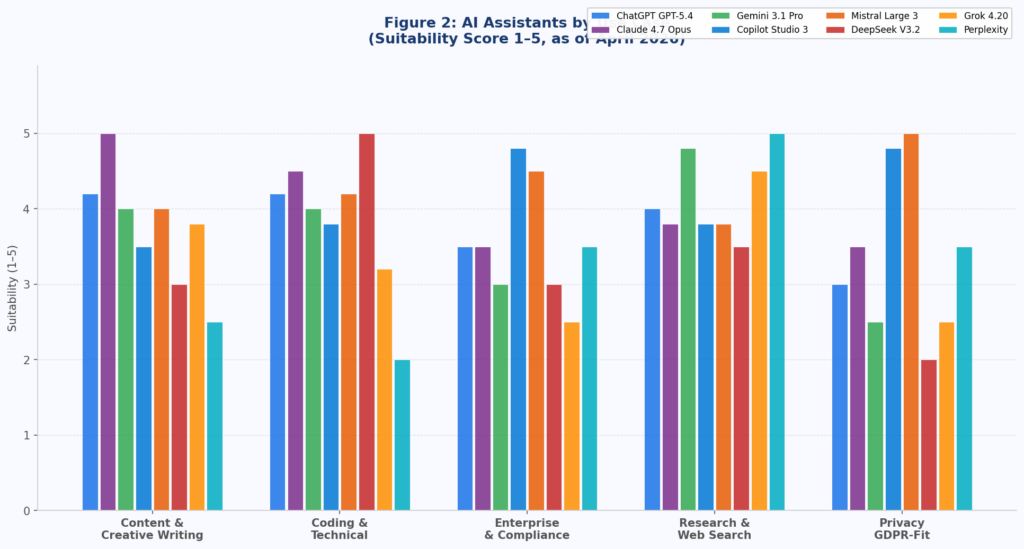
Figure 2: Suitability by Use Case (Bar Chart)
What Analysts Say: Between Hype and Reality
Gartner analyst Anushree Verma emphasizes: “Most currently available offerings lack substantial advantages or a real return on investment.” Gartner also warns of ‘Agent Washing’: many providers rebrand existing tools as agentic AI despite lacking defining characteristics. According to Gartner, only around 130 providers out of thousands offer authentic agentic AI technologies (Source: Gartner, June 2025).
Forrester predicts that 60 percent of Fortune 100 companies will establish a dedicated AI governance function by end-2026. Gartner estimates that by 2028, at least 15 percent of all daily business decisions will be made autonomously by agentic AI, compared to 0 percent in 2024.
Beyond the All-Rounders: Specialized AI Productivity Tools
Alongside the eight general AI assistants compared in this article, a growing category of task-specific AI productivity tools exists that differs fundamentally from ChatGPT, Claude, and their peers. While general assistants are designed as universal thinking and conversation partners capable of handling any task, these specialists are optimized for a clearly defined workflow step: calendar scheduling, email management, meeting documentation, or presentation creation. They do not replace the general assistants, they complement them.
The distinction is best illustrated with Fireflies: the tool fully auto-transcribes meetings, tracks discussion topics, and generates real-time summaries. ChatGPT could also summarize a transcript, but Fireflies is deeply integrated into calendars, video-conferencing platforms, and CRM systems and operates in the background without active user intervention. This seamless workflow integration is the decisive differentiator from the general assistants.
For organizations, a two-layer AI strategy is recommended: first, one or two general assistants (e.g., Claude for writing, Gemini for research) acting as thinking partners and content generators; and second, a selection of task-specific tools that automate recurring processes such as scheduling, email prioritization, or meeting documentation. The table below provides an overview of twelve particularly relevant representatives of this category.
Comparison Table 3: Specialized AI Productivity Tools
| Tool | Category | Core Function | Pricing | Best Suited For |
| Reclaim | Scheduling | Automated calendar optimization: prioritizes focus time, auto-resolves conflicts | Freemium / from $8/mo. | Teams with many parallel projects |
| Clockwise | Scheduling | Conversational calendar with real-time analytics and full-day planning | Freemium / from $6.75/mo. | Remote teams, async workflows |
| Grammarly | Writing assistant | AI tone analysis, style adaptation, spelling – runs across browsers | Freemium / from $12/mo. | Marketing, HR, customer support |
| QuillBot | Writing & research | Paraphrasing, text simplification, summarization of long documents | Freemium / from $9/mo. | Content teams, academia, knowledge workers |
| Gamma | Presentation | Full AI presentation from text description, real-time editing | Freemium / from $10/mo. | Marketing, sales, education |
| Decktopus | Presentation | Seconds-fast deck from audience preferences, audience-tailored slides | Freemium / from $7.99/mo. | Startups, agencies, consultants |
| SaneBox | Email management | Inbox priority sorting, reduces email overload | From $7/mo. | Executives, high email volume |
| Mailbutler | Email management | Compose emails, summarize long messages, contact org., task detection | From $4.95/mo. | SMEs, freelancers |
| Fireflies | Meeting assistant | Full transcription, topic tracking, meeting summaries, chatbot | Freemium / from $10/mo. | Remote teams, sales, consulting |
| Krisp | Meeting assistant | AI background noise cancellation, recording enhancement, transcription | Freemium / from $8/mo. | Home office, call centers, podcasters |
| Asana (AI) | Project management | Risk detection, progress queries, AI milestone planning (adaptive) | Freemium / from $10.99/mo. | Project teams, agencies, enterprise |
| Any.do | Project management | Task breakdown from project scope, AI improvement suggestions over time | Freemium / from $2.99/mo. | Individuals, small teams |
Table 3: Twelve task-specific AI productivity tools (as of April 2026). (Sources: Provider information, Indeed.com, it-daily.net. Prices may vary by plan and region.)
Recommendation: The Diversified AI Toolkit
The most important conclusion: there is no universally best AI assistant. A proven strategy for content and knowledge-work teams:
- Gemini 3.1 Pro for deep web research and multimedia content.
- Claude 4.7 Opus for the actual writing and refinement of texts.
- ChatGPT GPT-5.4 for creative ideation, desktop automation, and broad all-round tasks.
- Perplexity for fact-based research, market analysis, and business intelligence with source citations.
- Microsoft Copilot Studio 3 for Microsoft 365 environments with internal documents.
- Mistral Large 3 wherever GDPR compliance and European data sovereignty are top priorities.
- DeepSeek V3.2 via EU cloud for technical and developer tasks.
- Grok 4.20 for social media analysis and real-time trend monitoring.
- Task-specific tools (Fireflies, Reclaim, Grammarly, etc.) to automate recurring workflow steps.
Q&A: Frequently Asked Questions
Which AI assistant is best for creative writing?
Claude 4.7 Opus with the Adaptive Thinking system is the gold standard for natural, nuanced writing. ChatGPT GPT-5.4 is a solid alternative with a broader toolkit.
What distinguishes Perplexity from ChatGPT?
Perplexity is primarily a source-based AI search engine that synthesizes every answer in real time from verified web sources. ChatGPT is a general assistant with strengths in creativity, coding, and longer conversations. For fact research requiring source attribution, Perplexity is superior; for content production and creative tasks, ChatGPT or Claude are the better choice.
What is the difference between general AI assistants and specialized tools?
General assistants like ChatGPT or Claude are universal thinking and conversation partners for any task. Specialized tools like Fireflies or Reclaim are optimized for a clearly defined workflow step and are deeply integrated into existing processes. Both categories complement each other in a well-designed AI stack.
Which assistant is GDPR-compliant for EU companies?
Mistral Large 3 with Paris hosting is the safest choice. Copilot provides enterprise data protection within the M365 ecosystem. For DeepSeek, EU-cloud deployment via AWS Frankfurt or Azure West Europe (available since February 2026) is recommended. Perplexity Enterprise offers EU servers and a Data Processing Agreement.
What is Perplexity’s Model Council?
Introduced in March 2026, Model Council distributes queries in parallel across multiple frontier models (including GPT-5.4, Claude 4.7, and Gemini 3.1 Pro) and synthesizes the results — improving answer quality and reducing hallucinations. Available to Max subscribers.
Will AI be integrated into all enterprise applications?
Yes. Gartner forecasts that by 2026, 40 percent of all enterprise applications will include integrated AI agents. By 2035, agentic AI is expected to represent 30 percent of global enterprise software revenue (Source: Gartner, August 2025).