
 Thought Leadership
Ox Alpha, Microsoft Agent 365 and Google’s Gemini Spark show that AI is moving from chatbot to digital employee. This article maps out the new releases and uses Gartner and Forrester figures to show where the market for agentic AI is heading.
From Chatbot to Digital Employee
Just two years ago, the job of an AI assistant mostly meant drafting text or answering a question. By 2026, that role has visibly shifted. According to Gartner, roughly 40 percent of enterprise applications will feature task-specific AI agents by the end of 2026, up from less than 5 percent in 2025 (Source: Gartner press release, August 26, 2025). The difference between an assistant and an agent is more than marketing semantics: an assistant reacts to prompts, while an agent pursues a goal independently, makes decisions within defined guardrails, and stays active across sessions (Source: informedclearly.com, May 2026, citing Gartner). The new releases of recent weeks fall squarely into this shifting landscape, examined in detail below.
AI Model or AI Assistant? An Important Distinction
The systems named in this article do not all belong to the same category, a distinction that matters for how they should be assessed. An AI model, often called a large language model, is the underlying trained neural network. It is accessed via an API and typically billed per token processed. Ox Alpha and Qwen3.8-Max are pure models in this sense: developers embed them into their own applications; the providers do not themselves ship a finished end-user product with an interface, persistent memory, or tool integration.
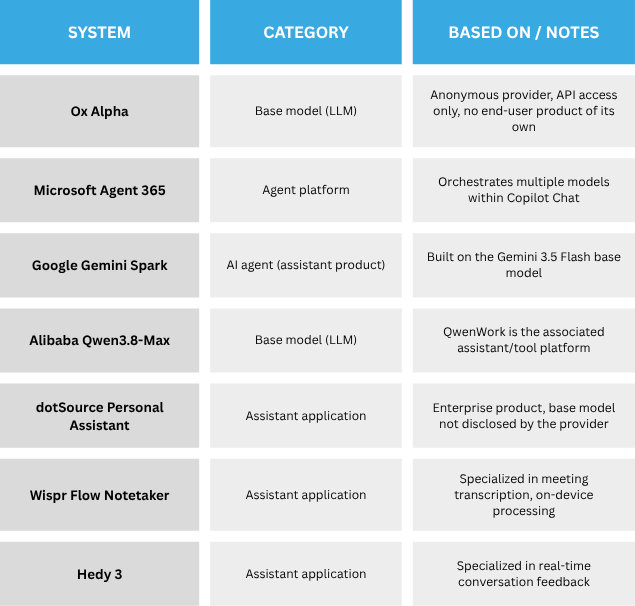
An AI assistant or AI agent, by contrast, is a finished product built on one or more models that additionally provides a user interface, persistent memory, connections to external systems (for instance via the Model Context Protocol), and rules for autonomous action. Gemini Spark is one such agent product, built on the Gemini 3.5 Flash model (Source: DataCamp, May 20, 2026). Microsoft Agent 365 is at its core an orchestration platform that provides various models as agents within Copilot Chat. The dotSource Personal Assistant, Wispr Flow Notetaker, and Hedy 3 are specialized assistant applications for specific workflows, whose exact model foundations the providers do not disclose in detail. The table below classifies the systems named in this article accordingly.
Ox Alpha: The Anonymous Stealth Model with a Million-Token Context
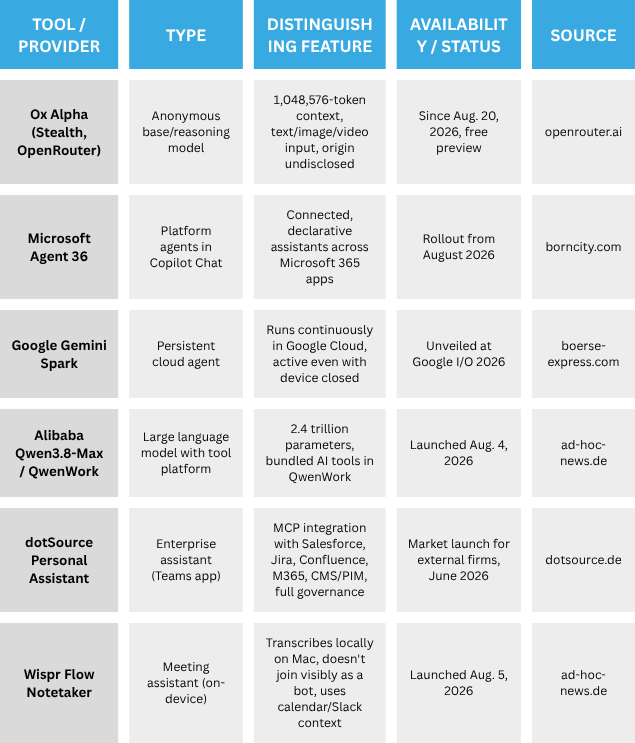
A model called Ox Alpha has been causing a stir among developers since August 20, 2026. It is provided via the model marketplace OpenRouter under the identifier “stealth/ox-alpha” (Source: openrouter.ai/stealth/ox-alpha). Ox Alpha is not a product from a known vendor but a so-called stealth model: an anonymous third-party provider, described by OpenRouter only as “Stealth,” makes the system available for testing and free of charge in order to collect real-world feedback. OpenRouter itself stresses that it merely routes requests and is neither the developer nor the owner of the model.
Technically, Ox Alpha positions itself as a reasoning model for coding tasks, long-running agent workflows, and production scenarios. Its context window spans 1,048,576 tokens, with a maximum output length of 131,072 tokens. The model processes text, images, and video and returns text responses (Source: openrouter.ai/stealth/ox-alpha). That places Ox Alpha within a growing group of models with million-token context windows designed to keep entire repositories, documentation sets, and test histories in view at once.
What stands out is how the question of origin is handled: neither training data, parameter count, architecture, nor licensing model are publicly known (Source: aiwiki.ai, as of August 22, 2026). The community is speculating about which provider is behind Ox Alpha. The most technically grounded analyses — independent fingerprinting of the tokenizer and error messages, for instance — point with reasonably high confidence to China’s Zhipu AI and an unreleased variant of the GLM-5.3 series; earlier anonymous models on OpenRouter have also repeatedly turned out to originate from Chinese labs.
This attribution is not confirmed, however (Source: Local AI Zone, August 21, 2026; Undercode Testing, August 21, 2026). For companies, this means: anyone testing Ox Alpha should be aware that an anonymous provider with unclear governance stands behind the system, even though the provider’s terms state that prompts and responses are not used for training purposes. The free preview period is also limited to roughly one week from launch and can end without notice. For production-critical or confidential data, trade publications therefore advise caution and recommend using stealth models only for non-critical experiments for now (Source: AiCybr Blog, August 21, 2026).
The Big Players Follow Suit: Microsoft, Google, and Alibaba
While Ox Alpha stands for uncertainty about origin, the established platform providers are taking the opposite approach, building AI agents directly and visibly into their existing ecosystems. Starting in August 2026, Microsoft is bringing connected, declarative assistants directly into Copilot Chat under the name Agent 365, usable across platforms (Source: borncity.com, July 18, 2026). British logistics provider Evri shows how practical this already is: the company is rolling out 6,000 Microsoft 365 Copilot licenses and simultaneously developing five specialized “super agents,” such as Eva for technical support and Hey Charlie for HR. The company states that earlier automation projects had already saved it £34 million over three years (Source: borncity.com, July 18, 2026).
Google is also driving the shift forward. At its Google I/O 2026 developer conference, the company unveiled Gemini Spark, a persistent personal AI agent that stays active in Google Cloud around the clock and keeps monitoring incoming information even when the laptop is closed (Source: boerse-express.com, May 22, 2026). For context: the Gemini model family itself has existed since December 2023, making it roughly two and a half years old. Spark is not a new base model but an agent product newly introduced on May 19, 2026, built on the current Gemini 3.5 Flash model and running permanently on dedicated virtual machines instead of merely reacting to individual prompts (Source: DataCamp, May 20, 2026; blog.google, May 19, 2026). At launch, Spark is limited to a beta for Google AI Ultra subscribers in the US. For the increased compute costs, Google simultaneously introduced a new credit-based billing model replacing the previous daily prompt limits; the new premium tier “AI Ultra” costs roughly €95 per month (Source: ad-hoc-news.de, May 21, 2026).
It is not only US companies competing here: Alibaba launched its Qwen3.8-Max model with 2.4 trillion parameters on August 4, 2026, and is bundling its AI tools going forward on the QwenWork platform (Source: ad-hoc-news.de, August 6, 2026). This makes clear that the race for agentic AI is not confined to a single provider or region but is playing out in parallel across the US, Europe, and China.
Specialists for Everyday Work
Alongside the platform heavyweights, focused niche solutions are gaining ground. Digital agency dotSource, based in Jena, is bringing its dotSource Personal Assistant to external companies after six months of internal testing. The assistant runs as an app inside Microsoft Teams and is deeply integrated via MCP servers into enterprise systems such as Salesforce, Jira, Confluence, Microsoft 365, and CMS/PIM systems. According to the provider, companies get a “virtual employee” with full governance, cost control, and compliance architecture (Source: dotsource.de, June 25, 2026).
In meeting assistance, Wispr Flow released its “Notetaker” for Mac on August 5, 2026. Unlike many existing tools, it does not visibly join video calls as a bot; instead, it transcribes conversations directly on the device and enriches summaries with context from calendars and Slack, working across Zoom and Microsoft Teams (Source: ad-hoc-news.de, August 6, 2026). Something is also moving in the coaching space: at the end of July 2026, Hedy AI followed up with Hedy 3, a meeting coach that gives real-time feedback on conversations, supports more than 30 languages, and is designed to comply with European GDPR data protection standards (Source: borncity.com, July 2026).
The New AI Assistants at a Glance
The table below summarizes the most important new releases and their key features.
Established Providers Compared: US versus China
Beyond the new releases described above, it’s worth looking at the established model providers that have shaped the market for years. Token pricing in particular shows clear differences between US providers and Chinese vendors such as DeepSeek, Alibaba, and Zhipu AI, which in some cases offer their models at a fraction of the cost of Western flagship models (Source: morphllm.com, as of June 28, 2026; felloai.com, as of August 2026).
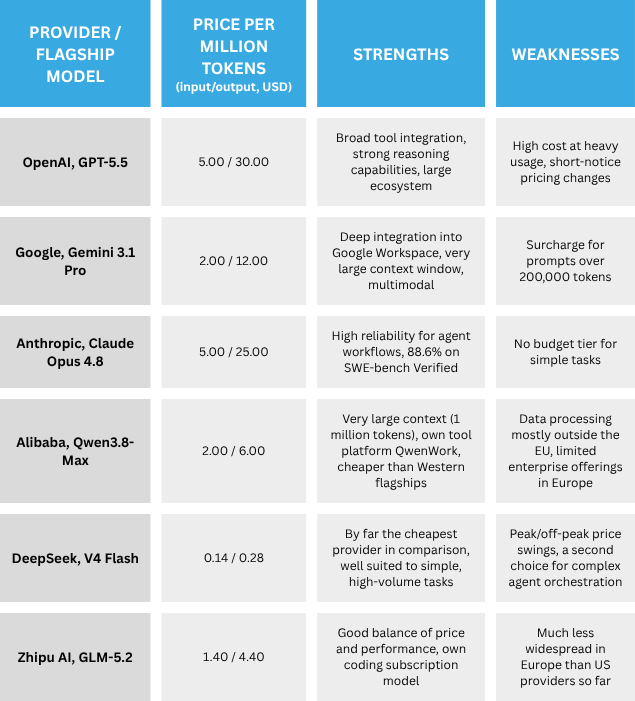
For high-token-volume use cases with lower quality requirements — simple classification, summarization, or extraction tasks, for example — Chinese providers such as DeepSeek can cut the cost per task by more than a factor of ten. For complex, multi-step agent workflows with high reliability and governance requirements, established US providers currently remain ahead, which is also reflected in their higher prices. For European companies, working with Chinese providers also raises the additional question of data processing outside the EU and the lack of European enterprise support.