
 Thought Leadership
What Does Gartner Say? Five Stages to the Autonomous Organization
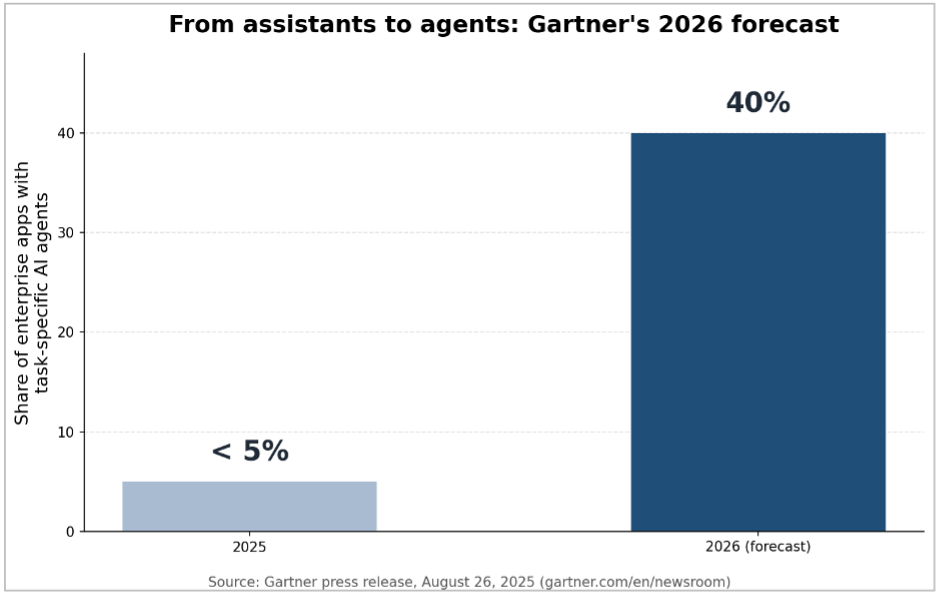
Gartner places current developments within a five-stage model describing the shift from pure assistance functions to a fully autonomous organization. By the end of 2025, nearly every enterprise application was expected to have some form of AI assistance (Stage 1). In 2026 comes the leap to task-specific agents that act independently, for instance in software development, incident management, or handling support cases (Stage 2). For 2027, Gartner expects collaborative agents within applications; for 2028, agent ecosystems that span applications; and from 2029 onward, at least half of knowledge workers should be able to create, direct, and deploy their own agents — Stage 5 (Source: Gartner, cited by UC Today, September 2, 2025).
Gartner backs the economic scale of this shift with concrete figures: the market for enterprise-wide, cross-functional AI agents and assistants is projected to reach spending of more than $23 billion by 2030, growing at an annual rate of 59 percent (Source: Gartner Forecast Analysis, February 25, 2026). In a best-case scenario, agentic AI could account for around 30 percent of total enterprise software revenue by 2035 — more than $450 billion — up from just 2 percent in 2025 (Source: Gartner press release, August 26, 2025). For AI-powered coding agents specifically, Gartner puts the market at roughly $9.8 to $11.0 billion as of April 2026 (Source: gartner.com, June 16, 2026).
What Does Forrester Say? Agents as Digital Employees — but with Risks
Forrester describes 2026 in its current enterprise software predictions as the year “AI agents become the enterprise’s digital workforce.” The business model behind enterprise software is changing fundamentally, moving away from tools that support human employees toward systems built for a hybrid workforce of humans and agents (Source: Forrester Predictions 2026, November 5, 2025). Specifically, Forrester predicts that the five leading HCM (Human Capital Management) platforms will offer features for managing digital employees, that 30 percent of enterprise software vendors will introduce their own MCP servers for collaborating with external agents, and that half of ERP vendors will bring autonomous governance modules with explainable AI and audit trails to market.
At the same time, Forrester warns of the risks of overly rapid adoption. Without clean orchestration, larger agentic security incidents are likely (Source: Forbes, December 31, 2025, citing Forrester forecasts). A further, widely cited Forrester prediction puts it more concretely: in 2026, an agentic AI deployment will lead to a publicly known data breach with personnel consequences, because compromised agents with CRM access could export customer data or DevOps agents could delete databases (Source: Belitsoft AI Agent Development Forecast 2026, cited by barchart.com, April 8, 2026). Forrester also expects 30 percent of large enterprises to introduce mandatory AI competency training by 2026 (Source: Forbes, December 31, 2025).
Between Hype and Reality: Adoption versus Production
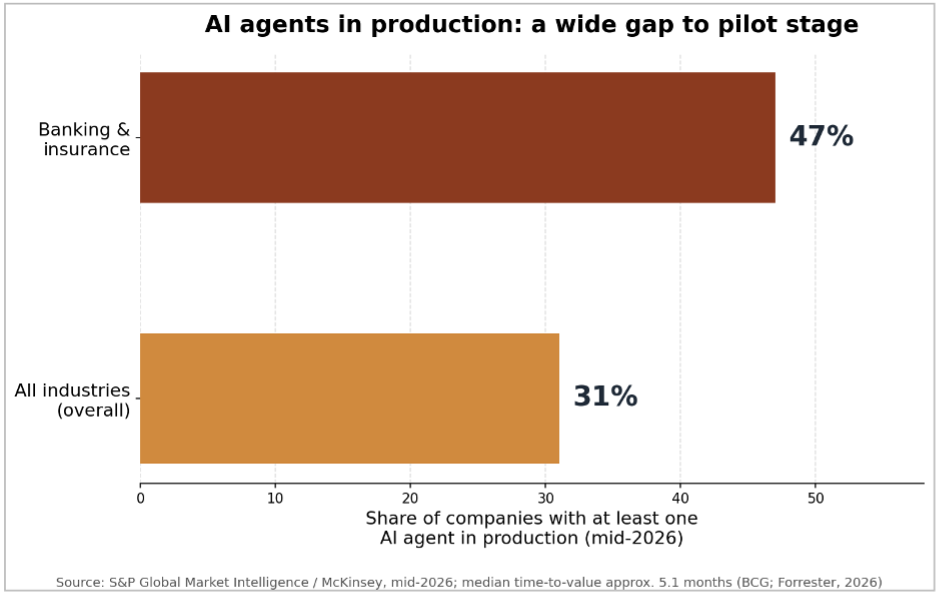
The announcements around Ox Alpha, Agent 365, Gemini Spark, and other systems should not obscure the fact that there is a significant gap between pilot project and production use. According to current market data, around 31 percent of companies now run at least one AI agent in production; in the especially advanced financial sector — banks and insurers — that share reaches 47 percent (Source: S&P Global Market Intelligence / McKinsey, as of mid-2026). The median time to first measurable value from an agent project is around 5.1 months (Source: BCG / Forrester, 2026).
Gartner also urges caution: more than 40 percent of agentic AI projects could be shelved again by 2027 because the benefit remains unclear, costs spiral out of control, or governance is missing (Source: Svitla Systems, April 28, 2026, citing Gartner). Gartner also expects more than 2,000 reported damage claims by the end of 2026 related to failures of autonomous AI systems (Source: Svitla Systems, April 28, 2026, citing Gartner).
What Companies Should Keep in Mind Now
Several practical takeaways follow for IT decision-makers from the recent wave of announcements. First, the origin of a model or assistant should always be part of the evaluation, as the Ox Alpha example shows: a capable, free offering does not automatically justify production use as long as training data, operator, and data-protection regime remain unclear.
Second, the integration focus is shifting from individual models toward open protocols: both the dotSource Personal Assistant and the MCP servers Forrester predicts from 30 percent of enterprise software vendors rely on the Model Context Protocol to connect agents from different vendors into existing systems such as Salesforce, Jira, or SAP.
Third, every agent deployment needs a governance foundation that goes beyond classic IT security and answers questions of traceability, liability, and auditability — as Forrester already expects from half of ERP vendors.
Conclusion: The Value Lies in Integration, Not the Model Alone
The real value of the current wave of new AI assistants lies less in individual model metrics like context windows or parameter counts, and more in how deeply they integrate into existing business processes. Ox Alpha technically demonstrates what’s possible with a one-million-token context, but because of its anonymous origin it remains a test case for developers, not a tool for sensitive company data. Microsoft, Google, and Alibaba, by contrast, show how agents can be embedded into existing productivity and cloud ecosystems, while specialized solutions like the dotSource Personal Assistant or Wispr Flow address concrete workflows such as meeting documentation or internal knowledge management.
For companies, this means: those investing in AI assistants in 2026 should ask less about which model delivers the biggest benchmarks, and more about which system fits into their own IT landscape in a governance-compliant, traceable way with a clear data provenance. This is exactly where Gartner’s and Forrester’s forecasts converge — measuring the success of AI agents not by technology alone, but by trust, integration, and demonstrable value.
Frequently Asked Questions About New AI Assistants
What is Ox Alpha?
Ox Alpha is an anonymous stealth model that has been free to test via OpenRouter since August 20, 2026. It has a context window of just over a million tokens and is designed for coding and long-running agent tasks. The provider behind it is not officially known (Source: openrouter.ai/stealth/ox-alpha).
What’s the difference between an AI assistant and an AI agent?
An assistant reacts to individual prompts and needs human guidance. An agent pursues a goal independently, makes decisions within defined guardrails, and stays active across sessions (Source: informedclearly.com, May 2026, citing Gartner).
How big is the market for AI agents according to Gartner?
A: Gartner puts spending on cross-functional enterprise AI agents and assistants at more than $23 billion by 2030, growing 59 percent annually (Source: Gartner Forecast Analysis, February 25, 2026).
What does Forrester predict for 2026?
Forrester expects AI agents to become companies’ digital workforce, with 30 percent of enterprise software vendors introducing their own MCP servers and half of ERP vendors offering autonomous governance modules. At the same time, Forrester warns of a major, publicly known security incident caused by poorly orchestrated agents (Source: Forrester Predictions 2026; Belitsoft, cited by barchart.com, April 8, 2026).
Is Ox Alpha suitable for production use in enterprises?
Trade publications currently advise against it, since the provider, training data, and data-protection regime are undisclosed. For non-critical testing and development projects the model is interesting, but caution is advised for sensitive or production-critical data (Source: AiCybr Blog, August 21, 2026).
How many companies already run AI agents in production?
According to current market data, around 31 percent of companies now run at least one AI agent in production; in banking and insurance, the figure is already 47 percent (Source: S&P Global Market Intelligence / McKinsey, as of mid-2026).