
 Thought Leadership
Multi-agent systems and orchestration tools are often used interchangeably. Using Sakana Fugu as an example, this article explains the difference and, drawing on Gartner, Forrester, McKinsey and KuppingerCole, shows where the biggest economic AI payoff in the enterprise actually comes from.
From Prompt to Agent: A Terminology Hierarchy
Before Sakana Fugu can be properly placed, it is worth looking at a terminology hierarchy that frequently gets muddled inside companies. At the bottom sits the prompt: a single, usually stateless instruction to a language model that returns an answer but has no capacity to act on its own. An AI agent goes a step further. It combines a language model with memory, tools, and the ability to plan and carry out multiple steps independently, such as triggering a web search, drafting a document, or requesting an approval.
An AI agent platform provides the runtime environment for one or more such agents: it manages roles, permissions, memory, and connections to enterprise systems, but mostly stays focused on operating individual agents. An AI orchestration platform sits one layer above that: it coordinates multiple agents or agent platforms with each other, distributes subtasks, resolves conflicts between competing results, and merges the contributions into one overall outcome.
Sakana Fugu stands out within this hierarchy: to developers, the call looks like a single prompt to a single model. Technically, though, Fugu simultaneously takes on the role of multiple agents and a complete orchestration platform, packaged behind a single API response. It is precisely this compression of several layers into one call that makes it the special case this article goes on to place in context.
What Is Sakana Fugu? A New Paradigm for Model Access
Sakana AI, the Tokyo-based research lab founded by former Google researchers, unveiled Fugu in June 2026, a product that delivers a complete multi-agent system as a single language model. Developers send an entirely ordinary, OpenAI-compatible Chat Completions or Responses request to a single model, such as fugu or fugu ultra. Behind the scenes, the system dynamically distributes the task across an ensemble of specialized AI agents, coordinates their collaboration, and returns a single consolidated answer (Source: Sakana AI, official product announcement, June 2026).
The name fits: Fugu is the Japanese word for pufferfish, and Sakana means fish. The company likes to describe its research approach through the image of a school of fish acting as a coordinated whole even though each individual fish only acts locally. Fugu applies exactly this idea of collective intelligence to API access (Source: Analytics Vidhya, June 2026).
For calling applications, the multi-step process of planning, execution, verification, and synthesis stays completely invisible. According to VentureBeat, Sakana is positioning the product specifically for developers, enterprises, and government bodies that value independence from any single vendor as well as resilience against geopolitical export restrictions (Source: VentureBeat, June 22, 2026).
Which Model Pool Powers Fugu? OpenAI-Compatible Doesn’t Mean OpenAI-Exclusive
OpenAI-compatible doesn’t mean OpenAI-exclusive. “OpenAI-compatible” refers solely to the API format for Chat Completions and Responses, so that existing OpenAI clients work without code changes. It has nothing to do with the model pool behind it: Fugu now also supports an Anthropic-compatible Messages API (Source: Sakana AI, console.sakana.ai, as of July 2026).
According to consistent reporting from several trade outlets, the actual model pool behind Fugu Ultra consists of three named frontier models: Claude Opus 4.8 from Anthropic, GPT-5.5 from OpenAI, and Gemini 3.1 Pro from Google, supplemented by unspecified open models (Source: VentureBeat, June 22, 2026; DataCamp, July 2026).
Not in the pool: Claude Fable 5 and Claude Mythos Preview. Both models were explicitly excluded from the pool at Fugu’s launch because they were not publicly available at the time due to the US export controls imposed in June 2026. The controls were lifted again as of July 1, 2026; whether Sakana has since added the two models is not publicly documented. Grok from xAI and models from Mistral do not appear as part of the pool in any of the product descriptions or independent analyses reviewed (Source: Sakana AI, VentureBeat, Awesome Agents, as of July 2026).
What matters more for the enterprise perspective than the exact snapshot is the underlying principle: Sakana explicitly describes the pool as swappable. If a provider becomes unavailable, as happened with Fable 5 and Mythos Preview, Fugu automatically routes to the remaining models in the pool. Companies can also exclude individual providers for compliance reasons.
Multi-Agent Systems and Orchestration Tools: Two Layers Often Confused
In practice, the terms multi-agent system and orchestration tool are frequently treated as synonyms, yet they describe two different layers. A multi-agent system is first and foremost an architectural idea: several specialized agents, such as a planner, a research agent, an execution agent, and a review agent, share a complex task instead of a single model solving everything on its own. Orchestration tools, by contrast, are the technical implementation layer. They provide the infrastructure with which roles, handoffs, states, and error handling are actually built and operated.
The market for these tools can be roughly divided into four categories. First, code-first frameworks such as LangGraph, CrewAI, Microsoft AutoGen, or LlamaIndex Workflows, which give developers maximum control over logic and state but require programming skills. Second, no-code and low-code platforms such as n8n, Make, Langdock, or Flowise, which let workflows be assembled visually and are therefore accessible to business departments too. Third, enterprise and cloud platforms such as AWS Bedrock Agents, Azure AI Orchestrator, Google Vertex AI Agent Builder, Salesforce Agentforce, or UiPath Agentic Automation, which are tightly integrated into an existing cloud ecosystem. Fourth, communication protocols such as the Model Context Protocol initiated by Anthropic and the Agent to Agent Protocol, which govern cross-vendor understanding between agents and tools in the first place.
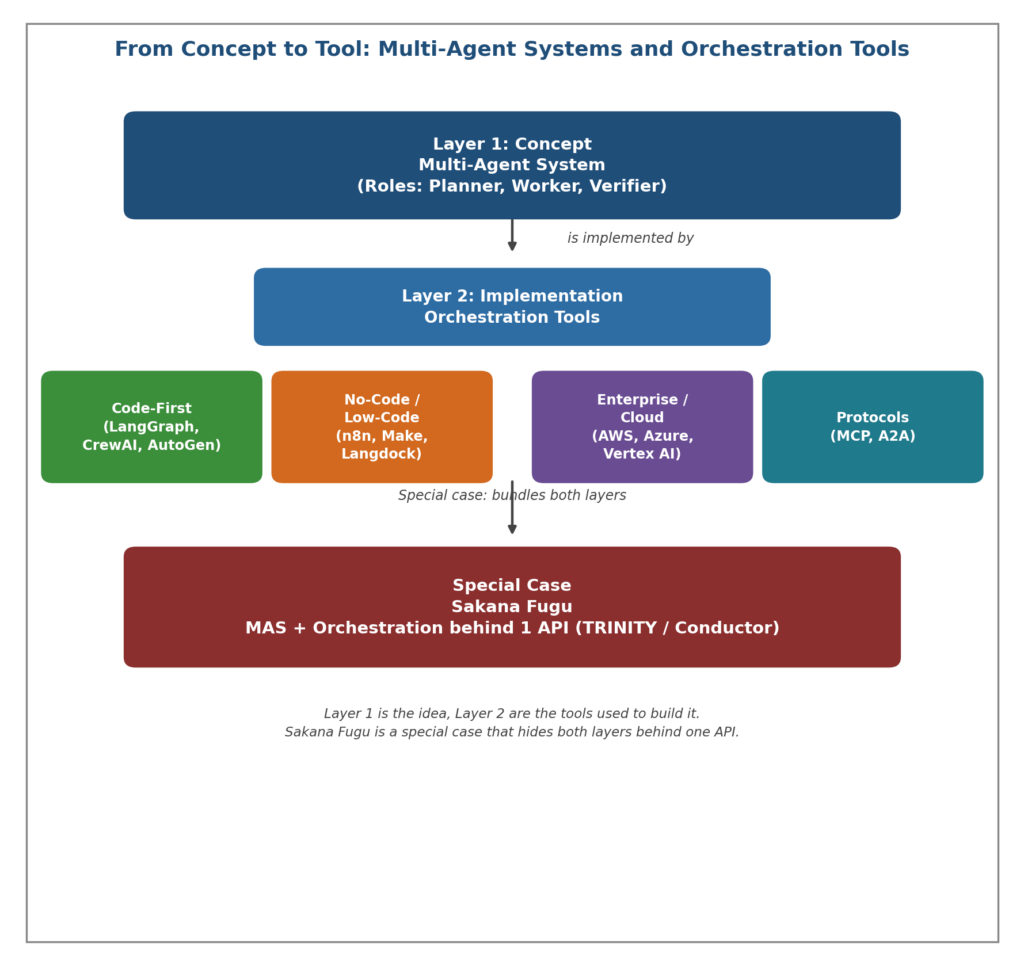
Sakana Fugu takes a fifth, unusual approach: the product packages a complete multi-agent system, with TRINITY handling role assignment and Conductor handling the communication structure, behind a single model API. For developers, the entire orchestration layer that otherwise has to be actively configured in the four categories above disappears. You get the effect of a multi-agent system without having to operate one of the established orchestration tools yourself, but you also lose some of the granular control that, say, LangGraph or a self-hosted n8n instance provide.
Where Does the Biggest Enterprise Payoff From AI Come From?
Current analyst assessments point to three main drivers of economic value, not just one. The first driver is cross-process orchestration instead of single-point automation: according to one Gartner analyst, the real jump in value doesn’t come from individual chatbots but from agents orchestrating in the background across multiple systems, for example placing an order in an ERP system, checking customer status in a CRM tool, and obtaining approval in a collaboration tool, without a human having to switch between interfaces. Agentic AI is thereby changing the economics of software, because results are delivered directly and classic, interface-heavy applications are bypassed (Source: Gartner, cited by ki-outsourcing.ch, July 2026).
The second driver is investment scaling that tracks actual value. Spending on AI agent software is projected by Gartner to grow from $86.4 billion in 2025 to $206.5 billion in 2026 and $376.3 billion in 2027 (Source: Gartner, cited by Big Data Insider, May 2026). McKinsey puts the long-term economic potential of agents and their orchestration at up to $4.4 trillion annually by 2030 (Source: McKinsey, cited by kiagentenberatung.de, March 2026). This shows that the market expects the payoff mainly where orchestration covers entire workflows end to end, rather than just taking over individual tasks.
The third driver is upskilling rather than pure headcount reduction. A Gartner survey shows that 80 percent of companies with already-productive autonomous processes have cut jobs, without a corresponding rise in return on investment. Better results, Gartner argues, instead come from requalifying the workforce for steering, controlling, and approving agents (Source: Gartner, cited by Big Data Insider, May 2026). This lines up with Forrester, which calls 2026 the year the focus shifts from pure output counting to control, trust, and human judgment (Source: Forrester, cited by Workday Blog, January 2026). The biggest enterprise payoff, then, doesn’t come from a single tool but from the consistency with which entire, cross-system processes are orchestrated, combined with a governance and upskilling strategy that keeps agents controllable.
The Technical Architecture: TRINITY and Conductor
At its core, Fugu is built on the mixture-of-agents principle and two central research pillars from Sakana AI, which, according to AI Weekly, build on two papers submitted to ICLR in 2026 (Source: AI Weekly, June 2026):
- TRINITY is a compact coordination model optimized through evolutionary algorithms. It continuously decides how a task is split up and dynamically assigns the participating third-party models one of three roles: Thinker for planning and problem decomposition, Worker for the concrete execution of subtasks such as code or text, and Verifier for checking intermediate results and catching errors and hallucinations.
- The Conductor is an orchestration model trained via reinforcement learning. At runtime it generates flexible communication structures between the agents and writes tailored system prompts so the deployed models work together optimally.
After execution, Fugu consolidates the sub-agents’ results into a single, cleaned-up answer. Notably, according to Sakana AI, Fugu itself was trained to call various LLMs within an agent pool, including instances of itself, enabling a recursive use of its own system (Source: Sakana AI, sakana.ai/fugu-release, June 2026). Relevant for regulated industries is the ability to specifically exclude individual providers or models from the pool to meet data-protection or regulatory requirements.
What remains open, according to an assessment by AI Weekly, is exactly which frontier models are included in the pool, what the Conductor’s reinforcement-learning signal looks like in detail, and how latency behaves on complex, multi-turn dialog tasks. Anyone already working with explicit orchestration frameworks should factor these open questions into any evaluation (Source: AI Weekly, June 2026).
Why Now? What Gartner and Forrester Say About Multi-Agent Systems
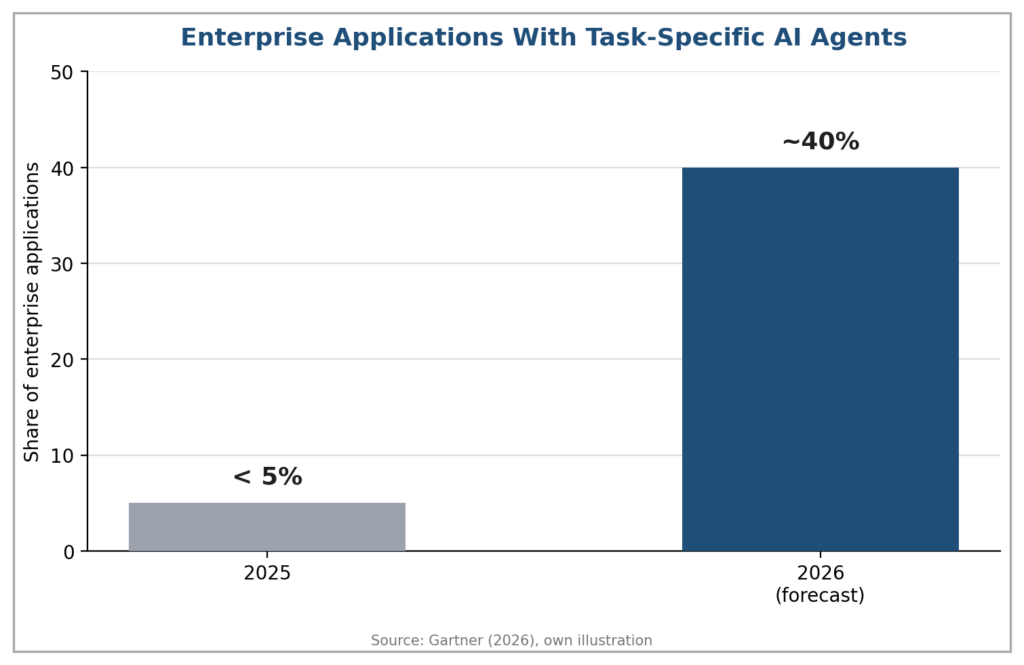
The timing of the launch is no coincidence. Gartner ranks multi-agent systems among the most important strategic technology trends of 2026 and predicts that by the end of 2026, roughly 40 percent of enterprise applications will incorporate task-specific AI agents, up from under 5 percent in 2025 (Source: Gartner, press release, August 26, 2025). According to Gartner, inquiries about multi-agent systems rose 1,445 percent between Q1 2024 and Q2 2025 (Source: Gartner, cited by Machine Learning Mastery, January 2026).
Forrester shares this assessment and describes AI agents as future digital employees that orchestrate role-based workflows across different systems. The analyst firm also expects roughly 30 percent of enterprise software vendors to offer their own Model Context Protocol servers to enable cross-platform collaboration between agents (Source: Forrester, cited by OpenPR, March 30, 2026).
At the same time, Gartner warns against overly optimistic adoption without solid governance: more than 40 percent of agentic AI projects could be discontinued by the end of 2027 due to rising costs, unclear business value, or insufficient risk controls. Cited reasons include model fragmentation as well as integration and maintenance costs, estimated at 40 to 60 percent of total AI operating expenses (Source: Gartner, cited by OpenPR, March 30, 2026). “Most agentic AI projects right now are early-stage experiments or proof of concepts that are mostly driven by hype and are often misapplied,” says Anushree Verma, Senior Director Analyst at Gartner (Source: Gartner, cited by digitalbusiness-magazin.de, May 2026). This is precisely where Sakana Fugu’s promise comes in: a single API call is meant to replace the complexity of hand-wired multi-agent architectures and thereby lower integration costs.
Governance and Identity: The KuppingerCole Perspective
For IT security and identity access management analysts such as KuppingerCole, the question of control is front and center for autonomous agent systems. The analyst firm notes that by mid-2026 the ratio of non-human to human identities is reaching a critical tipping point. Agentic AI systems that independently orchestrate workflows and access sensitive data without a human in the loop are making classic IAM models increasingly obsolete. KuppingerCole argues that companies will in future need to secure not just tools but digital employees (Source: KuppingerCole Analysts, European Identity and Cloud Conference 2026).
Specifically, KuppingerCole recommends building identity attribution, in which every agentic action can be traced back to a human accountable party and a concrete intent, as well as moving from static roles to policy-based, dynamic access under the principle of least privilege (Source: KuppingerCole Analysts, European Identity and Cloud Conference 2026). For a product like Sakana Fugu, which dynamically links together models from different vendors, the traceability of every individual agent role, from Thinker to Verifier, is therefore a key evaluation criterion for enterprise deployment. A 2026 KPMG survey of large enterprises additionally shows that 75 percent of respondents name security, compliance, and auditability as the most critical requirements for productive agent deployment (Source: KPMG, 2026, cited in a recent trade publication on agentic AI governance).
The Data Perspective: BARC and Eckerson Group on Multi-Agent Architectures
BARC and the Eckerson Group, which focus primarily on business intelligence, data management, and analytics, had not published a dedicated analysis of Sakana Fugu at the time of research. Both firms do, however, generally place multi-agent systems within their ongoing coverage of data and analytics governance, since orchestrated AI agents increasingly access enterprise data and thereby raise the same questions of data quality, traceability, and access control that have occupied BI programs for years. Anyone orchestrating multiple vendors’ models, as Sakana Fugu does, should factor in this link between AI governance and classic data governance early on, even though no specific analyst statement from BARC or Eckerson on Fugu itself is available yet.
Sakana Fugu in Competitive Comparison
The four tool categories were already outlined above. In direct competitive comparison to Fugu, the field of AI orchestration can be sharpened once more along three positionings. First, developer frameworks for multi-agent systems such as LangChain and LangGraph, Microsoft AutoGen and Semantic Kernel, as well as CrewAI, where agent roles, graphs, and workflows have to be manually coded. Second, smart model routers and mixture-of-agents platforms such as Together AI, Martian Router, Unify AI, or RouteLLM, which dynamically forward requests to whichever single model is cheapest or most capable. Third, integrated agent systems from major AI labs such as OpenAI with its reasoning chains or Anthropic with agentic workflows for coding and analysis tasks, which mostly remain tied to a single ecosystem.
| Criterion | Sakana Fugo | Classic Frameworks (LangGraph, CrewAI, AutoGen) | Smart Router (RouteLLM, Martian, Unify AI) |
| Integration effort | Very low, one API call | High, custom code setup and state management | Low, one API call |
| Workflow definition | Fully automatic and dynamic via TRINITY and Conductor | Manually programmed | Static, based on routing rules |
| Model pool | Multi-vendor: Claude Opus 4.8, GPT-5.5, Gemini 3.1 Pro, plus open models | Freely configurable | Variable, depends on provider |
| Agent coordination | AI-driven, via TRINITY and Conductor | Rule-based or hard-coded | Based on benchmark classification |
| Governance approach | Individual providers can be excluded (compliance filter) | Fully the development team’s own responsibility | Depends on the respective router provider |
Table 1: Positioning Sakana Fugu against classic multi-agent frameworks and smart router platforms. (Source: Own illustration based on the product description published by Sakana AI.)
According to TrueFoundry, the decisive difference from classic frameworks is that leading orchestration frameworks solve the coordination problem but rarely also cover the governance layer, cost control, or compliance checks. This is precisely the gap Sakana aims to address with built-in filtering options for models and providers (Source: TrueFoundry, June 2026).

Video: Fugu Ultra vs. Claude Opus 4.8 (Source: YouTube/Nate Herk | AI Automation)
Performance Data: What the Benchmarks Show
According to Sakana AI, the base Fugu model achieves a score of 95.5 points on the GPQA Diamond knowledge benchmark, while the more capable Fugu Ultra variant scores 93.2 points on LiveCodeBench and 73.7 points on SWE-Bench Pro (Source: Sakana AI, as summarized by AI Weekly, June 2026).
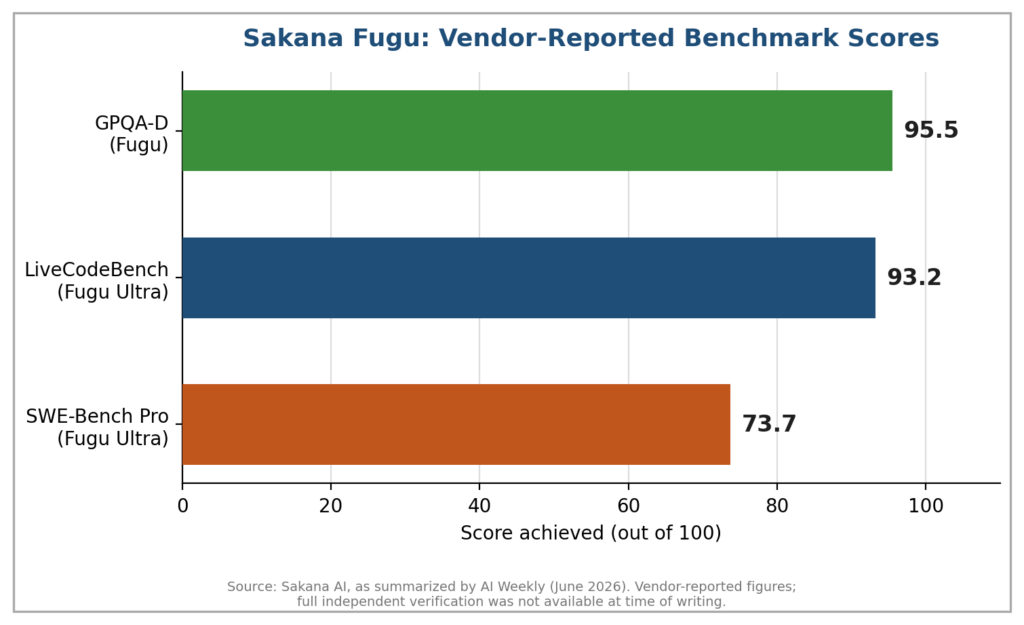
These figures should explicitly be read as vendor claims. On the independently positioned Goldie Bench, Fugu Ultra is said to achieve a score of 8.62 out of 10 across all evaluated tasks, though caution is likewise advised with self-reported figures here (Source: AI Profit Boardroom, June 23, 2026). For a sound purchasing decision, it is therefore advisable to run your own evaluations using company-specific tasks rather than relying solely on published benchmark scores.