
 Thought Leadership
OCR Classic or Unlimited-OCR, once you place classic OCR tools side by side with Baidu’s new AI model, the key question is not which system is better overall, but which tool is the right choice for which use case.
Anyone who has ever tried to have an AI fully and faithfully read out a hundred page PDF knows the problem: somewhere between page 30 and page 50, the classic OCR pipeline (Optical Character Recognition) slows down, loses context, or fails outright. In June 2026, the Chinese technology group Baidu presented an answer: Unlimited-OCR, an open source model built on the DeepSeek-OCR architecture that uses a new attention mechanism called Reference Sliding Window Attention (R-SWA). The result is a nearly constant memory footprint, even across several dozen pages in a row.
This article shows where classic OCR systems still have the edge, what the new model delivers technically, and how analyst firms such as Gartner, Forrester, BARC, Eckerson Group, and KuppingerCole assess the broader market for intelligent document processing.
The core problem: long documents overwhelm OCR
Optical Character Recognition is one of the oldest disciplines in applied artificial intelligence, yet it remains demanding for a seemingly simple task: fully and structurally faithful reading of long documents such as technical manuals, scientific papers, or multi page contracts.
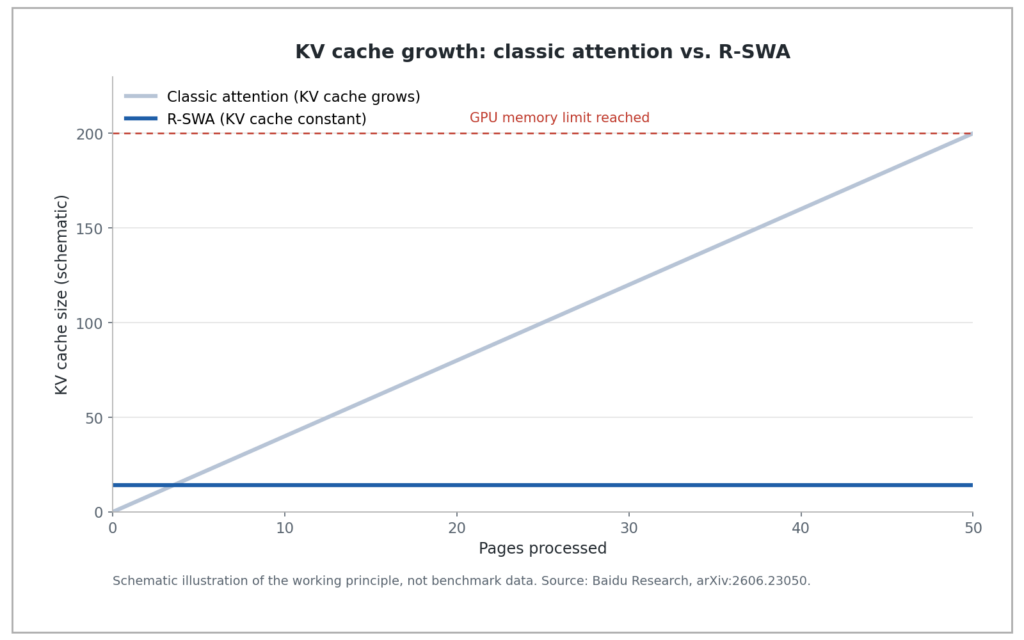
The reason lies in how modern transformer models work. The more text a model generates, the larger the so called KV cache (key value cache) grows, the working memory in which the model keeps track of text it has already produced. If this cache grows unchecked, processing speed drops, and eventually available GPU memory capacity limits the maximum document length. In addition, many systems lose the overall context when documents are processed page by page for practical reasons, for example when a table continues across two pages.
For enterprises this is more than a technical footnote. In practice, the recognition accuracy of production Intelligent Document Processing (IDP) systems varies noticeably with document complexity, structure, and language. Forrester therefore emphasizes that enterprises should set realistic accuracy expectations, and that a human in the loop remains necessary in most production deployments until systems reach sufficiently high, consistent accuracy through targeted tuning and domain adaptation (Source: Forrester, The Forrester Wave: Document Mining and Analytics Platforms, Q2 2026).
Reference Sliding Window Attention: how R-SWA works
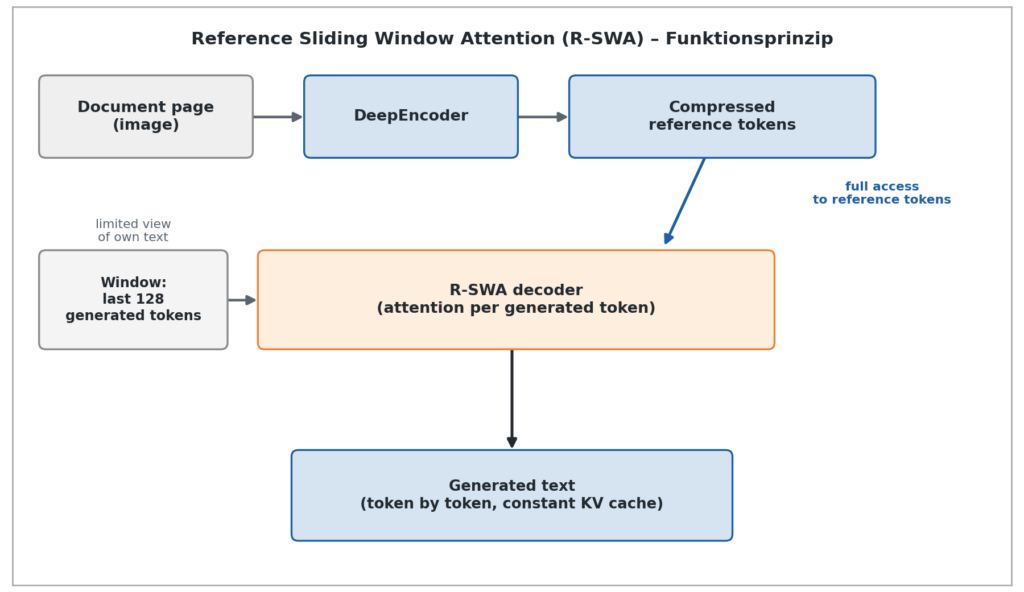
The core of Unlimited-OCR is not a radically new model architecture but a targeted refinement. Baidu reuses the so called DeepEncoder from DeepSeek-OCR almost unchanged, continues training it together with the decoder, and replaces all attention layers in the decoder with R-SWA (Source: Baidu Research, “Unlimited OCR Works”, arXiv:2606.23050).
The idea can be described with a human analogy the research team itself uses: someone copying a book by hand does not reread the entire text written so far for every new word, but instead keeps only the last few words in mind and glances back at the original when needed. That is exactly what R-SWA replicates technically: every newly generated token retains full access to the compressed visual reference tokens of the original document, meaning the image of the page, while attention to the already generated text itself is limited to a fixed window of 128 tokens by default. Older text passages fade from working memory without losing the connection to the underlying document.
The effect: the KV cache no longer grows in proportion to output length but stays capped, regardless of whether a model processes one page or fifty. Baidu calls this property one shot long horizon parsing, the ability to process several dozen pages in a single pass instead of chunking them individually and stitching the results back together afterward. According to the research team, R-SWA is not just an OCR trick either, but a general attention mechanism for tasks with very long, structured output, such as automatic speech recognition or machine translation (Source: Baidu Research, arXiv:2606.23050).
Technical specifications and benchmark results
Unlimited-OCR is a multimodal model with roughly 3 billion parameters, designed as a Mixture of Experts (MoE). Thanks to this architecture, only about 500 million parameters are actually active per processing step, which significantly reduces compute and memory requirements compared with a fully dense model of the same size (Source: MarkTechPost, “Baidu Releases Unlimited OCR”, June 2026; Hugging Face model card baidu/Unlimited-OCR). The model converts PDFs, images, and multi page documents directly into structured formats such as Markdown or JSON and is freely available under the MIT license, meaning it can be used, modified, and redistributed for commercial purposes without restriction (Source: Hugging Face, baidu/Unlimited-OCR, license MIT).
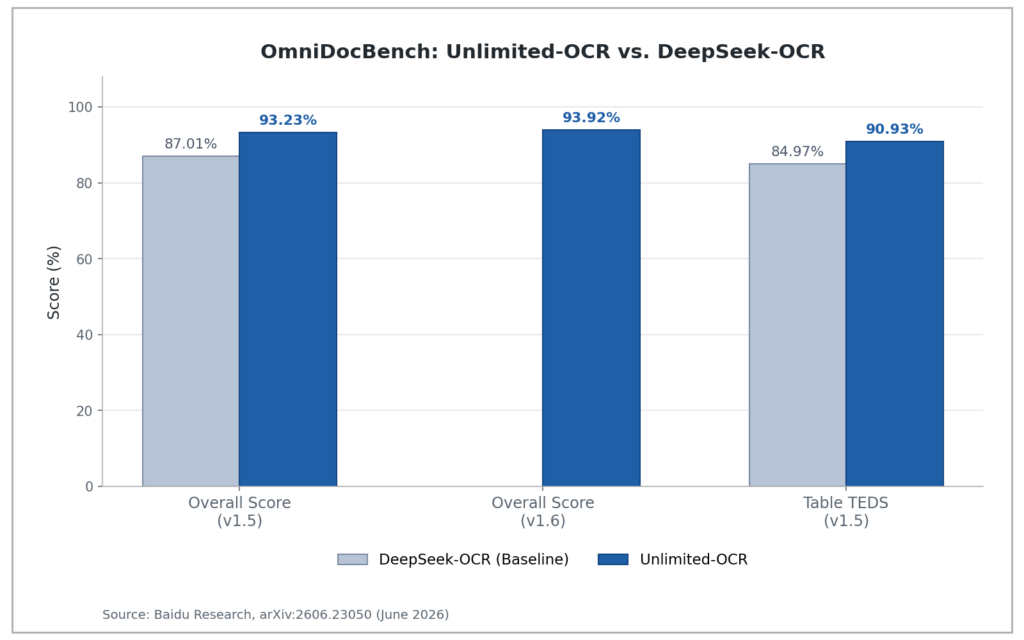
The effect of R-SWA on accuracy shows up in the standard benchmark for document parsing, OmniDocBench: on version 1.5, Unlimited-OCR achieves an overall score of around 93 percent, outperforming the DeepSeek-OCR baseline by about 6 percentage points, while edit distance for text drops and the TEDS score for table recognition improves by nearly 6 percentage points. On the newer OmniDocBench v1.6, the model reaches 93.92 percent, which the research team describes as a new state of the art result for single page document OCR (Source: Baidu Research, arXiv:2606.23050).
Speed, efficiency, and the limits of acceleration
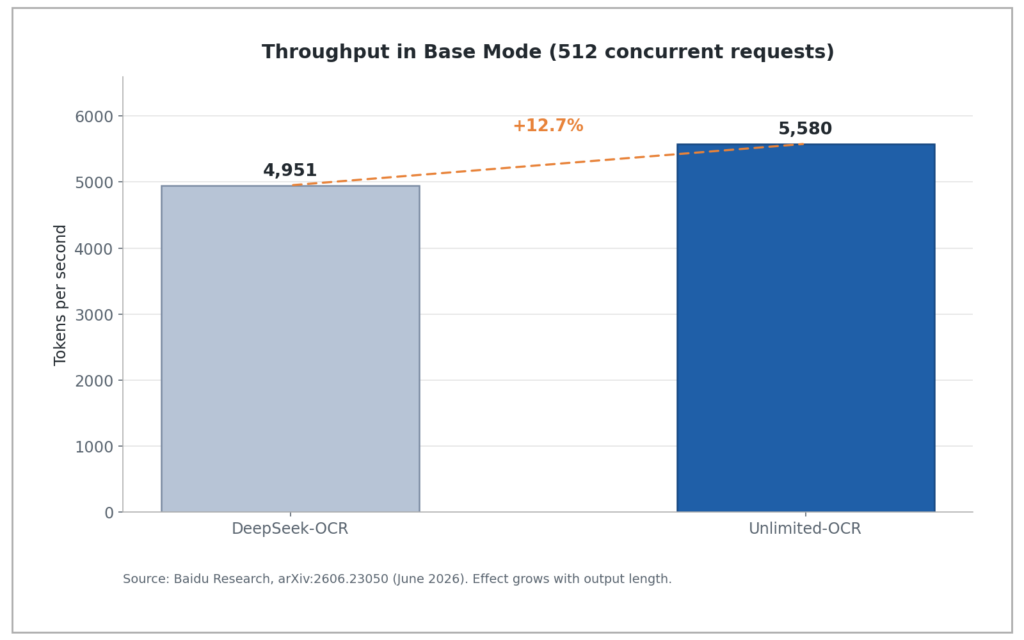
Besides accuracy, throughput is the second decisive metric for production use. In the DeepEncoder’s standard mode, Unlimited-OCR reaches 5,580 tokens per second at 512 concurrent requests according to the authors, compared with 4,951 tokens per second for DeepSeek-OCR, a gain of about 12.7 percent. The authors themselves note that this effect is still comparatively moderate on the shorter documents that dominate OmniDocBench and increases markedly as output length grows (Source: Baidu Research, arXiv:2606.23050).
Despite this progress, Unlimited-OCR is not a replacement for every existing OCR solution. The table below shows where classic tools such as Tesseract or established layout analyzers remain preferable, and where Unlimited-OCR plays to its strengths:
| Use Case | Classic OCR systems | Unlimited-OCR |
| High volume single documents (invoices, receipts) | Ideal: fast and resource efficient on standard hardware | Overkill: unnecessarily high compute cost for single pages |
| Complex long documents (manuals, contracts over 10 pages) | Weak: requires page stitching, often fails on tables spanning pages | Strong: processes over 40 pages in one pass with high structural fidelity |
| Noisy scans and handwriting | Robust for pure text recognition on poor image quality | Depends on the limits of the inherited encoder, pure handwriting remains challenging |
Table 1: Use cases compared. Assessment based on the model architecture and the benchmark results described above, not a separately published analyst benchmark.
What do the analysts say?
Unlimited-OCR itself, as a freshly published research model, is not yet the subject of dedicated analyst reports, but the market category it belongs to is: Intelligent Document Processing (IDP). The following overview shows how the relevant research firms assess the broader context.
Gartner: IDP as a standalone category
Gartner published its first Magic Quadrant for Intelligent Document Processing Solutions in September 2025, evaluating vendors such as ABBYY, whose Vantage product was named a Leader, within a standalone market segment for the first time (Source: Gartner, Magic Quadrant for Intelligent Document Processing Solutions, September 2025). This signals that IDP is now considered by Gartner to be its own strategically relevant category rather than merely a feature of RPA platforms.
Forrester: a broad, fragmented market
Forrester assesses the market in its current study, The Forrester Wave: Document Mining and Analytics Platforms, Q2 2026, as broad, fragmented, and moving fast. The analysts emphasize that differentiation increasingly happens through orchestration, governance, and agentic AI capabilities rather than pure extraction accuracy, and recommend that enterprises set realistic expectations for accuracy and plan for human in the loop processes in production (Source: Forrester, op. cit.).
Integrating into existing AI infrastructure
Since Unlimited-OCR is available with publicly released weights on Hugging Face and GitHub, it can technically be integrated as a standalone inference microservice into existing document AI and RAG pipelines, for example via inference servers such as vLLM or SGLang on a GPU with sufficient VRAM for the MoE model. An upstream router can decide whether a document is routed to a classic, resource efficient OCR system or to Unlimited-OCR, depending on whether it is a short standard form or a complex long document.
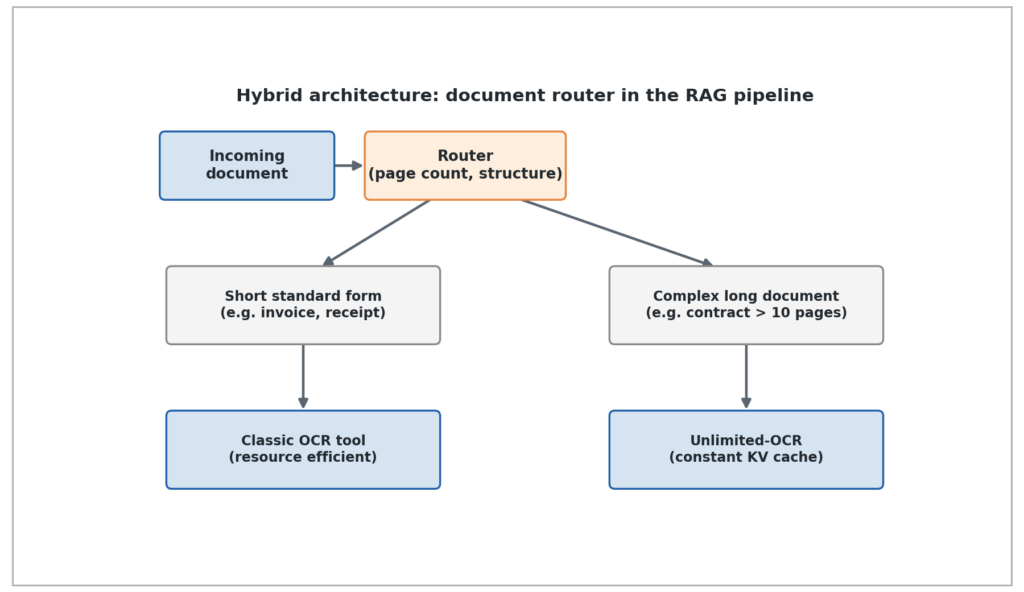
A hybrid approach is recommended for production use: lightweight, fast tools for the bulk throughput of simple single documents, and Unlimited-OCR specifically where structural fidelity across pages, for example with nested tables or formulas, is critical. From a governance perspective, and precisely because this is a self hosted open source model, an audit trail with exact page references and a clear assignment of who may access which extracted document content are important. These recommendations are conceptual in nature and do not replace an individual architecture and security review in the respective enterprise context.
A practical example
An illustrative, generalized scenario shows where the difference would be felt in practice: an IT service provider in the DACH region that converts technical manuals, maintenance logs, and multi page supplier contracts into a RAG powered knowledge base for clients regularly runs into two limits with classic OCR tools: tables that continue across a page break lose their row alignment, and for documents beyond 20 to 30 pages, processing time increases noticeably while GPU utilization approaches its limits. A model with a constant KV cache such as Unlimited-OCR would address exactly the point where classic pipelines today still depend on page stitching and manual rework. This example is deliberately kept general and does not describe a specific, publicly documented customer case for Unlimited-OCR, since the model is still too new for that.
Limitations and open questions
Promising as R-SWA is, Baidu’s own paper is fairly open about its limitations: errors accumulate on small, dense text, especially in the faster base mode with fixed resolution across multiple pages. In the higher resolution Gundam mode, accuracy improves but throughput drops. In addition, Unlimited-OCR inherits all the weaknesses of the underlying DeepSeek-OCR encoder, for instance with certain fonts, languages, or layouts, since R-SWA solves only the decoder’s memory problem, not the visual recognition capability itself. Independent benchmarks beyond the vendor’s own figures are also still lacking for many real world scenarios, a point external observers of the model release have raised critically as well.
Conclusion: the value for enterprises with document intensive processes
The value of Unlimited-OCR lies less in a leap in pure text recognition accuracy, which was already high for clean documents before this model, and more in the ability to process very long documents in a single, context stable pass, without the combination of growing memory demand and slowing speed that is critical for production systems. Combined with the MIT license, this lowers the barrier to entry for enterprises still struggling with page stitching workarounds and brittle table recognition across page boundaries. Anyone looking to feed contracts, technical manuals, or scientific reports into RAG pipelines at scale gains an open building block that, according to Gartner and Forrester, sits squarely within a market segment now treated as its own strategically significant category, provided governance and security aspects are considered from the outset.
Frequently asked questions about Unlimited-OCR (Q&A)
What exactly is Unlimited-OCR?
An open source vision language model developed by Baidu for document parsing, built on DeepSeek-OCR, that can process even very long documents in a single pass using Reference Sliding Window Attention (Source: Baidu Research, arXiv:2606.23050).
What distinguishes Unlimited-OCR from DeepSeek-OCR?
Unlimited-OCR reuses DeepSeek-OCR’s image encoder but replaces the decoder’s attention layers with R-SWA, keeping the KV cache constant instead of letting it grow with output length.
Is Unlimited-OCR free to use?
Yes. The model is released under the MIT license with openly available weights on Hugging Face and GitHub and may also be used commercially (Source: Hugging Face, baidu/Unlimited-OCR).
Does Unlimited-OCR replace classic OCR tools such as Tesseract?
No. For short, standardized single documents, classic, resource efficient OCR tools remain preferable. Unlimited-OCR plays to its strengths on long, complex documents with tables spanning multiple pages.
How do analysts assess the IDP market overall?
Gartner published the first Magic Quadrant for this category in 2025, Forrester describes a fragmented, growing market focused on governance and agentic AI, and BARC points to data quality as a growing risk in downstream AI pipelines.