

 Thought Leadership
Artificial intelligence is becoming the structural principle of enterprise architecture. Gartner, Forrester, BARC, Eckerson, and KuppingerCole call this shift AI Restacking. This article explains what it means for enterprise architects.
Artificial intelligence is evolving from a point tool into the structural principle of enterprise architecture. What began as the automation of individual processes is now reshaping how business processes, data, applications, and technology are interconnected. Analysts summarize this shift under the term AI Restacking, a reordering of the value chain that affects planning, operations, and governance alike.
For enterprise architects, this means a change of role. It is no longer just about aligning IT strategically with business goals, but about designing cognitive enterprise architectures in which data, applications, and technology work together as a learning system. The classical BDAT layers (Business, Data, Application, Technology) are connected through a continuous cognitive fabric that learns continuously from feedback. Gartner puts the urgency plainly: its annual Predicts 2026 study for enterprise architecture states that 66 percent of CEOs have business models that are not yet ready for the use of AI — and analysts explicitly regard enterprise architecture as the lever to close this gap.
Business Architecture: Artificial Intelligence as a Strategic Co-Pilot
In business architecture, the role of AI is shifting from a pure analysis tool to an integral part of strategic decisions. More and more companies are using AI to forecast market changes, simulate scenarios, and back business decisions with data. At the same time, generative AI is driving new business models: offerings can be conceived within days and tested through AI-based prototyping, considerably shortening innovation cycles.
A key element here is the Digital Twin of the Organization — a virtual representation of the entire company that simulates strategy and operations in real time. By linking data streams with AI-based feedback loops, executives can play through scenarios, assess risks, and fine-tune operational adjustments. Forrester describes a similar idea with its Cognitive Operating Model, a reference framework for organizational realignment in the age of AI that addresses why productivity gains at the task level have so far rarely added up to value creation at the enterprise level.
Data Architecture: From Data Warehouse to Cognitive Platform
Data quality determines the success of AI — and with it, a company’s future viability. Classical data warehouses are increasingly being replaced by cognitive data platforms that are self-learning, semantically networked, and context-aware. The Eckerson Group describes Data Fabric as the next stage in the evolution of data architecture: an automated, AI-supported approach that connects data silos into a semantic network, competing with — or complementing — the related concept of Data Mesh.
The guiding principle here is Data as a Product: data is no longer a byproduct of processes but a strategic asset made accessible in a controlled way through APIs, catalogs, and governance rules. That this foundation is anything but a given is shown by the BARC Data, BI and Analytics Trend Monitor 2026, a survey of 1,579 professionals and executives: data quality tops the trend list, ahead of data security and data culture. Without a solid data foundation, the study’s core message states, data and AI projects will not succeed in the long run.
Application Architecture: Intelligent Services and Modular AI Building Blocks
The application landscapes of the future are modular, event-driven, and AI-powered. A substantial share of enterprise applications today already have embedded AI, whether in the form of customer-service chatbots, predictive workflows in ERP systems, or automated reporting assistants. At the same time, applications are often being refactored with modular microservices and APIs so that AI components can be integrated as needed. This composable-enterprise paradigm makes it possible to stand up new services faster and adapt flexibly to changing requirements.
AI is also changing how software is developed. Generative tools act as co-pilots in development, writing code, creating tests and documentation, or suggesting integration patterns. This accelerates innovation, reduces technical debt, and shifts the architect’s role toward curating intelligent systems. The underlying infrastructure, too, is evolving from rigid batch systems to event-driven architectures in which data events are evaluated in real time — for example in fraud detection or dynamic pricing.
Technology Architecture: Infrastructure Becomes Self-Learning
Below the application layer, technology architecture is evolving into an adaptive, AI-optimized foundation. Cloud-native structures, containerization, and hybrid multi-cloud models are becoming standard to handle the heavy computing demands of AI workloads. At the same time, data processing is moving closer to the source, to the edge: factories, branches, or vehicles are becoming intelligent nodes of a learning infrastructure.
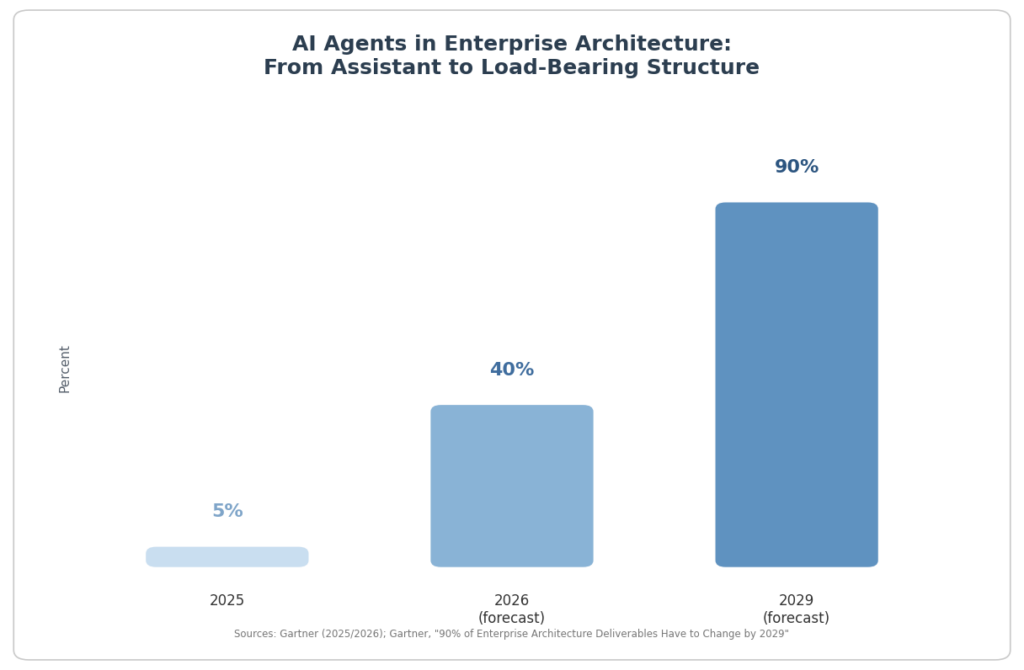
Gartner’s figures show just how fast this shift is happening. According to a forecast published in September 2025, 40 percent of enterprise applications will embed task-specific AI agents by 2026, up from less than 5 percent in 2025. Gartner also recorded a 1,445 percent increase in inquiries about multi-agent systems between Q1 2024 and Q2 2025. The shift becomes even clearer in a further Gartner forecast by analyst Rimma Gurevich: by 2029, 90 percent of all enterprise architecture deliverables will need to be designed for execution by AI agents, complementing or replacing human project teams.
Within these architectures, integrated AI and ML platforms are emerging with end-to-end MLOps pipelines for data integration, model training, deployment, and monitoring. AIOps exemplifies this shift: operations teams use machine learning to detect sources of failure in advance or to ensure compliance automatically. Enterprise architecture itself thereby becomes data-driven and turns into an active control system that visualizes dependencies, uncovers redundancies, and flags governance violations.
What Are the Analysts Saying? Gartner, Forrester, BARC, Eckerson, and KuppingerCole at a Glance
The major analyst firms are observing the transformation of enterprise architecture from different angles, but arrive at similar conclusions. Gartner sees enterprise architecture as the key lever for tying AI investment to business outcomes, while warning that much of today’s EA deliverables will need to be reworked for an agentic future. Forrester emphasizes the fragmentation of the vendor market: because no single vendor dominates agentic AI, in 2026 most companies are building so-called agentlakes — composable architectures for orchestrating distributed AI agents. In parallel, Forrester expects 60 percent of Fortune 100 companies to establish a dedicated AI governance leadership function, partly in response to growing regulatory requirements under the EU AI Act.
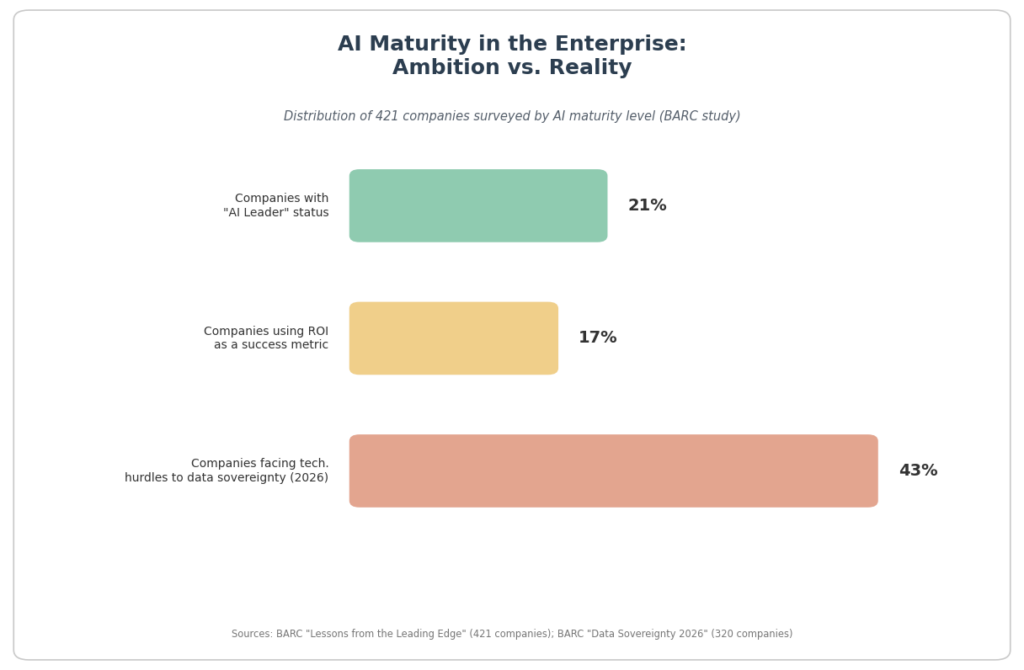
BARC’s study Lessons from the Leading Edge delivers a sobering interim assessment: of 421 companies surveyed, only around one in five reaches the status of a demonstrable AI Leader, and just 17 percent use return on investment at all as a success metric for AI projects. The BARC report Data Sovereignty 2026, a survey of 320 decision-makers, adds that 62 percent of companies name the use of data and AI in core processes as a key driver of data sovereignty, while the share of companies citing technical hurdles has risen from 26 to 43 percent.
The Eckerson Group places data architecture in context: Data Fabric is increasingly replacing the classic data warehouse because it manages metadata automatically, maintains data catalogs with AI support, and connects data silos into a semantic network that makes relationships visible. KuppingerCole, finally, focuses on the security dimension of cognitive architectures, explored further in the next section.
| Analyst Firm | Key Message on Cognitive Architectures | Source |
| Gartner | 40 percent of enterprise applications will embed task-specific AI agents by 2026; by 2029, 90 percent of all enterprise architecture deliverables must be designed for agentic workflows. | Gartner, Predicts 2026 / Hype Cycle for Enterprise Architecture 2026 |
| Forrester | The majority of companies will build composable agentlakes in 2026 to orchestrate fragmented AI agents; 60 percent of Fortune 100 companies will appoint a dedicated AI governance lead. | Forrester, Predictions 2026: AI and Tech Leadership |
| BARC | Only around one in five companies reaches the status of a demonstrable AI Leader; data quality remains the top trend for 2026, ahead of data security and data culture. | BARC, Lessons from the Leading Edge / Data, BI and Analytics Trend Monitor 2026 |
| Eckerson Group | Classical data warehouses are being replaced by AI-powered Data Fabrics that manage metadata automatically and connect data silos into a semantic network. | Eckerson Group, Data Fabric Research |
| KuppingerCole | The ratio of non-human to human identities will reach a critical point by mid-2026; an Identity Fabric with continuous, context-based trust becomes a requirement. | KuppingerCole, European Identity and Cloud Conference 2026 |
Security and Identity: Why Cognitive Architectures Need an Identity Fabric
As agentic AI spreads, the security architecture is changing fundamentally as well. KuppingerCole points out that autonomous, tool-using AI agents that chain actions and delegate tasks to sub-agents undermine the basic assumptions of classical identity and access management (IAM): human consent, deterministic behavior, and complete event-level traceability can no longer be assumed for autonomously acting agents.
Analysts expect the ratio of non-human to human identities to reach a critical tipping point by mid-2026. KuppingerCole therefore advocates for an Identity Fabric that brings together identity, network, device, and business signals into one context-aware system, replacing static roles with a model of Continuous Adaptive Trust. Every action an agent takes should remain traceable to a human owner and a concrete intent. For enterprise architects, this means security and governance are no longer downstream control layers but an integral part of the cognitive architecture itself.
Real-World Example: How EY Built an Agentic Platform
A real-world example shows what this can look like in practice: professional services firm EY has unified its previously scattered GenAI initiatives into a single agentic platform now used by more than 300,000 employees, which the company says has produced over 50,000 agents within nine months. The platform is organized in three layers: an intelligence layer with models and foundation services, co-developed with NVIDIA; an orchestration layer for workflows and agent control built on Microsoft Azure and Copilot; and a data and governance layer that ensures lineage, access rights, and compliance across the whole system. Mark Luquire, who leads EY’s global Microsoft alliance, sums up the approach: the firm deliberately chose to lean on its partner ecosystem rather than build the platform alone. The example shows how the principles described above, orchestration over tool sprawl and end-to-end governance, are already taking shape inside a real, large organization. (Source: EY case study, May 2026 – a vendor’s own account, not an independent study.)

Video tip: For a deeper dive, the recording “Agentic AI and the Future of Enterprise Architecture” (Ardoq Point of View, April 2026) offers an expert discussion on the future of enterprise architecture in the age of agentic AI.
Three Priorities for Enterprise Architects Today
Given the rapid proliferation of AI tools, platforms, and frameworks — all promising transformation — it is tempting to search for individual point solutions. Enterprise architects should resist that impulse: tools will keep evolving, converging, and being replaced, while the orchestration process through which intelligence flows across every layer of the enterprise endures. Three points matter most:
- Establish repeatable processes to identify where AI-driven decisions create the greatest leverage.
- Build feedback loops that allow the architecture to keep learning and adapting.
- Tie every AI investment decision consistently to business outcomes rather than tracking activity metrics alone.
Enterprise architects who focus on this orchestration create lasting value that outlasts any single technology cycle.
Conclusion: The Value of Cognitive Architectures
The value of cognitive enterprise architectures lies not in accumulating AI tools, but in designing a process through which the entire enterprise thinks, learns, and acts as one. Strategy, data, and technology form an interconnected whole that continuously learns from feedback. The figures from Gartner, Forrester, BARC, Eckerson Group, and KuppingerCole consistently show that the shift has already begun — but also that most companies remain far from genuine cognitive maturity. Those who invest today in repeatable processes, solid data quality, and a resilient Identity Fabric are laying the foundation for a competitive advantage that extends beyond the next technology cycle.
Questions and Answers on Cognitive Architectures
What is AI Restacking?
AI Restacking refers to the reordering of enterprise architecture in which artificial intelligence is not added as a single tool but embedded across every layer — business processes, data, applications, and technology.
How does a cognitive architecture differ from classical enterprise architecture?
Classical enterprise architecture statically aligns IT systems with business goals. A cognitive architecture treats business, data, applications, and technology as a learning system that continuously adapts based on feedback and real-time data.
What role does Data Fabric play in cognitive architectures?
According to the Eckerson Group, Data Fabric connects heterogeneous data sources into a semantic network and is gradually replacing classical data warehouses. It thereby forms the data foundation on which AI agents can operate reliably.
Why is identity governance becoming so important for AI agents?
Autonomous AI agents act without continuous human oversight, undermining classical IAM assumptions. KuppingerCole therefore recommends an Identity Fabric with continuous, context-based trust to keep every agent action traceable.
How many companies have already achieved genuine AI maturity, according to BARC?
According to BARC’s study Lessons from the Leading Edge, only around one in five of the 421 companies surveyed reaches the status of a demonstrable AI Leader with verifiable results.
What should enterprise architects tackle first?
Recommended priorities are repeatable processes for prioritizing AI use cases, resilient feedback loops for continuous learning, and consistently tying AI investment to measurable business outcomes.