
 Thought Leadership
With autonomous AI agents entering enterprise workflows, AI hallucinations are taking on a new level of risk. As these systems become increasingly capable of acting independently, the key challenge is detecting hallucinations early and keeping them under effective control.
The era of simple chatbots is over. Artificial intelligence is entering the core processes of companies in the form of autonomous AI agents — and with it, the risks are growing. Agents act independently, pull live data, and trigger workflows. This turns them into a new, often opaque identity on the network. The central question is: how can companies ensure that these agents work reliably and don’t hallucinate?
The New Dimension: Agents Instead of Simple Prompts
Simple prompting is no longer enough to meet the demands of modern AI systems. AI agents differ fundamentally from conventional language models. While LLMs merely generate text, agents can interact directly with systems: they execute shell commands, manipulate file systems, send emails, and call APIs.
These expanded capabilities open up a broad spectrum of risks. According to a Gartner survey from September 2025, 74 percent of IT decision-makers see AI agents as a new attack surface for their organization. Only 19 percent have high or complete trust in their vendor’s ability to provide adequate hallucination protection.
AI Hallucination Detection Software: How Effective Is It Really?
The question of how effective AI hallucination detection software really is has never been more relevant. Current developments show promising approaches — but also clear limitations.
Finch-Zk: Cross-Model Consistency as the Key
A notable advance is Finch-Zk, a framework from AWS researchers built on fine-grained cross-model consistency. The approach: instead of relying on a single model, different models are fed semantically equivalent prompts, and their responses are compared for fine-grained inaccuracies.
The results are impressive: Finch-Zk improved the hallucination-detection F1 score by 6 to 39 percent compared to existing methods on the FELM dataset. For correction, the framework achieved an average improvement in answer accuracy of 7 to 8 absolute percentage points — and up to 12.6 percentage points for individual models such as Llama 4 Maverick.
LettuceDetect: A Specialist for RAG Systems
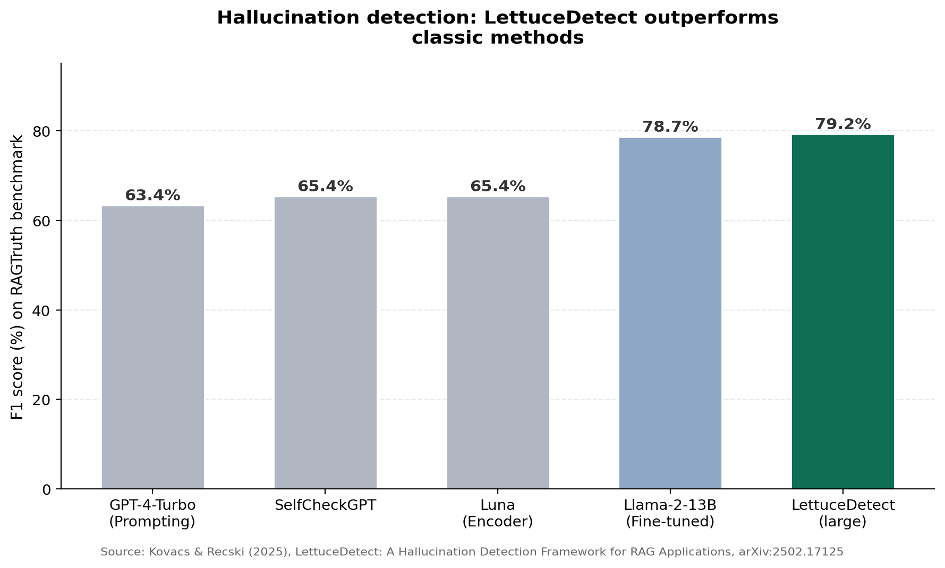
An alternative solution is LettuceDetect, a lightweight framework designed specifically for Retrieval-Augmented Generation (RAG) systems. It achieves an overall F1 score of 79.22 percent, outperforming prompt-based methods such as GPT-4-Turbo. LettuceDetect uses ModernBERT for processing long contexts (up to 8,192 tokens) and is optimized specifically for tasks with large context windows.
RefChecker: Fine-Grained Hallucination Checking
RefChecker from Amazon Science takes a different approach: the framework extracts so-called claim-triplets from AI responses and checks them against references. It distinguishes between three context settings (Zero, Noisy, and Accurate Context) and achieves improvements of 6.8 to 26.1 points over the best alternative on its own benchmark.
The Limits of Detection Software
Despite these advances, challenges remain. Detection software is no silver bullet. It can identify AI hallucinations but cannot fully prevent them. Particularly problematic: even models like GPT-4 still hallucinate in roughly 3 percent of cases on summarization tasks, according to the Vectara Hallucination Leaderboard. At ChatGPT’s current daily request volume of roughly 2.5 to 3 billion (as of 2025/2026), that would translate — purely arithmetically, in a worst-case scenario — into several tens of millions of potentially flawed outputs per day. This extrapolation is illustrative, since the actual model mix and task types vary; still, it illustrates the scale of the problem once you apply it to billions of daily interactions.
The Solution: A Zero-Trust Architecture for AI Agents
The most effective strategy is the consistent application of the zero-trust principle across the entire AI deployment. In practice, this means: trust no system or piece of data without first verifying identity and authorization — resting on three interlocking building blocks.
At the center are strict access controls: AI agents should only receive the rights they actually need for their specific task — and only for as long as they genuinely need them. Every permission should be granted for a specific, predefined purpose, remain auditable, and expire automatically rather than quietly accumulating within the system.
Equally indispensable is working human-in-the-loop governance. Companies must ensure that their agents do not act unlawfully, which is why decisions should never be made entirely autonomously. This human oversight works best when combined with robust tools and safeguards that either block critical actions outright or, at minimum, trigger a warning and require explicit approval.
On top of that comes a secure RAG architecture: for Retrieval-Augmented Generation systems, it is essential that both user and agent access, as well as the use of AI features, are subject to strict permission controls. Without such safeguards, companies risk serious data leaks.
The Future: Governance as a Competitive Advantage
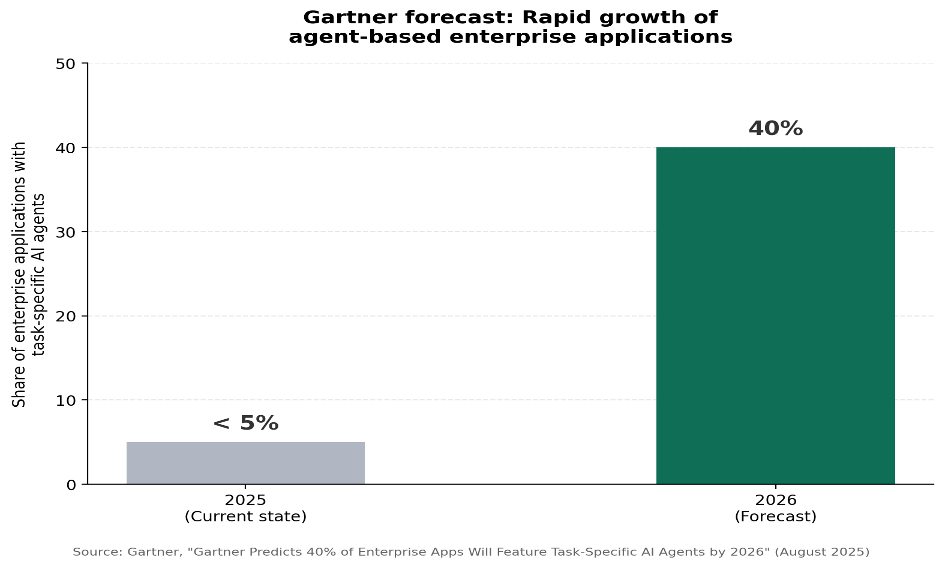
Gartner forecasts that by the end of 2026, 40 percent of enterprise applications will already integrate task-specific AI agents — a massive jump from less than 5 percent in 2025. By 2028, a third of user experiences are expected to shift from classic application interfaces to agent-based front ends.
The biggest obstacles to deploying autonomous AI agents are not technical in nature: they lie in insufficient trust in the security, governance, and hallucination-protection mechanisms available. Companies that establish a robust zero-trust architecture today secure a decisive competitive advantage.
Conclusion: Detecting AI Hallucinations — and Preventing Them
AI Hallucination detection software is an important tool — but no substitute for a well-thought-out security architecture. The most effective solutions, such as Finch-Zk and LettuceDetect, significantly improve detection rates but cannot fully eliminate hallucinations. The key to success therefore lies in the interplay of technical detection mechanisms, strict access controls, human oversight, and continuous monitoring — it is only together that these four elements reach their full effect.
Anyone who wants to deploy AI agents safely must treat them for what they are: potentially unpredictable, yet highly capable digital employees who need clear boundaries and permanent oversight.
Q&A Session
How reliable is current software for detecting AI hallucinations?
Effectiveness varies significantly. Frameworks such as Finch-Zk achieve F1-score improvements of 6 to 39 percent over existing methods. LettuceDetect achieves an F1 score of 79.22 percent. However, no software is perfect — even top models like GPT-4 still hallucinate in roughly 3 percent of cases on summarization tasks.
Can AI agents really cause harm on their own?
Yes. AI agents can execute shell commands, manipulate file systems, and call APIs. In practice, documented cases already exist in which agents carried out flawed or unauthorized actions — such as accidentally deleting data or acting outside their intended permission scope. Such incidents underscore why strict access controls are indispensable.
What is the difference between simple prompting and using AI agents?
While simple prompting only generates text, AI agents can actively act: they pull live data, trigger workflows, and make decisions independently. This capacity for action carries significant additional risk.
What is the best way for companies to protect themselves against hallucinations?
The most effective strategy is a zero-trust architecture combined with strict access controls, human-in-the-loop governance, and a secure RAG architecture. In addition, companies should deploy specialized detection software and continuous monitoring.