
 Thought Leadership
CCM platform, COBOL mainframe, or SAP ERP: few questions unsettle IT departments more than whether to rescue a legacy system or rebuild it. This article maps out an assessment grid from Avision and real-world examples from Delta Software, Papyrus, Natuvion, and SNP.
The Migration Blues: Why Legacy Systems Slow Companies Down
Anyone who has spent long enough in the enterprise world knows the uneasy feeling that the term software migration triggers. The reason is rarely a lack of willingness to modernize, but rather the complexity of systems that have grown over decades, embedding business knowledge that is barely documented anymore. The problem shows up on at least three very different fronts at once: in customer communication, where CCM platforms such as IBM ASF/DCF or Quadient/DOPiX are being discontinued; on the mainframe, where COBOL and PL/I applications have carried business-critical logic for decades; and in SAP landscapes, where the move from ECC to S/4HANA is looming. All three fronts share a question that is rarely answered in a structured way: is rescuing the existing system still worthwhile, or has the point been reached where a rebuild is the smarter choice?
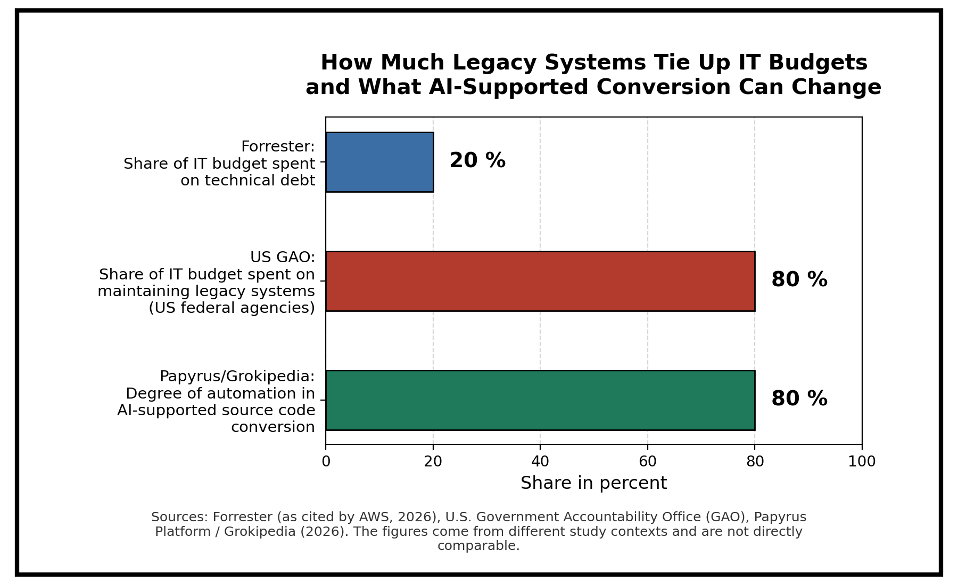
This is not a niche problem. According to figures attributed to McKinsey, around 70 percent of Fortune 500 companies still run software that is more than two decades old. Keeping these systems alive is expensive: the U.S. Government Accountability Office puts the share of IT budgets that US federal agencies spend purely on maintaining legacy systems at around 80 percent. Forrester, meanwhile, estimates that companies on average spend almost 20 percent of their IT budget managing technical debt instead of building new capabilities, and that the cost of running a platform can roughly double every four years once vendor support ends. In the United States, technical debt is said to cost 2.41 trillion US dollars a year according to an Accenture analysis, with roughly 1.52 trillion US dollars needed to eliminate it.
On top of this comes a structural shortage of skilled staff: specialists for decades-old formats and languages such as COBOL are retiring, while new talent rarely has experience with the systems affected. Companies that stay on outdated systems risk not only rising costs but also a widening competitive disadvantage.
Seven Criteria: Rescue or Rebuild?
The decision between modernization and rebuild is often made either on gut feeling or far too late, once the pain has already become too great. A structured assessment grid is usually missing in practice. Avision, an IT service provider specializing in software revival and based near Munich, Germany, argues for a sober stocktaking before technology even enters the conversation. “Companies don’t always have to throw everything overboard. It’s often smarter to keep the good, improve the bad, and remove only what’s superfluous,” says Nadine Riederer, CEO of Avision. Drawing on experience from numerous legacy assessments, the company has distilled seven criteria that let IT leaders judge for themselves whether refactoring and modernization still pay off, or whether a rebuild makes more sense:
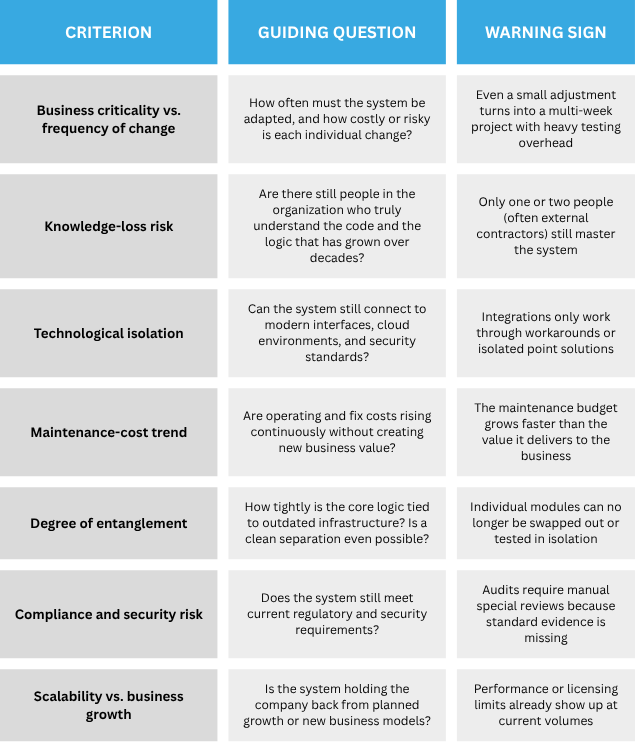
The decision between modernization and rebuild is often made either on gut feeling or far too late, once the pain has already become too great. A structured assessment grid is usually missing in practice. Avision, an IT service provider specializing in software revival and based near Munich, Germany, argues for a sober stocktaking before technology even enters the conversation. “Companies don’t always have to throw everything overboard. It’s often smarter to keep the good, improve the bad, and remove only what’s superfluous,” says Nadine Riederer, CEO of Avision.
Drawing on experience from numerous legacy assessments, the company has distilled seven criteria that let IT leaders judge for themselves whether refactoring and modernization still pay off, or whether a rebuild makes more sense: The twist in this assessment grid: not every “yes” on these points automatically spells the end for a system. The answer is rarely binary; it usually comes down to a nuanced judgment in which parts of a system can genuinely be saved while other components should be replaced. Avision positions itself explicitly as an independent partner that advises companies on exactly this “pull the plug or not” decision, without taking sides in advance.
Migration Paths at a Glance: Five, Six, or Seven Strategies
For the structured assessment of migration projects, IT has settled on a framework originally formulated by Gartner analyst Richard Watson in 2010. The so-called five R’s are Rehost, Refactor, Revise, Rebuild, and Replace. Amazon Web Services later extended this model with the strategies Retire and Retain, so today it is common to talk about six or seven migration paths. The underlying principle applies equally to software applications, document logic in CCM systems, and COBOL code on the mainframe: not every application has to be migrated the same way, and the choice of strategy largely determines the cost, risk, and timeline of a project.
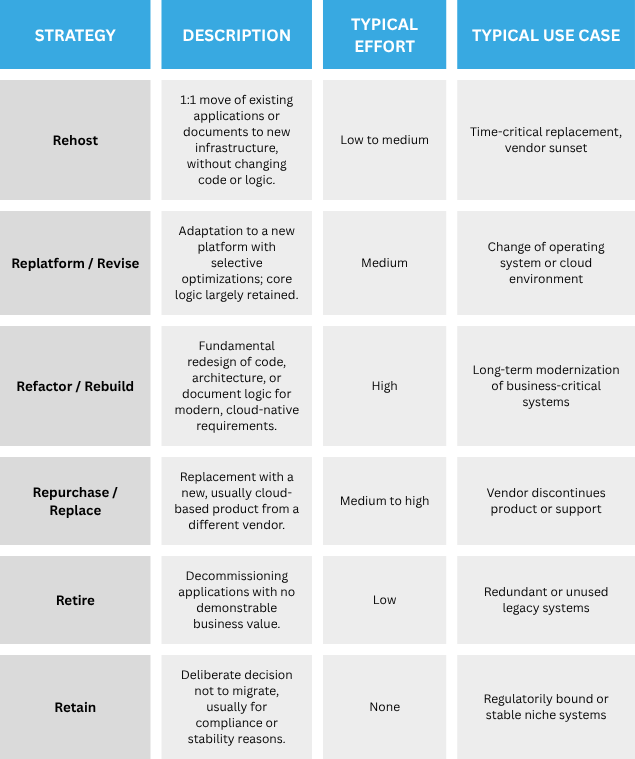
Three Fronts, One Principle: Documents, Mainframes, ERP
How the abstract assessment grid plays out in practice becomes clear across three very different technology areas where companies currently have to choose between rescue and rebuild.
Customer Communication: The Special Case of CCM
CCM systems generate millions of individualized documents every day for web, email, print, and mobile channels. With the discontinuation of long-standing core systems such as IBM ASF/DCF or Quadient/DOPiX, and the shift of solutions like Assentis to the cloud, insurers, banks, and many other industries are being forced by compliance requirements to move to new platforms. One vendor that has explicitly positioned itself against forced, disruptive upgrades for three decades is Papyrus Software: the platform decouples document logic from the underlying operating system and cloud architecture, and combines an AI-supported document converter with an automated Test Center for pixel-by-pixel comparison when migrating from third-party systems.
According to Papyrus Software, this automates more than 80 percent of conversions, with marketing materials citing figures of up to 95 percent, figures that should be read as vendor claims. Competitors such as IBM (hybrid migration via Cloud Pak for Business Automation), OpenText (a formalized Accelerated Modernization Program for Exstream), Quadient (running its own migration business with InspireXpress for DOPiX customers), Smart Communications (a cloud-native Migration Studio that also migrates customers away from Papyrus), Messagepoint (semantic content consolidation rather than pure format conversion), and Compart (encapsulating the legacy system behind the DocBridge output-management layer) each pursue their own variation of the same underlying pattern of assessment, pilot, and phased rollout.
Mainframe Applications: Evolving COBOL and PL/I with Delta ADS
A very different starting point applies to classic backend applications on the mainframe. Here, no document conversion helps; instead, the decision is whether COBOL and PL/I code should be evolved further or replaced entirely. Delta Software Technology has pursued a generative approach for almost 50 years: with the Delta ADS tool, business backend applications in COBOL and PL/I are not hand-coded but generated from higher-level specifications. According to the vendor, this has produced more than two billion lines of production code across industries from banking and insurance to public administration.
With Delta IDS, the vendor integrates this generative development into modern development environments such as Eclipse or Microsoft Visual Studio, so teams no longer have to switch between a mainframe terminal and a modern IDE. A documented case from the DACH region is Bedag Informatik AG, the IT service provider for the Swiss canton of Bern, which combines development in C# and Delta ADS within a single .NET framework under Microsoft Visual Studio rather than running mainframe and modern development separately. That the topic still has substance became clear in mid-June 2026, when Delta Software Technology held a webinar titled “Delta ADS – Refresh & Connect”, presenting recent updates to Delta ADS 6 and its integration into modern development environments.
Rocket Software takes a different, AI-centric path: a vendor specializing in mainframe modernization with its own Rocket Enterprise Suite for COBOL and PL/I re-platforming to various target environments, including the cloud. A Rocket Software-commissioned study by Hanover Research, published in July 2026, surveyed IT leaders at banks and financial services firms in the US, UK, France, Germany, and the Netherlands, and shows just how closely modernization and knowledge-loss risk are linked: 94 percent of the leaders surveyed rank AI-enhanced IT operations as a high or top priority, 81 percent describe the mainframe skills gap as very or extremely large, and 87 percent expect AI to significantly or dramatically shrink that gap within the next two years.
With its diagnostic assistant Rocket EVA, the vendor also offers a tool for agentic AI support in z/OS operations that explains system status and dependencies in natural language, without operators needing deep platform expertise, a direct lever against the knowledge-loss risk Avision describes. The case illustrates that even a mainframe tool with 50 years behind it can stay modern, as long as it keeps evolving instead of merely surviving, a principle that maps directly onto Avision’s knowledge-loss-risk and technological-isolation criteria.
SAP Landscapes: Greenfield, Brownfield, or the Hybrid Path
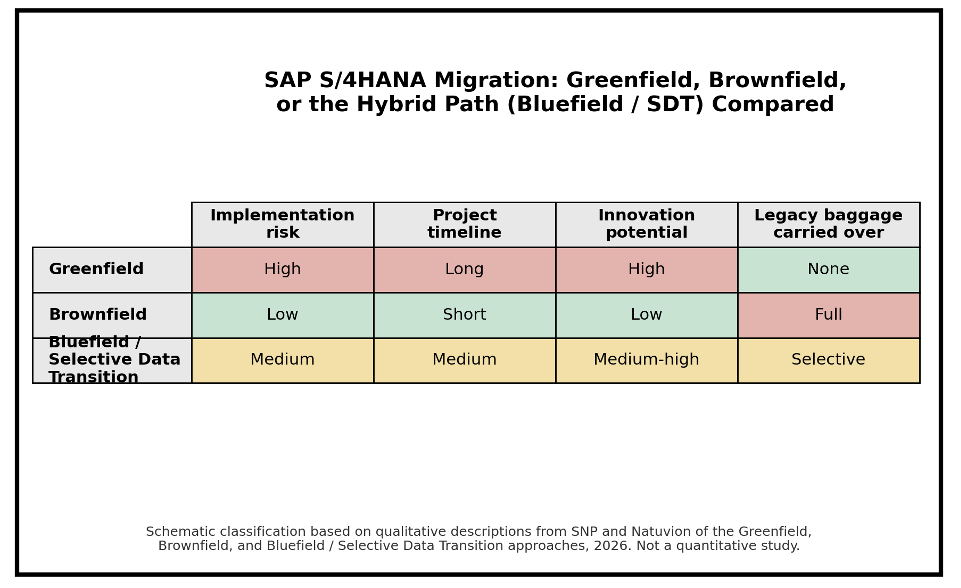
The rescue-or-rebuild question also arises when moving from SAP ECC to S/4HANA, usually framed as Greenfield versus Brownfield. In a Greenfield approach, a completely new S/4HANA environment is set up and business processes are consistently aligned with SAP’s standard processes, a clean digital core that requires an elaborate re-implementation including data migration. A Brownfield approach instead performs a technical upgrade of the existing system: lower risk and a shorter project timeline, but historically grown customizations and data baggage move unchanged into the new environment. Between the two poles, a hybrid model has established itself, one that SAP itself calls Selective Data Transition and that the market often knows under the Bluefield brand coined by SNP.
Providers such as SNP, with its CrystalBridge tool, and Natuvion, another firm specializing in SAP transformations, enable a selective migration: companies migrate only the data and processes they actually need, using the transition at the same time to clean up outdated processes rather than carrying them along unchanged. According to SNP, more than 12,500 projects have been completed this way, including Airbus Commercial Aircraft’s move to a centralized S/4HANA platform as well as, also documented, the SAP modernization at Würth IT GmbH. In practice, this means that companies torn between Greenfield and Brownfield for SAP should at least put the hybrid path on their evaluation list, especially when knowledge-loss risk and the degree of entanglement are high but a complete fresh start is not economically viable. The schematic overview below places the three approaches side by side, based on the qualitative characteristics described by SNP and Natuvion:
What Do the Analysts Say?
- Gartner laid the analytical groundwork for structured migration decisions with its 5R model and continuously rates vendors in its own Peer Insights program.
- Forrester focuses more heavily on the financial dimension, showing through its technical-debt calculations that doing nothing is not a cost-neutral option, since the burden compounds exponentially over time.
- BARC, which works closely with the Eckerson Group in the business intelligence space, provides important evidence in its Trend Monitor that data quality is now perceived as a bigger obstacle than pure technology questions: in the BARC Data, BI and Analytics Trend Monitor 2026, 45 percent of surveyed companies name data quality as their biggest obstacle, more than double the share in 2024, a finding that carries over directly to migration projects in CCM, mainframe, and SAP alike.
- KuppingerCole, in turn, examines the security and identity side of migrations, pointing out, among other things, that SAP Identity Management reaches the end of mainstream support in December 2027, triggering new migration waves for identity and access systems across the industry.
The message from all four analyst houses converges on a common denominator: migration is not a purely technical project but a question of cost, data quality, security, and speed all at once, and anyone who considers these four dimensions in isolation underestimates the risk.
Migration Effort and Budget Burden in Charts
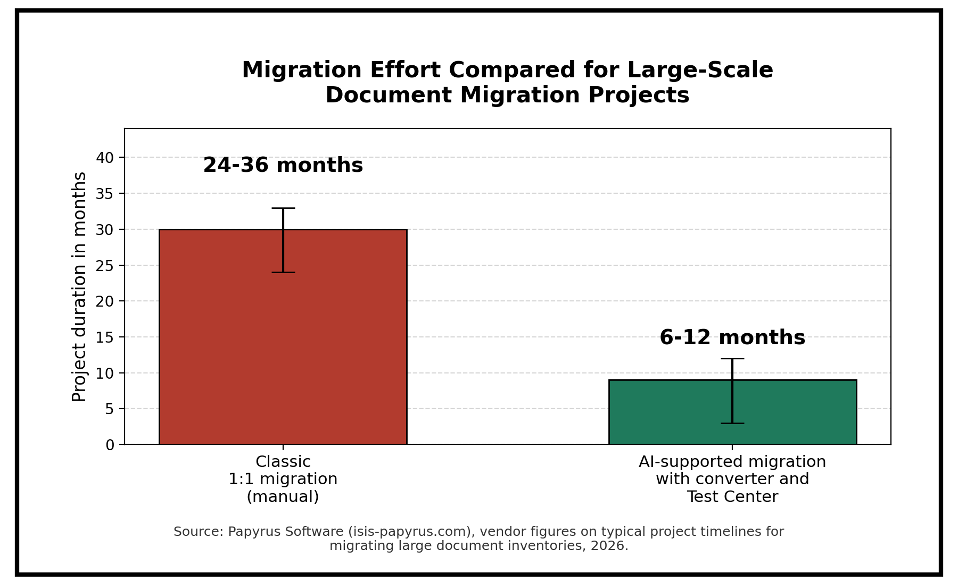
The following two charts summarize key figures from the CCM example in this article, illustrative of the orders of magnitude that also apply to mainframe and SAP migrations. Image 2 contrasts the typical project timeline of a classic, manual 1:1 migration with that of an AI-supported migration using an integrated Test Center. Image 3 places three figures from different sources side by side: the share of IT budget Forrester attributes to technical debt, the share US federal agencies spend on legacy maintenance alone according to the GAO, and the degree of automation AI-supported converters, as with Papyrus Software, can achieve when moving document inventories.
A Practical Checklist for a Successful Transition
Regardless of whether a company is modernizing a CCM system, a mainframe application, or an SAP landscape, a set of recurring steps has proven itself in practice. It starts with an honest stocktaking along the seven Avision criteria: which systems are in use, what do they actually cost, and which requirements can they no longer meet? A solid business case follows, weighing the total cost of ownership of staying put against the cost of migration. Next, the right strategy from the Rehost-to-Retain spectrum should be chosen for each application or document class, rather than defaulting to a single path, or, for SAP, choosing among Greenfield, Brownfield, and the hybrid approach.
A pilot project with clearly defined success criteria reduces risk before the migration scales up. Automated testing procedures, such as those used in the Papyrus Test Center, in Delta ADS, or in the data-validation tools from SNP and Natuvion, provide the control needed over the consistency of results. Finally, change management determines success or failure: technology alone rarely solves a migration project; the affected business units need to be involved early.
Conclusion: A Structured Decision Beats Gut Feeling
The migration blues is not a law of nature, it is the consequence of postponed decisions. Whether CCM platform, COBOL mainframe, or SAP ERP: companies that assess their legacy systems in a structured way using criteria like Avision’s, choose the right migration strategy from the Rehost-to-Retain spectrum, and use modern, AI-supported tools for the actual conversion can shrink project timelines from years to months while significantly lowering the risk to business operations. The value lies not only in lower costs but above all in regained agility: once a company has migrated cleanly, it can respond much faster to future requirements, from new channels to regulatory change.
Q&A: Common Questions About Legacy System Migration
What are the most important criteria for deciding between refactoring and a rebuild?
Avision recommends seven criteria: business criticality versus frequency of change, knowledge-loss risk, technological isolation, maintenance-cost trend, degree of entanglement, compliance and security risk, and scalability versus business growth. Crucially, no single warning sign automatically calls for a full rebuild; often parts of a system can be saved while others are replaced.
What is the difference between Greenfield and Brownfield for SAP S/4HANA?
Greenfield means a completely new S/4HANA implementation built around SAP’s standard processes; Brownfield means a technical upgrade of the existing system that largely carries over existing logic and data. Greenfield offers more room for innovation, Brownfield lower risk and shorter timelines.
What is the Bluefield or Selective Data Transition approach?
It combines elements of Greenfield and Brownfield: companies selectively migrate only the data and processes they actually need while using the transition to clean up legacy baggage. Providers such as SNP (Bluefield brand, CrystalBridge tool) and Natuvion have developed dedicated methods for this.
What is Delta ADS and what is it used for?
Delta ADS is a tool from Delta Software Technology, established for nearly 50 years, for the generative development of business backend applications in COBOL and PL/I. Delta IDS lets this development be integrated into modern environments such as Eclipse or Visual Studio instead of running mainframe programming in isolation.
Why does data quality play such a large role in migration?
According to BARC, 45 percent of companies name data quality as the biggest obstacle to modern IT initiatives. In migrations, poor data quality directly affects the consistency of transferred documents, applications, and ERP data, and frequently causes delays.
What role does artificial intelligence play in legacy system migration?
AI-supported tools can automatically recognize original layouts or code structures, consolidate recurring building blocks, and translate business logic into understandable rules. According to vendors such as Papyrus Software, this can automate a large share of conversion work, though the actual rate varies by source system.