

 Thought Leadership
In brief: A Kearney study reveals the cycle of delayed network rollout and shrinking investment in Germany. The same pattern throttles IT infrastructure and AI: Gartner warns of rising technical debt despite $6.37 trillion in global IT spending in 2026.
Investment backlogs, skills shortages, regulatory pressure: anyone discussing digitalization in Germany quickly arrives at symptoms. The real cause often lies deeper, in a structure that sustains itself. Management consultancy Kearney recently made this pattern visible in its Global Telecom Health Index for the telecom industry. It’s worth a closer look, because the same principle currently determines how successfully companies modernize their IT infrastructure and put artificial intelligence to productive use.
Kearney Global Telecom Health Index: Germany Falls Behind
Kearney’s Global Telecom Health Index rates 34 telecom markets worldwide across five dimensions: financial performance, commercial performance, technology rollout, market environment, and customer satisfaction. Germany lands in the back ranks, even though operators’ financial standing sits in the upper midfield. In commercial performance, the German market ranks 33rd of 34; in technology rollout, 31st; and in customer satisfaction, 29th.
According to the study, the cause isn’t capital but execution. 5G already reaches 99 percent of the population, but on fixed-line networks fiber reaches only 40 percent of households, with just 15 percent actually connected. Across the markets studied, the global averages are 75 percent and 51 percent respectively. Christoph Neunkirchen, partner and managing director at Kearney and co-author of the study, puts it plainly: Germany’s problem isn’t a lack of capital, but the lagging execution of network rollout and utilization.
This creates a cycle the study describes across several markets: limited network quality dampens customer satisfaction and willingness to pay, and lower revenue in turn dampens the funds available for the next rollout step. Switzerland, ranked 5th in the index, shows the cycle can also turn positive: quality generates willingness to pay there, which produces the revenue for the next investment cycle.
Why the Pattern Also Applies to IT Infrastructure Modernization
What the Kearney study describes for fiber and mobile networks is, at its core, a general pattern of IT economics: whoever delays investment in infrastructure doesn’t just lose competitiveness, they also shrink the funds available for the next modernization step. This pattern shows up almost identically in general IT infrastructure and in AI investment – only here, the decisive metric isn’t fiber connection rates but so-called technical debt.
Gartner defines technical debt as the sum of inefficiencies and risks arising from outdated systems or deferred maintenance that must be resolved in the future. According to Gartner, on average around 40 percent of infrastructure systems across all asset classes carry potential technical debt issues. This debt builds up when teams take short-term shortcuts to meet delivery deadlines, and quality, scalability, and resilience suffer in the long run.
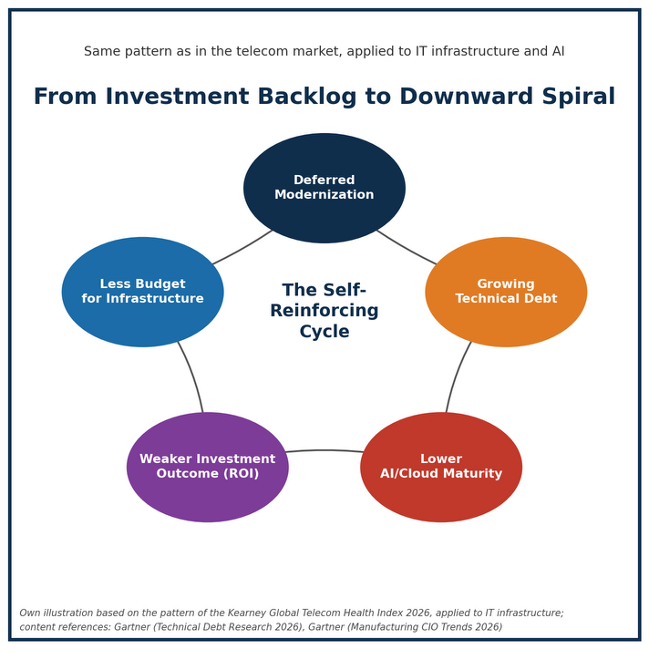
The mechanism is the same as in the telecom market: deferred modernization generates growing technical debt. Growing technical debt reduces the ability to productively use new technologies such as cloud-native architectures or AI applications. Lower AI and cloud maturity weakens achievable return on investment. A weaker ROI in turn reduces the budget available for the next round of modernization – and the cycle starts over.
AI Investment: Technical Debt Intensifies the Cycle
This pattern is currently most visible around artificial intelligence. A February 2026 Gartner report on the top trends for manufacturing CIOs names accumulated technical debt as one of three key obstacles that could slow AI progress over the next three years. Aging IT, OT, and ET systems along with complex integrations reportedly curb the scalability of AI projects and raise cost, risk, and rigidity. The report also finds that 48 percent of manufacturers with defined modernization plans are actively modernizing their core systems today – meaning the rest continue to operate on an outdated base.
The cycle also shows up in investment decisions themselves. A Gartner survey of 782 infrastructure and operations leaders found that only 28 percent of AI projects fully meet ROI expectations, while 20 percent of initiatives are openly considered failures. A further Gartner survey of 394 supply chain leaders at companies with at least $250 million in annual revenue shows that while 67 percent of digital investment already goes to AI, 55 percent of the supply chain executives surveyed are unclear what return these investments actually deliver.
Gartner analyst Sandhya Mahadevan, speaking at the Gartner CSO and Sales Leader Conference, pointed out that the obstacles to a solid AI ROI mostly lie in an organization’s own structural factors – data maturity, user adoption, and choosing the right use cases, for instance. At the Gartner Finance Symposium/Xpo 2026 in Sydney, Gartner analyst Sharma likewise stressed that CFOs mistakenly treat artificial intelligence as a single ROI problem instead of viewing it as a portfolio of very different investments, each with its own time horizon, risk profile, and ongoing costs.
Gartner IT Spending 2026: $6.37 Trillion at a Glance
Despite these warning signs, investment continues at scale, as Gartner’s latest figures show. Worldwide IT spending is set to rise to $6.37 trillion in 2026, up 14.2 percent from the prior year. Gartner has repeatedly revised its forecast upward over the course of the year: in October 2025 it still projected 9.8 percent growth, in February 2026, 10.8 percent, in April 2026, 13.5 percent, and finally in July 2026, 14.2 percent. Gartner analyst John-David Lovelock called the buildout of the compute capacity needed for AI the largest infrastructure project humanity has ever undertaken.
Within this growth, the balance is shifting clearly toward infrastructure. According to Gartner’s April 2026 forecast, spending on data center systems is set to jump 55.8 percent in 2026 and surpass $788 billion – far stronger than any other segment. Software spending is expected to grow 15.1 percent, communication services spending 4.8 percent, and device spending 8.2 percent. Overall, IT services remain the largest single category at $1.87 trillion. Gartner describes this as a multi-speed market, in which hyperscaler investment and AI-centric software segments are pulling well ahead of traditional categories.