

 Thought Leadership
Forrester on Infrastructure Modernization: Complexity as a Brake
Forrester likewise observes the link between investment backlogs and modernization pressure from multiple angles. Forrester notes that enterprise network complexity has grown by two orders of magnitude within a decade, driven by multi-cloud and hybrid-cloud architectures, the integration of partner solutions, and zero-trust frameworks. This complexity makes it even harder for companies to catch up on modernization backlogs once they’ve built up.
The current Forrester Wave report on Infrastructure Outsourcing Services from Q3 2026 also shows how differently providers handle the tension between legacy operations and AI-ready infrastructure. According to Forrester, some providers score especially well where infrastructure decisions are tightly linked to application modernization, platform engineering, and AI initiatives, while others remain strong in classic data center operations and mainframe support but are less differentiated in AI-optimized infrastructure design. For industries such as insurance, Forrester projects technology spending will rise by $173 billion, or 7.8 percent, in 2026, with the focus shifting increasingly from pure modernization toward intelligence and differentiation.
Bitkom Figures: Germany’s Digitalization Lag Internationally
Figures from industry association Bitkom likewise paint a picture of a Germany that keeps investing yet keeps losing ground internationally. For 2026, Bitkom expects Germany’s ICT market to grow 4.4 percent to €245.1 billion, driven mainly by software, cloud services, and infrastructure projects. Infrastructure-as-a-Service is especially dynamic, with an expected increase of 21.0 percent, while the global ICT market is projected to grow 8.5 percent to €5.9 trillion in 2026, with the US setting the pace at a 41 percent share and 12.7 percent growth. Germany’s international market share stands at just 3.8 percent.
Germany also fell three places to rank 17 of 27 in the 2026 Bitkom DESI Index, which measures digitalization across EU member states, down from rank 14 the year before. Bitkom president Ralf Wintergerst commented that Germany is making progress on digitalization, but other countries are moving faster. Anyone who wants to get ahead in digital competition needs to become not just better, but faster.
The Five Stations of the IT Cycle at a Glance
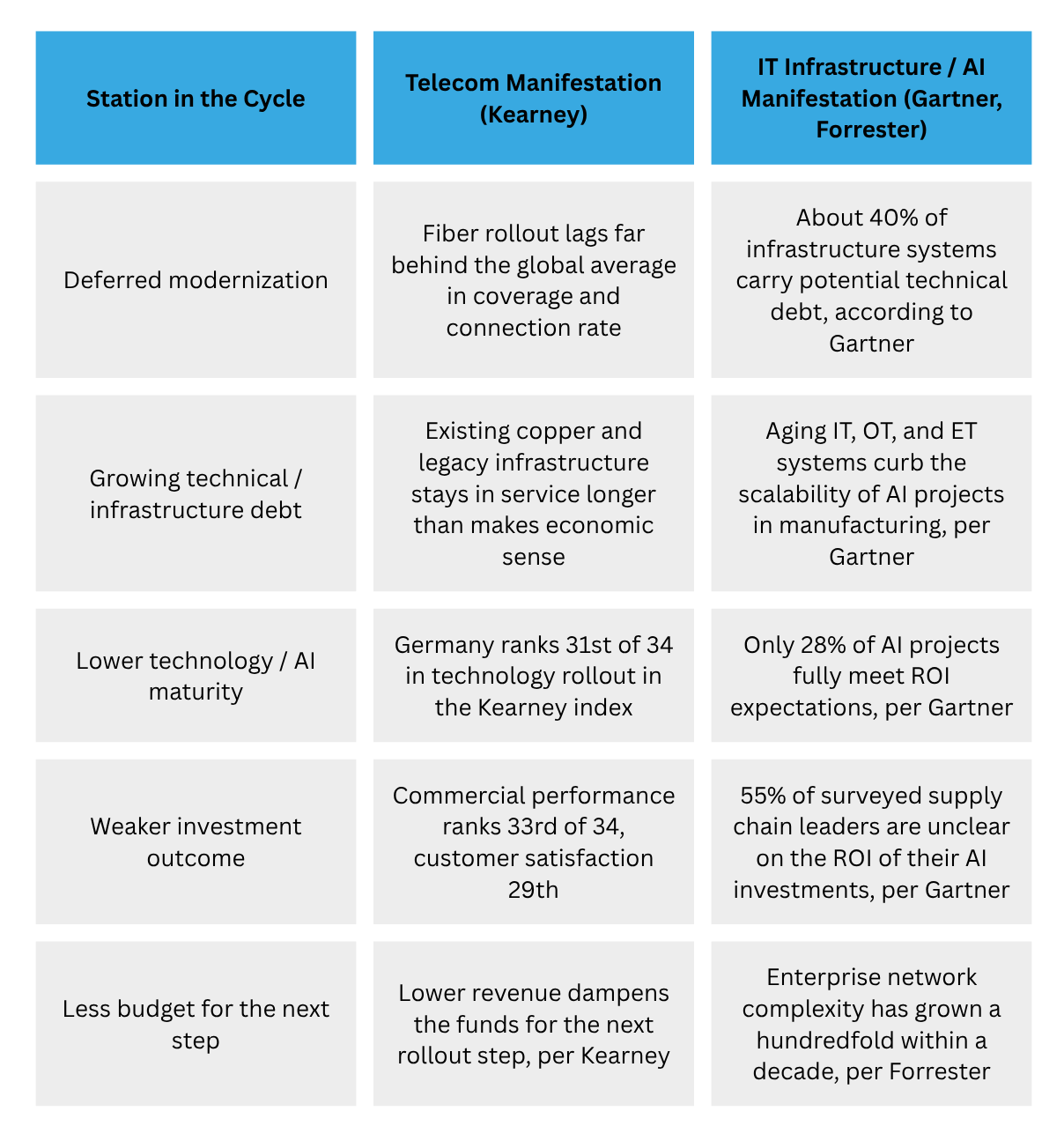
The table below maps the pattern from the Kearney telecom study onto general IT infrastructure and shows where companies can intervene to break the cycle.
Reducing Technical Debt: How to Break the Cycle
Switzerland’s position in the Kearney index shows the mechanism can also turn in the other direction: ranked 5th of 34 markets with 70 of 100 points, it sits in the top third on four of the five scoring dimensions. Average fixed-line fiber speeds of nearly 300 Mbit/s and 5G usage among 82 percent of mobile customers generate willingness to pay there, which in turn produces the revenue for the next investment cycle.
A comparable approach can be derived for IT infrastructure and AI. Gartner advises infrastructure and operations leaders to stop treating technical debt as a purely technical problem and instead treat it as a strategic opportunity, systematically weighing business value, financial resources, and direct and indirect risk against each other. Gartner estimates that leaders who manage technical debt with a structured methodology will have around 50 percent fewer outdated systems by 2028 than organizations that don’t. At the level of AI investment, Gartner recommends steering projects not as a single ROI problem but as a portfolio of distinct initiatives with their own time horizons and risk profiles, and measuring progress consistently rather than treating cost savings as proof of success too quickly.
The Value for IT Decision-Makers
The value of this comparison lies in making an abstract problem tangible. Anyone who treats technical debt, low cloud maturity, or disappointing AI results as isolated individual problems is unlikely to solve them sustainably. But anyone who recognizes them as stations of a self-reinforcing cycle – as Kearney described for telecom and as Gartner and Forrester document in figures for IT infrastructure and artificial intelligence – can target the point of greatest leverage: the consistent, prioritized modernization of the infrastructure every further digitalization and AI initiative is built on.
Frequently Asked Questions About the Self-Reinforcing Cycle in IT
What does “self-reinforcing cycle” mean in IT?
It refers to a mechanism in which deferred infrastructure investment leads to growing technical debt, which in turn limits the ability to use new technologies such as AI or cloud, which lowers achievable ROI and thereby further shrinks the funds available for the next round of modernization.
What share of IT systems carry technical debt, according to Gartner?
According to Gartner, on average around 40 percent of infrastructure systems across all asset classes carry potential technical debt issues.
How many AI projects meet ROI expectations, according to Gartner?
According to a Gartner survey of 782 infrastructure and operations leaders, only 28 percent of AI projects fully meet ROI expectations, while 20 percent are openly considered failures.
How high is global IT spending in 2026, according to Gartner?
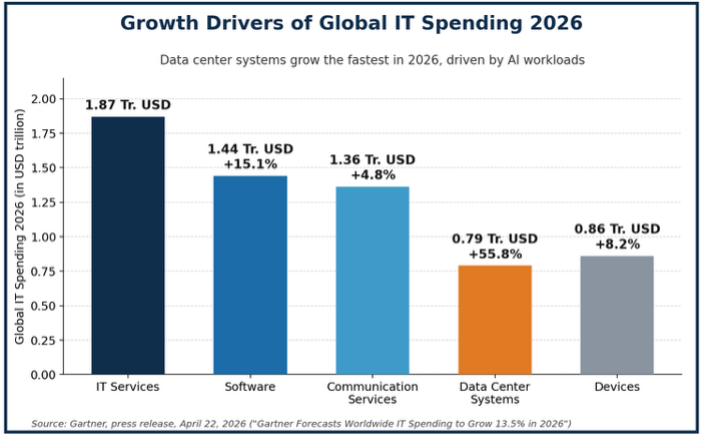
Gartner puts worldwide IT spending in 2026 at $6.37 trillion, up 14.2 percent from 2025, with data center systems growing fastest at 55.8 percent.
What does the Kearney study say about the German telecom market?
The Kearney Global Telecom Health Index rates the German market, despite solid financials, as one of the three weakest of 34 countries studied, mainly due to lagging fiber rollout and the resulting low commercial performance.
How can the cycle be broken?
Gartner recommends assessing technical debt systematically by business value, resources, and risk, and steering AI investments as a portfolio of distinct initiatives with their own time horizons rather than evaluating them uniformly.