
 Thought Leadership
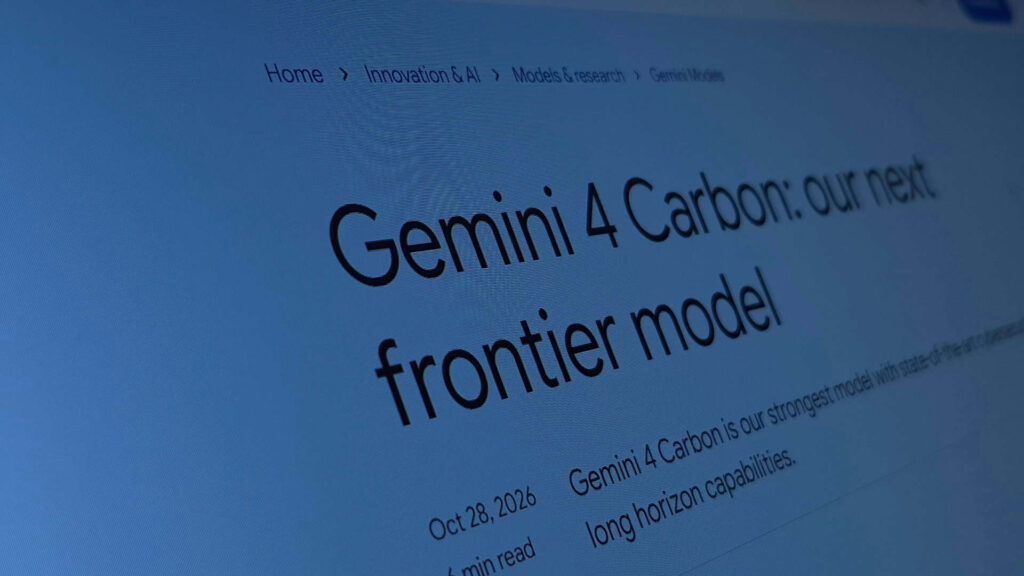
Google is opening its most powerful model to paying developers. DeepMind has used AI agents to prove key security properties of the libsignal library.
Google has expanded access to its most powerful AI model, Gemini 4 Carbon. Paying developers can now use it through the Gemini API in AI Studio and Android Studio. Businesses can access it through Gemini for Business, Google’s Antigravity development environment, and its CodeMender security agent. Google AI Ultra subscribers will receive access gradually through the Gemini app, Google Search’s AI Mode, and Antigravity. Since October 28, Carbon had been available exclusively to selected cyber defense organizations participating in the Fairwind program. A specialized version for cybersecurity will remain exclusive to these participants.
Until November 30, Carbon API access costs USD 2 per million input tokens and USD 10 per million output tokens, matching the pricing of Gemini 4 Argon. After that, prices will double to USD 4 and USD 20, respectively. Google is also testing a new /swarm feature in Antigravity that turns a single prompt into a team of coordinated agents.
Machine-Level Proofs
In parallel, Google DeepMind has introduced the AlphaProof Code framework. It enables security experts to work alongside AI agents to formally verify software, mathematically proving that it meets specified requirements. The framework was applied to libsignal, the reference implementation of the Signal Protocol, which is used for encryption not only by the Signal messaging app but also by WhatsApp and Google Messages. Human experts worked with agents powered by Carbon and Anthropic’s Claude Opus 5.5 to write the specifications.
Carbon-based agents then generated more than six million lines of proofs in Lean, a programming language that checks every proof mechanically and rejects invalid ones. According to DeepMind, key cryptographic security properties were verified down to the level of machine instructions. To test whether the approach could detect flawed code, the researchers deliberately reintroduced two genuine vulnerabilities that had already been fixed into an isolated version of the code.
“As AI-driven security threats grow, rigorously verifying the Signal protocol implementation gives us even greater confidence in our code’s privacy guarantees.”
Ehren Kret, Signal CTO
Limitations
The results apply to Google’s own build of the code, which was executed using a small command-line utility, not to the Signal apps themselves. Side-channel attacks were also excluded from parts of the analysis. Anthropic reported in October that it had used AI to generate formal proofs for 123 open-source libraries at the machine-code level. Formal verification has long been considered too resource-intensive for widespread adoption, as proofs previously had to be written largely by hand.
(Editorial Team)