
 Thought Leadership
It won’t be the next language model that decides the future of artificial intelligence — it will be access to compute. That is exactly where the new strategic partnership between Nvidia and Safe Superintelligence (SSI) comes in.
While many AI companies keep pouring billions into ever-larger models, Nvidia and the research lab Safe Superintelligence (SSI) founded by OpenAI co-founder Ilya Sutskever are focusing on the industry’s real bottleneck: scalable, high-performance data centers and specialized AI infrastructure.
SSI is gaining access to Nvidia’s upcoming Vera Rubin platform and says it expects this to increase its available compute by a factor of ten — a tenfold jump SSI says it plans to reach within the next twelve months. Nvidia has confirmed a “substantial investment” but has not disclosed a figure. Reuters and Bloomberg, citing people familiar with the matter, report an investment of roughly five billion US dollars. That makes the partnership, announced on July 27, 2026, one of the largest strategic AI investments of 2026.
Key Facts at a Glance
- Nvidia and Safe Superintelligence have entered a long-term strategic partnership.
- Nvidia confirms a substantial stake but has not disclosed the investment amount.
- Reuters and Bloomberg put the investment at roughly $5 billion.
- SSI gains access to the upcoming Vera Rubin platform and aims to increase its compute tenfold.
- SSI is currently valued at around $32 billion — with only about 30 to 35 employees and no published product.
- Both companies plan to jointly develop future AI computing platforms.
Why Nvidia and SSI Are Ushering In a New Phase of the AI Industry
The partnership between Nvidia and Safe Superintelligence (SSI) is far more than a classic stake in a promising AI start-up. It exemplifies a fundamental shift in the market: competition is moving from the development of individual language models to control over the underlying AI infrastructure.
While the quality of large language models mostly determined a company’s success in recent years, access to compute is increasingly becoming the real bottleneck today. Training modern foundation models and agentic AI systems requires tens of thousands to hundreds of thousands of specialized GPUs, high-speed networking, powerful storage architectures, and data centers with enormous energy demands. Companies that can provide or exclusively use this infrastructure gain a lasting competitive advantage — and the Nvidia-SSI partnership illustrates this development vividly.
Rather than simply selling hardware, Nvidia is increasingly positioning itself as the strategic infrastructure partner of choice for select AI labs. The company invests capital, provides state-of-the-art compute platforms, and in return gains insight into the future requirements of AI research. According to Nvidia, the company decided to pursue the partnership after gaining an unusually deep look into SSI’s previously tightly guarded research.
Compute Becomes the New Strategic Resource
Just a few years ago, the algorithm was seen as the most important success factor in the AI market. Today, the availability of compute increasingly determines the pace of innovation.
The next generation of AI systems won’t emerge from better models alone, but from the ability to train and run those models with ever-larger datasets, more powerful accelerators, and more energy-efficient data centers. Compute is becoming a strategic resource in its own right — comparable in importance to semiconductors or cloud infrastructure in earlier waves of technology.
For businesses, this means a shift in perspective: going forward, it won’t just be about choosing the right AI model, but equally about the infrastructure on which that model is developed, trained, and run. Decisions about cloud strategy, GPU availability, networking, and energy supply are becoming an integral part of AI strategy.
Why SSI Is Especially Attractive to Nvidia
Safe Superintelligence occupies a unique position in the AI landscape. The company deliberately avoids a product-driven approach and so far has published neither commercial applications nor regular research results. Instead, SSI focuses exclusively on developing a powerful yet robustly “aligned” artificial intelligence. It is precisely this long-term research focus that makes the company attractive to Nvidia.
For Nvidia, this creates a dual benefit. On one hand, the company gains a major customer for its upcoming Vera Rubin platform. On the other, Nvidia gains early insight into the hardware requirements of future generations of AI systems. This feedback loop between research and hardware development is likely to become an important competitive advantage going forward.
Just how central SSI’s research is to the deal was made clear by Ilya Sutskever, co-founder and CEO of SSI, in the joint announcement: “We have research that is worth scaling, and access to a large Nvidia compute cluster will make that possible,” Sutskever said, according to Nvidia’s official announcement.
Why IT Decision-Makers Should Watch This Deal
- Compute is becoming the central competitive factor for AI.
- AI infrastructure is emerging as a strategic investment field.
- Hyperscalers, chipmakers, and research labs are collaborating more closely.
- Requirements for data centers, power supply, and networks are rising sharply.
- Companies should plan their AI roadmap together with their infrastructure strategy going forward.
The Vera Rubin Platform — More Than Just a New GPU Generation
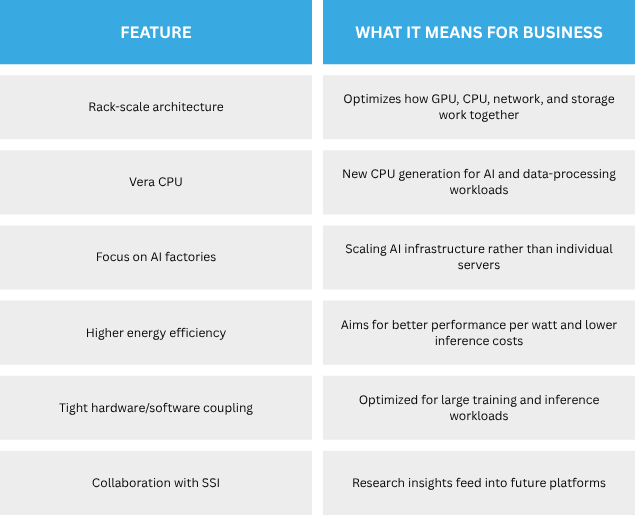
With the Vera Rubin platform, Nvidia isn’t simply aiming to launch a faster GPU. Instead, the company is building a fully integrated AI infrastructure specifically designed for training and running the next generation of large AI models and agentic AI systems. Vera Rubin combines high-performance GPUs, the new Vera CPU, high-speed networking, and an optimized memory architecture into one tightly coordinated platform. This shifts the focus from individual accelerators to complete “AI factories” that scale far more efficiently. A Vera Rubin NVL72 rack comprises 72 Rubin GPUs, 36 Vera CPUs, plus the associated networking and data-processing components. How this rack-scale architecture translates into real-world data centers is illustrated bythe NVL72 reference architecture for power and cooling unveiled jointly with Schneider Electric, designed to let operators plan gigawatt-scale AI data centers.
For Safe Superintelligence (SSI), this architectural approach is of central importance. The company gains not just additional compute, but access to a platform purpose-built for extremely large training and inference workloads. Nvidia explicitly describes a tenfold increase in available compute capacity for SSI. At the same time, both companies plan to jointly advance future compute platforms, feeding SSI’s research findings into hardware development.
From Blackwell to Vera Rubin — What’s Changing Technically
Blackwell already marked a significant advance over Hopper. Vera Rubin goes a step further. Nvidia no longer describes the platform primarily as a GPU generation, but as a rack-scale architecture in which processors, networking, storage, and power delivery are designed as one integrated system. The goal is to optimize data exchange between thousands of accelerators while significantly lowering energy consumption per AI token processed.
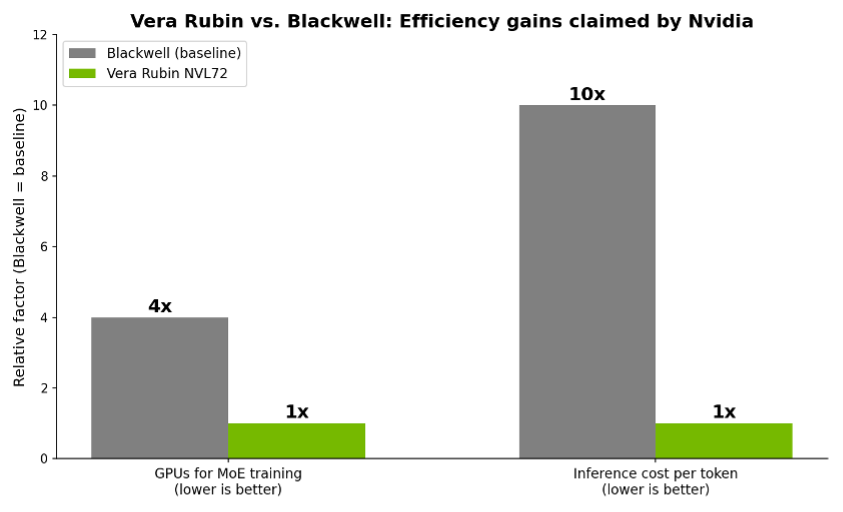
According to Nvidia’s own figures, this efficiency leap shows up in concrete numbers: for training certain mixture-of-experts models, a Vera Rubin NVL72 system reportedly needs only a quarter of the GPUs Blackwell requires — that is, four times fewer GPUs. For AI inference, costs per token are said to drop to one-tenth of previous levels. The platform was built specifically for large multi-agent systems, real-time inference, and training very large models.
AI Factories Instead of Classic Data Centers
One of the most important changes concerns how data centers will be planned going forward. Nvidia increasingly talks about “AI factories” — specialized data centers whose architecture is consistently designed around AI workloads. In these environments, thousands of GPUs, CPUs, networking components, and storage systems operate as a tightly coupled unit. The goal is to move data between components with as few bottlenecks as possible, substantially speeding up both training and inference.
For businesses, this represents a fundamental shift in perspective. Where individual GPU servers were often simply added on in the past, planning complete AI infrastructures is now moving to the forefront. Topics such as power supply, liquid cooling, network bandwidth, and storage hierarchies are becoming strategic factors in AI adoption.
Why the Platform Is Decisive for SSI
SSI aims to develop an artificial intelligence that is both highly capable and robustly aligned. Research programs like this require extensive training runs, continuous evaluation, and large-scale safety testing. The partnership with Nvidia gives the company the infrastructure it needs — SSI had previously relied mainly on Google TPUs, and can now broaden its research infrastructure considerably. Nvidia stresses that the combination of its investment and access to the Vera Rubin platform should increase SSI’s available compute capacity by an order of magnitude. At the same time, the collaboration gives Nvidia a rare window into the requirements of future AI systems, insights it can feed into the development of upcoming platforms.
A Multi-Billion Valuation Without a Product — Why Investors Are Still Betting on SSI
Safe Superintelligence (SSI) is one of the most unusual companies of the current AI wave. Founded in 2024 by Ilya Sutskever, Daniel Levy, and Daniel Gross, the research lab has so far had neither a commercial product nor published research results nor any meaningful revenue. Yet with a valuation of around $32 billion, SSI ranks among the most valuable private AI companies in the world.
The path there unfolded in clear stages: SSI’s first funding round in September 2024 valued the company at roughly $5 billion; a further round in April 2025, raising $2 billion, pushed the valuation to $32 billion. Investors include Andreessen Horowitz, DST Global, Greenoaks, Sequoia Capital, and Lightspeed Venture Partners — and, since April 2025, Alphabet and Nvidia itself as strategic investors. According to several market estimates, total funding — including the new Nvidia investment — has now reached or exceeded $7 billion.
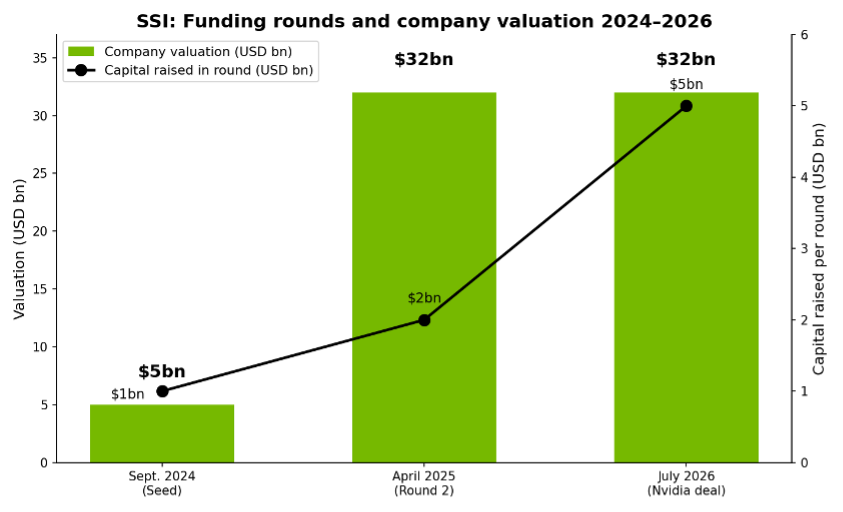
The newly announced partnership with Nvidia underscores that investors are measuring the company’s worth not by near-term revenue, but by its long-term technological potential. Nvidia confirms a stake in SSI but discloses neither its size nor its financial terms. It was Reuters and Bloomberg, citing people familiar with the matter, that first reported an investment of roughly $5 billion — a figure Nvidia has not officially confirmed.
Research Becomes Its Own Asset Class
Just a few years ago, investors mainly valued AI companies based on revenue growth, user numbers, or the pace of product development. Safe Superintelligence points to a different trend: capital is increasingly flowing into research teams whose economic value rests almost entirely on an expected scientific breakthrough.
SSI is a particularly striking example. The company reportedly employs only around 30 to 35 people, deliberately forgoes a near-term product strategy, and focuses exclusively on developing a robustly aligned superintelligence. For traditional venture capital investors, such a business model would be unusual. In today’s AI market, however, many see it as a strategic option with extraordinary potential.
Why Nvidia Is Willing to Invest Early
For Nvidia, the stake is more than a financial investment. The company secures access to one of the industry’s most renowned AI research teams while gaining insight into future requirements for training and inference platforms. According to the company, Nvidia was given an unusually deep look into SSI’s previously confidential research before the partnership was finalized — a key factor in the decision to collaborate.
Just how deep that trust runs was made clear by Nvidia CEO Jensen Huang in the joint announcement: “Ilya achieved a foundational breakthrough with AlexNet that helped ignite the modern AI revolution. We’re excited to see what breakthroughs SSI will achieve with our Vera Rubin platform,” Huang said.
With this, Nvidia is pursuing a strategy already visible with other AI companies: the chipmaker doesn’t just sell hardware but invests specifically in companies whose future compute needs are likely to be substantial. The partnership thus strengthens both demand for upcoming platforms like Vera Rubin and Nvidia’s position as the AI industry’s strategic infrastructure partner.