
 Thought Leadership
Market Reaction — Between Enthusiasm and Skepticism
Financial markets reacted to the partnership in mixed ways. On one hand, it is seen as a strong signal of Nvidia’s confidence in SSI’s research. On the other, the scale of the investment and the company’s high valuation raise questions about the sustainability of the current AI investment boom.
Nvidia shares initially fell by around five percent after the announcement — though in the context of broader weakness across the semiconductor sector that day, as market reports show; the SSI deal was not the sole trigger.
Critics point out that the AI market is increasingly characterized by close financing ties between chipmakers and AI labs. Investments, long-term hardware contracts, and access to exclusive compute reinforce one another. Investor Michael Burry was especially blunt in his criticism, warning of a circular financing model in which a chipmaker invests in AI companies that, in turn, buy that chipmaker’s chips — a pattern he described as “circular financing on a biblical scale.” The Bank for International Settlements (BIS) has likewise pointed to the growing concentration and partly debt-financed structure of AI expansion as a risk worth watching.
Supporters see these close partnerships as a necessary condition for developing ever more capable AI systems. Skeptics, on the other hand, warn of capital, infrastructure, and technological development concentrating among a small number of market participants. That debate is likely to continue accompanying the market in the years ahead — because as compute requirements grow, so does not only capital demand but also dependence on a small number of providers of high-performance AI infrastructure.
What Analysts Take Away From the Partnership
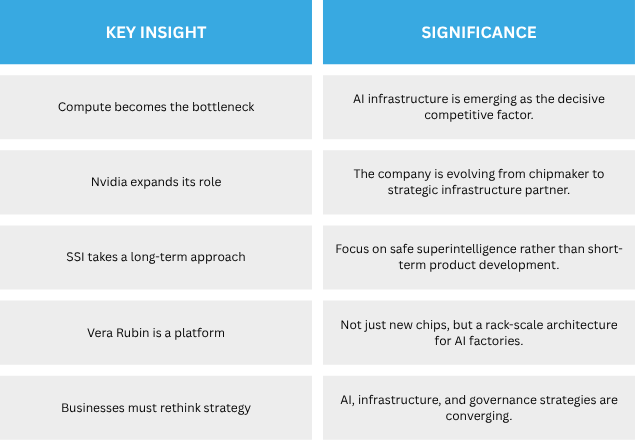
The collaboration between Nvidia and Safe Superintelligence (SSI) is not just a single multi-billion-dollar deal. It reflects several developments market watchers have been describing for months: the shift from GPUs to complete AI infrastructure systems, the growing importance of agentic AI, and the rising priority placed on governance and safety.
Rather than viewing the partnership in isolation, it’s worth looking at the broader trends behind it.
Trend 1 — AI Infrastructure Becomes the Largest Investment Field
According to Gartner, the focus of AI spending is increasingly shifting toward infrastructure — including AI-optimized servers, network architectures, specialized semiconductors, and AI-optimized cloud infrastructure. Gartner expects this segment to account for the largest share of global AI spending, driven in particular by hyperscalers and technology vendors.
Against this backdrop, the Nvidia-SSI partnership takes on an added strategic dimension. Nvidia isn’t just supplying chips — it’s expanding its position as a provider of complete AI infrastructure, from accelerators to networking to full rack-scale systems. Just how broad this push has become is clear when looking beyond the SSI deal: in 2026, Nvidia struck an expanded collaboration with the SK Group on AI factories and memory technology, with a reported framework volume of around $500 billion; a joint venture with NAVER and Brookfield worth roughly $10 billion to expand Korea’s national AI infrastructure; and further government-backed AI infrastructure programs across Asia.
The SSI investment thus fits into a growing network of strategic partnerships through which Nvidia is positioning itself as the central infrastructure partner of the global AI industry — precisely the development Gartner highlights as a decisive competitive advantage in the market for AI networking and infrastructure platforms.
At the same time, competitive pressure is rising: how alternative AI chip architectures and multi-vendor strategies position themselves against Nvidia’s CUDA ecosystem will help determine how tightly companies bind themselves to a single infrastructure partner over the long term.
Trend 2 — Value Creation Shifts to Complete AI Systems
Forrester, too, views this shift less as a new chip cycle than as a transition to integrated AI systems. The focus is no longer on individual hardware components but on the full value chain — from silicon through compute platforms and software to data and physical infrastructure.
For businesses, this means future AI projects can no longer be considered in isolation. Decisions about GPU procurement, network capacity, storage architecture, and cloud strategy must be planned together, early on. Infrastructure is becoming an integral part of corporate strategy rather than merely a technical operations question.
Trend 3 — Agentic AI Drives Up Compute Demand
The next generation of AI applications will increasingly consist of autonomous or semi-autonomous agents that carry out complex tasks independently over extended periods. Such systems place significantly higher demands on inference performance, networking, and storage than classic chatbots. The pace of this shift is captured in Gartner figures: by the end of 2026, roughly 40 percent of enterprise applications are expected to embed task-specific AI agents, up from less than 5 percent in early 2025. Gartner also notes that demand is increasingly shifting from pure training environments toward inference and agentic-AI workloads.
This development is especially relevant for SSI. The company says it is working on a “robustly aligned artificial intelligence.” Should this research approach succeed, the infrastructure required will go far beyond today’s AI clusters — one reason access to the upcoming Vera Rubin platform is so strategically significant.
Trend 4 — Safety and Governance Become a Competitive Factor
As AI systems grow more capable, the requirements around governance, transparency, and control rise as well. It’s no longer enough for businesses to simply deploy powerful models. Equally important is the ability to monitor their behavior, assess risk, and meet regulatory requirements — such as those under the EU AI Act. Forrester notes that, in this context, companies in 2026 are increasingly building so-called “agent lakes” — composable architectures for managing distributed AI agents — partly in response to these growing regulatory demands.
Against this backdrop, SSI’s research focus stands out. The company aims to develop a superintelligence that is both highly capable and safely aligned. Nvidia explicitly cites its insight into this research direction, and the strategic relevance it sees in it, as a reason for the partnership.
What This Means for CIOs
For IT decision-makers, the partnership yields five key takeaways:
- Compute becomes the bottleneck. Access to high-performance AI infrastructure is emerging as the decisive competitive factor.
- Infrastructure must be planned strategically. GPU clusters, networking, storage, and power supply will increasingly belong on the AI roadmap.
- AI projects are becoming longer-term. Infrastructure investments can no longer be judged solely by short-term use cases.
- Governance is gaining importance. Capability and safety must be considered together.
- Partnerships matter more. Building capable AI increasingly happens within ecosystems of chipmakers, cloud providers, and research institutions.
Impact on Businesses — What CIOs Should Do Now
The Nvidia-Safe Superintelligence (SSI) partnership shows that competition in the AI market is fundamentally changing. While new language models dominated the conversation in recent years, the underlying infrastructure is now becoming the decisive success factor. Compute, networking, power supply, and specialized AI platforms are increasingly determining innovation speed and competitiveness.
For companies, this means AI can no longer be treated purely as a software project. Anyone hoping to benefit from generative and agentic AI over the long term must plan infrastructure, data strategy, governance, and business applications together. Building these capabilities is becoming a core task for the IT organization.
Five Recommendations for IT Decision-Makers
1. Develop AI Strategy and Infrastructure Together
Many companies define their AI roadmap independently of their infrastructure planning. Going forward, that separation becomes a liability. GPU capacity, networking, storage architecture, and power supply should be factored into AI strategy from the outset.
2. Treat Compute as a Strategic Resource
Access to high-performance compute infrastructure is becoming a competitive factor. Companies should decide early which workloads belong in the public cloud and which are more economical on dedicated or owned infrastructure over the long run.
3. Build In Governance From the Start
As AI systems become more capable, regulatory requirements rise with them. Governance, transparency, traceability, and risk management should be considered during the planning phase — not bolted on after AI solutions are already deployed.
4. Evaluate Partner Ecosystems
The market is increasingly moving toward integrated platforms. Companies should therefore evaluate complete ecosystems — from infrastructure to development tools to support — rather than comparing individual hardware or software products in isolation.
5. Plan for Long-Term Scale
Rolling out the first AI applications is often just the beginning. What matters is whether the infrastructure can later scale to hundreds or thousands of production AI agents. Architecture decisions should be made with scalability in mind.
Conclusion
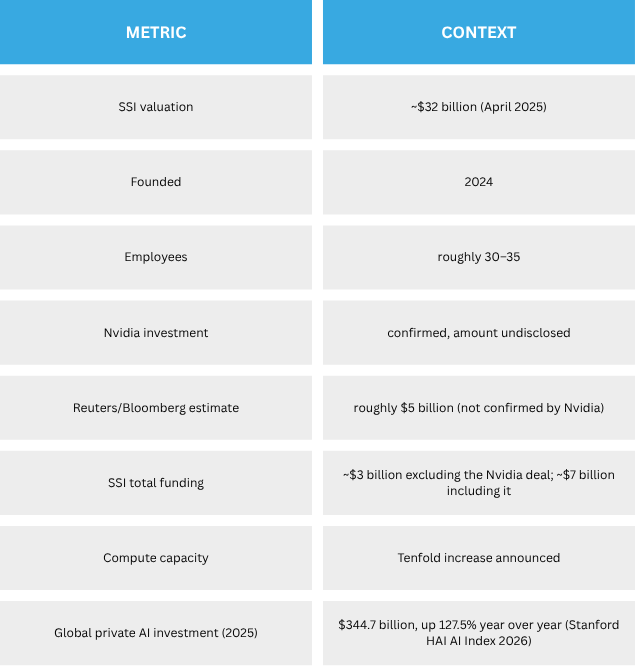
The partnership between Nvidia and Safe Superintelligence marks a turning point in the AI market. It illustrates how competition is increasingly shifting from individual models to control over the underlying infrastructure. Nvidia isn’t just investing capital — it’s positioning itself as the long-term technology partner of one of the world’s most ambitious AI research labs. In return, SSI gains access to the upcoming Vera Rubin platform and aims to scale its compute capacity by an order of magnitude. Nvidia itself confirms a substantial stake but discloses no investment figure; the widely cited $5 billion figure comes from Reuters and Bloomberg reporting.
For businesses, the real significance of the deal lies less in its financial scale than in what it signals. Successful AI strategies will increasingly be defined not by powerful models alone, but by the ability to combine compute, data, governance, and infrastructure into one scalable architecture. Companies that recognize this early put themselves in a position to make productive use of the next generation of agentic AI systems.
Frequently Asked Questions (FAQ)
What is Safe Superintelligence (SSI)?
SSI is an AI research lab founded in 2024 and led by OpenAI co-founder Ilya Sutskever. The company aims to develop a safe superintelligence and deliberately positions itself outside the traditional commercial cycle — without product deadlines or revenue targets.
How much is Nvidia investing in SSI?
Nvidia itself confirms only a “substantial investment” without naming a figure. Reuters and Bloomberg, citing people familiar with the matter, put the investment at roughly $5 billion — a figure that remains officially unconfirmed.
What is the Vera Rubin platform and how does it differ from Blackwell?
Vera Rubin is Nvidia’s next-generation AI infrastructure, expected to become available in the second half of 2026. As a rack-scale architecture, it integrates GPUs, the new Vera CPU, networking, and storage into a single platform optimized for AI workloads. Compared with Blackwell, Nvidia claims significant efficiency gains: up to four times fewer GPUs for training certain models and up to ten times lower cost per token for inference.
Why is the partnership strategically important?
SSI gains access to state-of-the-art compute infrastructure expected to increase its available compute tenfold. In return, Nvidia secures a long-term customer and valuable insight into the requirements of future AI models.
What risks does the partnership carry?
Critics such as investor Michael Burry warn of a circular financing model in which chipmakers invest in AI companies that then buy back their chips. There is also a risk that SSI may struggle to meet the high expectations tied to a $32 billion valuation without a product or revenue.
What does the deal mean for European businesses?
The partnership shows that powerful AI will increasingly be tied to data center infrastructure, power supply, and high-speed networking. European companies should factor these considerations into their digital and AI strategies early on.
Further Reading on it-daily.net
For more on the rapid adoption of AI agents in enterprises and the underlying Gartner forecasts, see the article “AI Assistants Compared 2026” on it-daily.net.